
94%
OFF
OFF
Environmental Management Training
- Lifetime Access
- All Levels
- PDF Certificate
£296
£19
14-Day Money-Back Guarantee
Learn With Confidence








Environmental Management Training
Build Practical Knowledge to Understand, Manage and Improve Environmental Performance
Environmental issues are no longer simply concerns for environmental specialists. Businesses, organisations, communities and governments increasingly need to understand how their activities interact with the natural environment and how environmental risks can be identified, assessed and managed.
From environmental legislation and business responsibilities to ecosystem management, environmental risk assessment, monitoring, auditing and management systems, effective environmental management requires an understanding of both environmental science and practical decision-making.
Environmental Management Training is designed to provide learners with a broad foundation in the principles, practices and approaches used to understand and manage environmental issues.
The course explores environmental management from multiple perspectives, including business, law, economics, science, risk management and ecosystem management. This multidisciplinary approach helps learners understand why environmental management cannot be treated as a single isolated function.
Across nine structured modules, you will explore the fundamentals of environmental management, environmental goals, business and legal considerations, standards and monitoring, environmental economics, risk assessment, environmental science, ecosystem management and different environmental management approaches.
Whether you are considering a career in environmental management, working in business or sustainability, studying a related subject or simply looking to strengthen your understanding of environmental responsibilities, this training provides a valuable starting point.
Why Environmental Management Matters
Every organisation has the potential to affect the environment through its use of energy, water and materials, generation of waste, emissions, land use and other activities.
Effective environmental management helps organisations understand these impacts and make better-informed decisions.
It can involve identifying environmental risks, complying with relevant requirements, monitoring performance, reducing negative impacts, improving resource efficiency and supporting long-term sustainability.
However, environmental management is a broad discipline. It requires knowledge of environmental science as well as an understanding of organisational processes, economic considerations, legal responsibilities and risk management.
This is why Environmental Management Training takes a comprehensive approach.
Instead of concentrating on one environmental issue, the course introduces a range of concepts that can help you understand the wider environmental management landscape.
You will explore questions such as:
-
What is environmental management?
-
What are the key goals of environmental management?
-
How does environmental management affect businesses?
-
Why does environmental law matter?
-
What are environmental management systems?
-
How can environmental performance be monitored?
-
What is eco-auditing?
-
How can environmental risks and impacts be assessed?
-
What role does environmental science play?
-
Why is ecosystem management important?
-
What approaches can organisations use to manage environmental issues?
By exploring these areas, you can develop a more structured understanding of environmental management and its practical importance.
What You Will Learn
The Environmental Management Training curriculum covers nine key areas:
-
Introduction of Environmental Management
-
Environmental Management Fundamentals and Goals
-
Environmental Management — Business and Law
-
Standards, Monitoring, Modelling, Eco-Auditing and Environmental Management Systems
-
Environmental Management and Economics
-
Environmental Risk Management, Impact, Hazard and Risk Assessment
-
Environmental Management and Science
-
Ecosystem Management
-
Environmental Management Approaches
Together, these modules provide a broad foundation for understanding environmental management in organisational and wider environmental contexts.
Module 1 – Introduction of Environmental Management
The first module provides an Introduction of Environmental Management and establishes the foundation for the rest of the course.
You will explore what environmental management means and why it is important in modern organisations and communities.
The introductory lesson gives you a starting point for understanding the relationship between human activities and the environment.
You will begin developing awareness of the different factors that environmental managers and organisations need to consider when managing environmental impacts.
This module helps establish the terminology and concepts required to understand the more specialised subjects covered later in the course.
By completing this module, you should have a clearer understanding of environmental management as a multidisciplinary field and its relevance to organisations, communities and environmental protection.
Module 2 – Environmental Management Fundamentals and Goals
The second module explores Environmental Management Fundamentals and Goals.
Effective management requires clear objectives. Environmental management is no different.
This module introduces the fundamental principles that underpin environmental management and explores the goals organisations may seek to achieve when managing their environmental performance.
You will consider why organisations need to understand their environmental impacts and how environmental objectives can support more responsible decision-making.
The module can help you develop a stronger understanding of the relationship between environmental responsibilities and organisational performance.
You will also gain insight into why environmental management needs to be approached systematically rather than as a collection of isolated environmental activities.
Module 3 – Environmental Management — Business and Law
Environmental management has significant implications for businesses.
Module 3 examines Environmental Management — Business and Law, helping learners understand the connection between environmental responsibilities, organisational activity and legal requirements.
Businesses operate within regulatory frameworks that can influence how they manage environmental impacts.
This module introduces the importance of understanding environmental law and recognising the relationship between legal obligations and environmental management practices.
You will also explore the business perspective of environmental management and consider why environmental performance can be relevant to organisational decision-making.
Understanding the interaction between environmental management, business and law can help you develop a more comprehensive view of the responsibilities organisations may face.
Module 4 – Standards, Monitoring, Modelling, Eco-Auditing and Environmental Management Systems
Module 4 introduces several important tools and practices used within environmental management.
You will explore standards, monitoring, modelling, eco-auditing and Environmental Management Systems (EMS).
Environmental monitoring can help organisations understand their environmental performance and identify changes that may require attention.
Modelling can support analysis and decision-making, while environmental auditing can provide a structured way of reviewing environmental performance and management practices.
Environmental Management Systems provide a framework for organising environmental responsibilities and processes within an organisation.
By studying these concepts together, you will develop a stronger understanding of how environmental management can move from general intentions to structured organisational processes.
This module is particularly valuable for learners who want to understand how organisations can monitor, evaluate and improve their environmental performance.
Module 5 – Environmental Management and Economics
Environmental decisions are also influenced by economic considerations.
Module 5 examines Environmental Management and Economics, introducing the relationship between environmental responsibility and economic decision-making.
Environmental management can involve costs, investments, efficiencies and long-term considerations. Organisations may need to balance environmental objectives with financial and operational priorities.
This module helps you appreciate why economics is an important part of environmental management.
You will explore the connection between environmental decisions and economic considerations, developing a broader perspective on how environmental issues can influence organisational choices.
Understanding this relationship can help learners think about environmental management in practical and strategic terms.
Module 6 – Environmental Risk Management, Impact, Hazard and Risk Assessment
Risk management is a central component of effective environmental management.
Module 6 focuses on Environmental Risk Management, Impact, Hazard and Risk Assessment.
You will explore the concepts of environmental hazards, impacts and risks and develop an understanding of why these need to be identified and assessed.
Environmental risk assessment can help organisations understand potential consequences and make more informed decisions about managing environmental issues.
This module encourages systematic thinking about risk rather than relying on assumptions.
You will develop awareness of how identifying hazards and assessing potential impacts can contribute to better environmental decision-making.
The knowledge covered in this module can be particularly relevant to learners interested in environmental compliance, sustainability, business risk or environmental management.
Module 7 – Environmental Management and Science
Environmental management is closely connected to scientific knowledge.
Module 7 explores Environmental Management and Science, helping learners understand why scientific principles are important when assessing environmental conditions and impacts.
Scientific knowledge can provide the evidence needed to understand environmental change, resource use, pollution, ecosystems and other environmental issues.
This module reinforces the multidisciplinary nature of environmental management.
Rather than treating environmental management purely as an administrative or business function, you will develop greater appreciation of the scientific foundations that support environmental decision-making.
This can help you become more comfortable engaging with environmental information and understanding why evidence-based approaches are important.
Module 8 – Ecosystem Management
The environment consists of interconnected systems, and effective environmental management requires an understanding of these relationships.
Module 8 focuses on Ecosystem Management.
You will explore the importance of ecosystems and develop awareness of why environmental management needs to consider interactions between organisms, natural resources and human activities.
Ecosystem management provides a broader perspective than focusing on individual environmental problems.
It encourages consideration of the wider system and the relationships between different environmental components.
This knowledge can help you understand why decisions affecting land, water, biodiversity and resources can have wider environmental consequences.
Module 9 – Environmental Management Approaches
The final module examines Environmental Management Approaches, bringing together concepts introduced throughout the course.
You will explore different ways of approaching environmental management and develop a clearer understanding of how organisations and environmental professionals can respond to environmental challenges.
Different situations may require different strategies. An effective environmental management approach needs to consider the nature of the environmental issue, organisational circumstances, legal requirements, available resources and potential risks.
This final module helps consolidate your learning and encourages you to think about environmental management as an ongoing process of assessment, planning, implementation and improvement.
Practical Learning Outcomes
By completing Environmental Management Training, you can develop a broad foundation of environmental management knowledge.
You will be able to:
-
Explain the fundamental principles of environmental management.
-
Understand the key goals of environmental management.
-
Recognise how environmental issues can affect businesses and organisations.
-
Understand why environmental law is relevant to organisational activities.
-
Develop awareness of environmental standards and monitoring.
-
Understand the purpose of environmental modelling.
-
Explain the role of eco-auditing.
-
Understand the purpose of Environmental Management Systems.
-
Recognise the relationship between environmental management and economics.
-
Identify basic environmental hazards and potential impacts.
-
Understand the principles of environmental risk assessment.
-
Appreciate the role of science in environmental decision-making.
-
Develop awareness of ecosystem management.
-
Recognise different approaches to environmental management.
-
Apply foundational environmental management concepts to further learning.
-
Develop a more informed perspective on environmental responsibility and sustainability.
Develop a Systems-Based View of Environmental Management
One of the key benefits of Environmental Management Training is that it encourages you to look at environmental issues from multiple perspectives.
Environmental problems rarely exist in isolation.
A business decision may have economic implications, legal implications and environmental consequences. An operational activity may create a potential environmental hazard that needs to be assessed. An environmental impact may affect an ecosystem in ways that extend beyond the original activity.
Understanding these connections allows you to approach environmental management more effectively.
The course therefore combines business, law, economics, science and risk management with practical environmental management concepts.
Understand Environmental Risk
Environmental risk can arise from many different sources.
Understanding the difference between a hazard, an impact and a risk is an important starting point for managing environmental concerns.
Through the environmental risk management module, you will develop greater awareness of how environmental risks can be identified and assessed.
This knowledge can help you approach environmental problems more systematically and understand why risk assessment is an important part of responsible environmental management.
Understand Environmental Management Systems
Organisations need systems and processes if they want to manage environmental performance consistently.
Environmental Management Systems provide a structured framework for organising environmental responsibilities and activities.
Through Environmental Management Training, you will develop an introductory understanding of EMS concepts alongside monitoring, standards and eco-auditing.
This knowledge can help you understand how organisations can move towards more systematic environmental management rather than relying solely on individual actions.
Connect Environmental Management with Business
Environmental management is increasingly relevant to organisational strategy.
Businesses need to consider environmental impacts alongside operational and economic priorities.
The course introduces this relationship by examining environmental management from a business and economic perspective.
This can help learners appreciate that environmental responsibility and business activity do not have to be treated as completely separate subjects.
Understanding environmental management can support better awareness of resource use, environmental risks, compliance considerations and sustainability-related decision-making.
Who Is This Course For?
Environmental Management Training is suitable for a wide range of learners.
Aspiring Environmental Professionals
If you are considering a career in environmental management, sustainability or environmental consultancy, this course can provide a useful introduction to core concepts.
Sustainability Professionals
Professionals working in sustainability can use the training to strengthen their understanding of environmental management principles.
Business Professionals
Managers, business owners and employees can benefit from understanding how environmental issues intersect with business operations, law and economics.
Students
Students studying environmental science, sustainability, business, geography, engineering or related subjects can use the course to broaden their knowledge.
Health, Safety and Compliance Professionals
Professionals whose responsibilities include risk, compliance or organisational management may find environmental management knowledge a useful addition to their existing skills.
Career Changers
If you are exploring environmental or sustainability-related career opportunities, the course offers an accessible way to build foundational subject knowledge.
Support Your Professional Development
Environmental management knowledge can complement skills across numerous sectors.
Construction, manufacturing, facilities management, energy, engineering, agriculture, property, business and public-sector organisations can all interact with environmental issues.
Developing knowledge in this area can therefore support broader professional development.
The Environmental Management Training course can help you establish a foundation before progressing to more specialised study, professional qualifications or practical workplace experience.
The course is educational in nature and should not be considered a substitute for professional qualifications, regulatory guidance or specialist advice where these are required.
Learn the Foundations of Environmental Management
Environmental management is about understanding environmental impacts and making informed decisions about how those impacts can be managed.
It requires more than knowledge of environmental issues alone. It also involves understanding business, law, economics, science, risk, ecosystems, monitoring and management systems.
That is what makes Environmental Management Training a valuable learning opportunity.
Across nine modules, you will explore the fundamental concepts that underpin environmental management and develop a broader understanding of how environmental responsibilities can be approached in practical and organisational settings.
You will learn about environmental management fundamentals, business and law, environmental management systems, monitoring, auditing, economics, risk assessment, science and ecosystems.
You will also explore different environmental management approaches, helping you bring the various themes together.
Start Building Your Environmental Management Knowledge Today
Environmental challenges are becoming increasingly important across businesses, organisations and communities.
Developing environmental management knowledge can help you better understand these challenges and recognise the processes used to assess, manage and improve environmental performance.
Environmental Management Training provides a structured foundation covering the key concepts you need to begin exploring this field.
Whether you want to enhance your professional knowledge, support your studies, explore a new career direction or gain a better understanding of environmental responsibility, this course can help you take the next step.
Build your understanding of environmental management, risk, ecosystems, business, law, economics and environmental management systems—and develop the knowledge needed to engage more confidently with environmental challenges.
Enrol in Environmental Management Training today and start building a stronger foundation for your environmental and sustainability learning journey.
Course Modules
Course Content
Module 1 – Introduction of Environmental Management
-
Lesson 1 – Introduction of Environmental Management
Module 2 – Environmental Management Fundamentals and Goals
Module 3 – Environmental Management— Business and Law
Module 4- Standards, Monitoring, Modelling, Eco-Auditing and Environmental Management Systems
Module 5 – Environmental Management and Economics
Module 6- Environmental Risk Management, Impact, Hazard and Risk Assessment
Module 7 – Environmental Management and Science
Module 8 – Ecosystem Management
Module 9 – Environmental Management Approaches
What our students say
Excellent
4.9 average
158 Reviews

Earn an Accredited Certificate
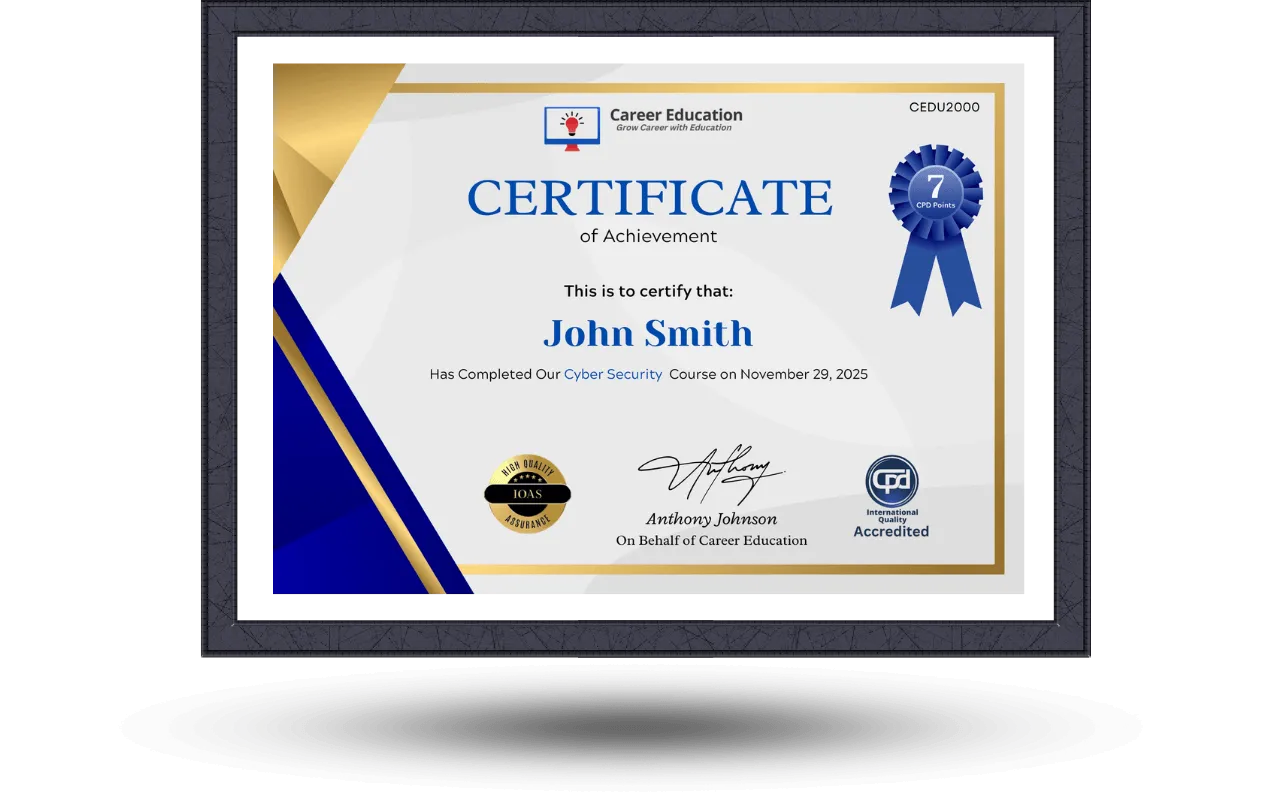
Upon completion of any course, all students are entitled to a CPD IQ Accredited e-certificate that will be issued by Career Education signifying the completion of your course.
After you complete the course and assignment, you will be eligible to order a free certificate accredited by CPD International Quality by completing the form below.
Hardcopy certificates and transcripts are also available for a small additional fee. More information is disclosed upon course completion.
Similar Courses


Frequently Asked Questions
The lifetime membership includes unlimited access to all courses, resources, and updates for a one-time fee.
You can purchase the membership directly from our website using a secure checkout process.
Yes, selected courses can be downloaded for offline access through our mobile app.
Yes, all future updates and new courses are included at no extra cost.
Yes, we offer a 30-day money-back guarantee if you are not satisfied with the membership.