
OFF
Tasks and Remedial Actions
- Lifetime Access
- All Levels
- PDF Certificate
Learn With Confidence






Overview
# Tasks and Remedial Actions
**Tasks and Remedial Actions** is a practical, outcome-focused online course designed to help learners develop the skills needed to identify tasks, prioritise responsibilities, delegate effectively, monitor progress, analyse root causes, and implement appropriate corrective measures.
In any workplace or professional environment, problems rarely resolve themselves. Successful organisations rely on people who can recognise what needs to be done, determine priorities, assign responsibilities, monitor progress, investigate underlying causes, and take appropriate action when things do not go according to plan. The ability to manage tasks effectively while responding to problems with structured corrective actions can contribute significantly to productivity, accountability, quality, compliance, and continuous improvement.
This **Tasks and Remedial Actions** course provides a structured learning journey covering the complete process from identifying and prioritising tasks through to implementing corrective actions. Rather than focusing only on theory, the course encourages practical thinking and provides learners with a framework for approaching responsibilities and workplace issues more systematically.
Whether you are responsible for managing projects, supervising employees, coordinating teams, handling operational activities, maintaining standards, or supporting continuous improvement, the principles covered in this course can help you become more organised and effective.
## What You Will Learn
By completing **Tasks and Remedial Actions**, you will develop a stronger understanding of how to manage tasks and respond to issues in a structured and professional way.
You will learn how to:
* Understand the relationship between tasks, responsibilities, and corrective actions
* Identify tasks that need to be completed
* Prioritise tasks according to urgency and importance
* Delegate responsibilities appropriately
* Establish accountability within teams
* Monitor task progress and performance
* Recognise potential delays, problems, and performance gaps
* Investigate the underlying causes of problems
* Apply root cause analysis principles
* Develop practical corrective action plans
* Assign responsibilities for corrective measures
* Monitor the implementation of corrective actions
* Evaluate whether corrective actions have achieved their intended results
* Support continuous improvement through structured action
* Develop a more proactive approach to workplace problem-solving
## Build a Strong Understanding of Tasks and Corrective Actions
The first step towards effective task management is understanding what a task actually requires. Tasks can range from simple routine activities to complex responsibilities involving multiple people, resources, and deadlines.
At the same time, corrective actions are important when an existing process, activity, or outcome does not meet the required standard. Simply identifying a problem is not enough. Organisations need to understand what happened, why it happened, what needs to change, who is responsible, and how the effectiveness of the solution will be assessed.
**Tasks and Remedial Actions** introduces these concepts in a structured way, helping learners understand how effective task management and corrective action planning can work together.
## Module 1: Introduction to Tasks and Corrective Actions
The course begins with an introduction to **Tasks and Corrective Actions**, establishing the foundation for the topics covered throughout the programme.
You will explore the importance of clearly defined tasks and understand why corrective actions are necessary when problems, errors, failures, or performance gaps occur.
The introductory lesson helps you recognise the difference between completing routine tasks and responding to issues that require corrective intervention. You will also begin developing an understanding of how structured action can contribute to better workplace outcomes.
This foundation prepares you for the more practical areas covered in the later modules.
## Module 2: Task Identification and Prioritisation
Effective task management begins with knowing exactly what needs to be done.
In this module, you will explore methods for identifying tasks and determining which activities require immediate attention. Not every task has the same level of importance, urgency, complexity, or impact.
You will develop an understanding of how to evaluate tasks and establish appropriate priorities. This can help reduce confusion, improve organisation, and ensure that important responsibilities are not overlooked.
You will also consider how effective prioritisation can support productivity. When tasks are organised according to their importance and deadlines, individuals and teams can make better use of their time and resources.
By the end of this module, you should be better prepared to create a clear picture of what needs to be completed and determine which activities should take priority.
## Module 3: Task Delegation and Accountability
Effective managers and team leaders understand that they cannot always complete every task themselves. Delegation is therefore an important part of successful task management.
This module explores the principles of **task delegation and accountability**, helping learners understand how responsibilities can be assigned appropriately.
You will consider factors such as skills, experience, workload, responsibility, and expected outcomes when determining who should handle particular tasks.
The module also highlights the importance of accountability. Delegating a task does not mean abandoning responsibility for the outcome. Effective delegation involves establishing clear expectations, communicating requirements, providing appropriate support, and monitoring progress.
You will learn how structured delegation can help teams work more efficiently while creating greater clarity about who is responsible for specific activities.
## Module 4: Task Execution and Monitoring
Identifying and assigning tasks is only the beginning. Effective execution requires ongoing attention to progress, quality, deadlines, and expected outcomes.
In this module, you will explore approaches to task execution and monitoring. You will learn why monitoring is important and how it can help identify issues before they become larger problems.
You will consider how to track progress, recognise delays, review performance, and determine whether tasks are being completed according to expectations.
Effective monitoring can also provide useful information for corrective action. If a task is not progressing as planned, early identification allows individuals and managers to investigate the problem and determine what action may be necessary.
This module therefore connects task management with continuous oversight and improvement.
## Module 5: Root Cause Analysis
When something goes wrong, it can be tempting to address only the most visible problem. However, fixing the immediate symptom does not necessarily prevent the same issue from happening again.
**Root Cause Analysis** provides a more systematic approach.
In this module, you will explore how to investigate problems and identify the underlying factors that contributed to them. Rather than simply asking what went wrong, you will learn to consider why the problem occurred.
Understanding root causes can help organisations develop more effective and sustainable solutions. It can also reduce the risk of repeatedly dealing with the same problem.
You will develop a more structured approach to analysing issues, gathering relevant information, considering contributing factors, and identifying potential underlying causes.
These skills can be valuable across many professional environments where quality, efficiency, safety, compliance, or performance are important.
## Module 6: Corrective Action Planning
Once the root cause of a problem has been identified, the next step is to determine what should be done.
This module focuses on **Corrective Action Planning**, helping you understand how to develop practical responses to identified problems.
You will explore how to define corrective actions, establish responsibilities, set realistic expectations, and determine appropriate methods for monitoring progress.
An effective corrective action plan should be clear and practical. It should explain what needs to change, who is responsible for implementing the change, what resources may be required, and how progress will be evaluated.
By developing structured corrective action plans, you can move from simply recognising problems to creating actionable solutions.
## Module 7: Implementation of Corrective Actions
Planning corrective actions is important, but successful implementation is what ultimately creates change.
The final module focuses on the **Implementation of Corrective Actions**, helping learners understand how planned actions can be put into practice and monitored effectively.
You will consider how to communicate corrective actions, coordinate responsibilities, monitor implementation, and evaluate results.
Implementation should not be treated as a one-time activity. It is important to determine whether the corrective action has actually addressed the problem and whether further action is necessary.
By learning how to monitor and evaluate corrective actions, you can develop a more continuous approach to improvement.
## Develop Better Workplace Organisation
One of the key benefits of **Tasks and Remedial Actions** is its potential to improve organisational skills.
When tasks are clearly identified, prioritised, delegated, and monitored, individuals and teams can operate with greater clarity. Responsibilities become easier to understand, deadlines can be managed more effectively, and potential problems can be identified earlier.
These principles can be applied to everyday professional activities, from managing routine workloads to coordinating larger projects and improvement initiatives.
## Improve Accountability and Responsibility
Clear accountability is essential for effective task management.
When people understand what they are responsible for and what outcomes are expected, it becomes easier to monitor progress and identify areas that require support or improvement.
**Tasks and Remedial Actions** helps learners understand how accountability can be incorporated into task delegation and corrective action processes.
This can contribute to stronger communication, clearer expectations, and more organised teamwork.
## Develop a Structured Problem-Solving Approach
Problems are inevitable in professional environments. What matters is how effectively those problems are handled.
The course provides a structured framework for moving from problem identification to root cause analysis, corrective action planning, implementation, and monitoring.
This approach can help you respond to issues more systematically instead of relying solely on assumptions or quick fixes.
Developing these skills can improve your ability to assess situations, identify appropriate actions, and support longer-term solutions.
## Support Continuous Improvement
Corrective actions should not simply be viewed as responses to failure. They can also become opportunities for improvement.
When organisations investigate problems and identify their underlying causes, they can learn from what happened and make changes that improve future performance.
The principles covered in **Tasks and Remedial Actions** can therefore support a culture of continuous improvement. Learners can use these approaches to identify opportunities to strengthen processes, improve task management, and reduce the likelihood of recurring issues.
## Who Is This Course For?
**Tasks and Remedial Actions** can be valuable for a broad range of learners, including:
* Team leaders and supervisors
* Managers and department coordinators
* Project team members
* Operations professionals
* Business owners and entrepreneurs
* Employees responsible for workplace tasks
* Quality and improvement professionals
* Individuals involved in process management
* Professionals seeking stronger problem-solving skills
* Anyone interested in improving task and corrective action management
The course can be particularly useful for learners who want to develop practical workplace capabilities without requiring extensive prior knowledge.
## Practical Outcomes You Can Take Forward
After completing **Tasks and Remedial Actions**, you should have a clearer understanding of how to manage tasks and respond to problems through structured corrective action.
You will be better prepared to:
* Identify and organise responsibilities
* Determine task priorities
* Delegate activities effectively
* Establish accountability
* Monitor task execution
* Recognise performance gaps
* Investigate the causes of problems
* Develop corrective action plans
* Implement corrective measures
* Monitor corrective action outcomes
* Contribute to continuous improvement
These capabilities can be applied across different roles, industries, and workplace environments.
## Take the Next Step in Your Professional Development
Effective task management and corrective action are valuable skills for anyone who wants to contribute to better workplace performance. From organising everyday responsibilities to addressing complex operational problems, a structured approach can make it easier to determine what needs to happen, who should take action, and how results should be evaluated.
**Tasks and Remedial Actions** gives you the opportunity to build this understanding through a clear progression of topics, starting with task and corrective action fundamentals and moving through prioritisation, delegation, monitoring, root cause analysis, planning, and implementation.
Rather than simply learning concepts, you will develop a practical framework that can help you approach responsibilities and problems with greater structure and confidence.
If you want to improve your task management abilities, strengthen accountability, develop better problem-solving skills, and understand how corrective actions can be planned and implemented effectively, **Tasks and Remedial Actions** provides a valuable foundation.
**Start learning today and develop practical skills for identifying tasks, solving problems, implementing corrective actions, and supporting continuous improvement.**
Course Modules
Course Content
Module 1_ Introduction to Tasks and Corrective Actions.
-
Lesson 1_ Introduction to Tasks and Corrective Actions.
Module 2_ Task Identification and Prioritization.
Module 3_ Task Delegation and Accountability.
Module 4_ Task Execution and Monitoring.
Module 5_ Root Cause Analysis.
Module 6_ Corrective Action Planning.
Module 7_ Implementation of Corrective Actions.
What our students say

Earn an Accredited Certificate
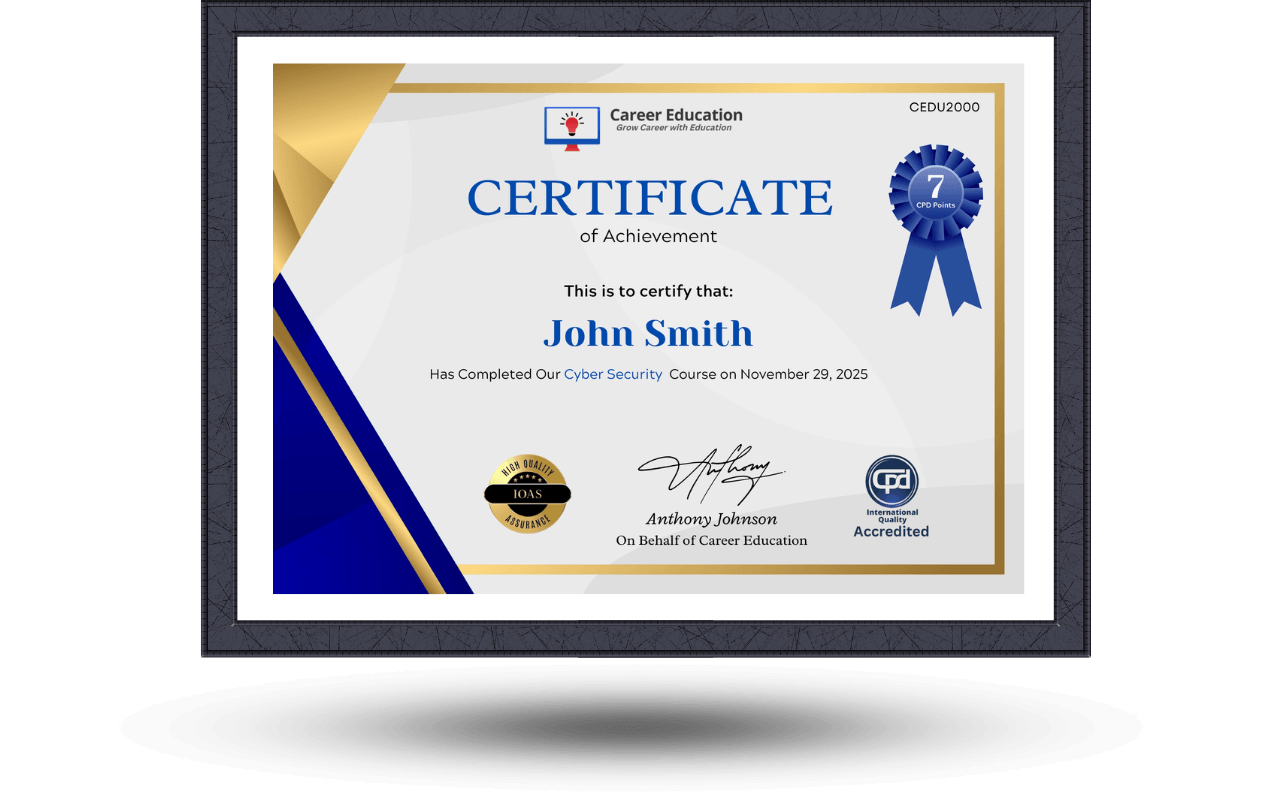
Upon completion of the course, an e-certificate will be downloadable from Khan Education signifying the completion of your course. But, the course is CPD Accredited and after you complete the assignment, you will be eligible to order a certificate accredited by CPD International Quality for £5.99 only. If you want a hardcopy certificate accredited by CPD IQ, you can get it for only £15.99.
Get your CertificateSimilar Courses