
94%
OFF
OFF
R Programming Fundamentals
- Lifetime Access
- All Levels
- PDF Certificate
£296
£19
14-Day Money-Back Guarantee
Learn With Confidence









R Programming Fundamentals
Build Practical R Programming Skills for Data Analysis and Statistical Work
R Programming Fundamentals is a practical course designed to help learners develop a strong foundation in R programming and use it confidently for working with data, creating visualisations, applying statistical functions, and building reusable programming solutions. Whether you are completely new to R or want to strengthen your understanding of its core concepts, this course provides a structured pathway from the basics to practical data-focused programming skills.
R is widely used for data analysis, statistics, research, reporting, and data visualisation. Learning how to work effectively with R can help you turn raw datasets into meaningful information, automate repetitive tasks, explore patterns, and communicate findings through clear visualisations.
This course focuses on outcomes rather than theory alone. By progressing through each module, you will develop the knowledge needed to work with R environments, datasets, objects, conditions, iterations, functions, visualisation techniques, and statistical functions. You will gain a clearer understanding of how R works and how its different features can be combined to solve practical problems.
Why Learn R Programming?
Data is central to modern organisations, research, business decisions, technology, healthcare, finance, education, and many other fields. As the amount of available data continues to increase, the ability to analyse and interpret that information has become an increasingly valuable skill.
R provides a powerful environment for statistical computing and data analysis. Unlike spreadsheet-based approaches that can become difficult to manage with large or complex datasets, programming in R allows you to create repeatable processes, manipulate information systematically, perform calculations, and produce visual outputs.
Learning R Programming Fundamentals can give you a foundation for developing these capabilities.
Instead of simply learning individual commands, you will explore the concepts that underpin R programming. This helps you understand how to approach problems logically and build your confidence when working with R.
What Will You Learn?
Throughout the R Programming Fundamentals course, you will work through six focused modules covering essential R programming concepts.
Module 1: Introduction To R
The course begins with an introduction to R, giving you the foundation required to understand the programming environment and begin working with R.
You will become familiar with the role of R in data analysis and statistical computing while developing an understanding of the basic concepts needed to work within the language.
This introductory knowledge can help you approach subsequent modules with greater confidence. Rather than being overwhelmed by unfamiliar programming concepts, you will gradually build your understanding and learn how different elements of R work together.
By completing this module, you can:
-
Develop a basic understanding of R programming.
-
Become familiar with the purpose and uses of R.
-
Build a foundation for working with R throughout the course.
-
Understand essential concepts needed for further R programming study.
Module 2: Workspaces and Datasets
Working with data is one of the most important aspects of R. Module 2 introduces workspaces and datasets, helping you understand how information can be organised and managed within an R environment.
A clear understanding of datasets is essential when performing data analysis. You need to know how information is represented and managed before you can effectively explore, manipulate, visualise, or analyse it.
This module helps establish the practical knowledge required to work with data more confidently.
By completing this module, you can:
-
Understand the concept of an R workspace.
-
Develop familiarity with datasets in R.
-
Work more confidently with data within the R environment.
-
Prepare for further data analysis and visualisation tasks.
Module 3: Objects
Objects are fundamental to programming in R. Module 3 explores objects and helps you understand how R stores and works with different types of information.
Developing a strong understanding of objects can make it easier to write and interpret R code. It also provides an important foundation for working with datasets, calculations, functions, and other programming features.
As you progress through the course, this knowledge will support your ability to organise information and use R more effectively.
By completing this module, you can:
-
Understand the role of objects in R.
-
Develop a stronger understanding of how R handles information.
-
Work more effectively with different types of data.
-
Build a foundation for writing more structured R code.
Module 4: Conditions, Iteration and Functions
Programming becomes significantly more powerful when you can make decisions, repeat processes, and create reusable instructions. Module 4 introduces conditions, iteration, and functions, giving you important tools for developing more flexible R programs.
Conditions allow programs to respond differently depending on specific circumstances. Iteration can help you perform repeated operations efficiently, while functions allow you to organise code into reusable components.
These concepts can help you move beyond basic commands and start thinking more systematically about programming problems.
By completing this module, you can:
-
Understand how conditions work in R.
-
Explore iteration and repeated processes.
-
Develop an understanding of functions.
-
Create more organised and reusable programming solutions.
-
Approach programming tasks with greater logical structure.
Module 5: Data Visualisation
Numbers and datasets can contain valuable insights, but presenting those insights clearly is equally important. Module 5 introduces data visualisation and helps you understand how R can be used to represent information visually.
Effective visualisation can make patterns, relationships, comparisons, and trends easier to identify. It can also help you communicate analytical findings to other people in a more accessible format.
Through this module, you will develop an understanding of how visualisation fits into the wider data analysis process.
By completing this module, you can:
-
Understand the importance of data visualisation.
-
Explore ways to represent data visually in R.
-
Improve your ability to interpret patterns and relationships.
-
Develop clearer ways to communicate data-driven findings.
-
Use visualisation as part of a broader analytical workflow.
Module 6: Statistical Functions In R
The final module focuses on statistical functions in R, bringing together the programming and data concepts covered throughout the course.
Statistical functions can help you calculate and explore information efficiently. R’s capabilities make it particularly useful for learners who need to work with numerical data, perform statistical calculations, or explore datasets systematically.
This module helps you build confidence in using R as a tool for statistical analysis while reinforcing the programming foundations developed in earlier modules.
By completing this module, you can:
-
Understand the role of statistical functions in R.
-
Explore statistical calculations using R.
-
Apply R programming concepts to data-focused tasks.
-
Strengthen your ability to work with numerical information.
-
Develop a foundation for further statistical and data analysis learning.
Practical Outcomes of R Programming Fundamentals
Completing R Programming Fundamentals can give you a broad set of foundational skills that can be applied to future learning and practical data tasks.
You will develop an understanding of how R works and how its core programming features can support data-related activities. You will also gain experience with concepts that form an important part of more advanced R programming and data analysis.
By the end of the course, you should be better prepared to:
-
Navigate fundamental R programming concepts.
-
Work with workspaces and datasets.
-
Understand and use objects.
-
Apply conditions to programming tasks.
-
Use iteration for repeated processes.
-
Understand and work with functions.
-
Create and interpret data visualisations.
-
Explore statistical functions in R.
-
Approach data problems using programming concepts.
-
Continue developing your R and data analysis skills.
Who Is This Course For?
R Programming Fundamentals is suitable for learners who want to establish or strengthen their understanding of R programming.
It can be particularly useful for:
-
Beginners interested in learning R.
-
Students developing programming and data skills.
-
Professionals who want to understand R for data-related work.
-
Aspiring data analysts.
-
Learners interested in statistical computing.
-
Researchers who want to develop programming knowledge.
-
Anyone looking for a structured introduction to R.
You do not need to be an advanced programmer to benefit from the course. The curriculum starts with fundamental concepts and progressively introduces more programming and data-focused topics.
Develop Skills for Data-Focused Work
One of the key advantages of learning R is the ability to combine programming with data analysis. Instead of treating data as a static collection of numbers, you can learn how programming concepts can be used to explore, process, visualise, and analyse information.
The skills developed through R Programming Fundamentals can also provide a useful foundation for exploring more advanced areas such as data science, statistical analysis, research programming, and data visualisation.
As your knowledge grows, you can continue building on the fundamentals by learning more advanced R techniques and exploring specialised packages and analytical approaches.
Build Confidence Through Structured Learning
Learning a programming language can initially seem challenging, particularly when you encounter unfamiliar terminology and concepts. A structured course can make the learning process more manageable by introducing fundamental ideas before moving towards more advanced applications.
R Programming Fundamentals follows a six-module structure that takes you through the essential building blocks of R. Starting with an introduction to R, the course progresses through workspaces, datasets, objects, programming logic, functions, visualisation, and statistical functions.
This progression helps you develop knowledge step by step rather than attempting to understand everything at once.
Take the Next Step in Your R Learning Journey
Whether your goal is to improve your data skills, explore statistical programming, support your professional development, or prepare for more advanced study, R Programming Fundamentals can provide a valuable starting point.
You will explore the core concepts behind R programming while developing practical knowledge that can support future data-focused projects and learning. From understanding objects and datasets to working with functions, visualisations, and statistical functions, the course gives you a well-rounded introduction to the essential features of R.
Start R Programming Fundamentals today and build the programming foundation you need to work more confidently with R, data, visualisation, and statistical analysis.
Course Modules
Course Content
Module 1 Introduction To R
-
Lesson 1 Introduction To R
Module 2 Workspaces and Datasets
Module 3 Objects
Module 4 Conditions, Iteration and Functions
Module 5 Data Visualisation
Module 6 Statistical Functions In R
What our students say
Excellent
4.9 average
158 Reviews

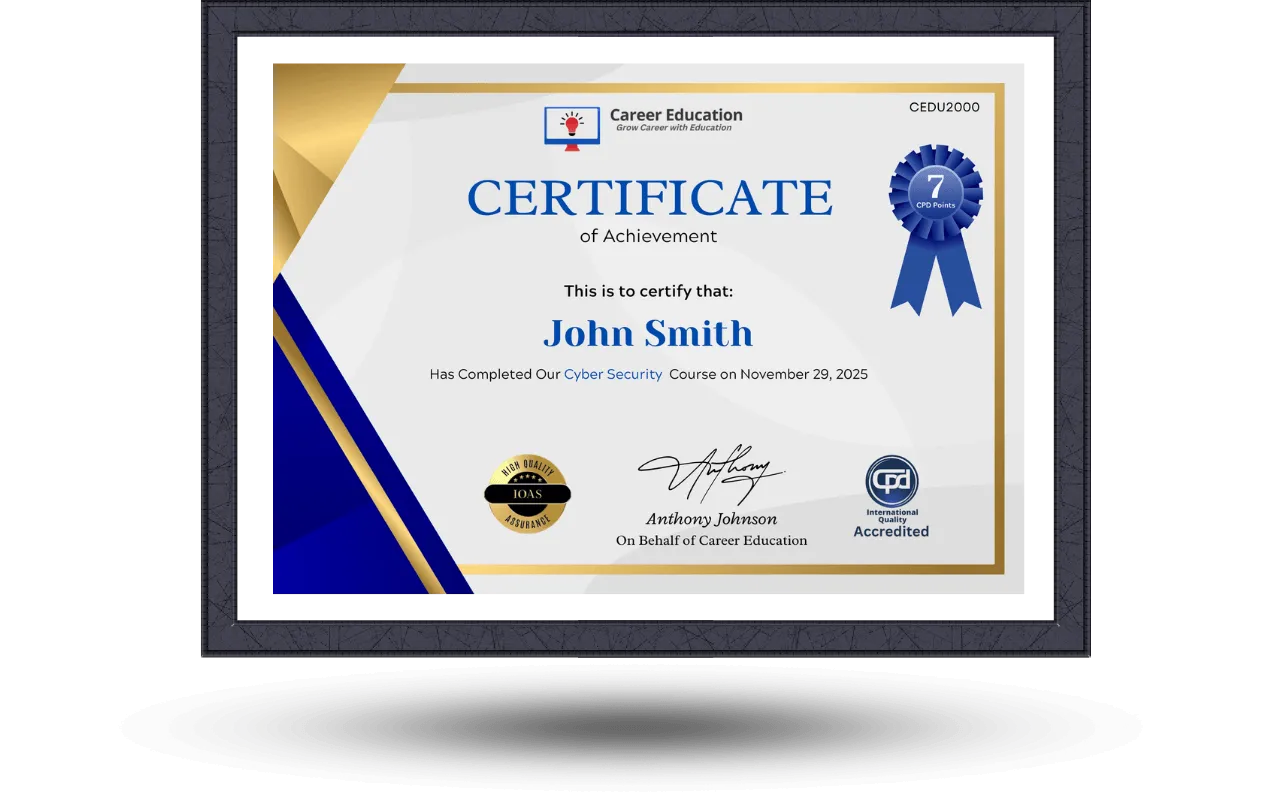
Earn an Accredited Certificate
Upon completion of any course, all students are entitled to a CPD IQ Accredited e-certificate that will be issued by Career Education signifying the completion of your course.
After you complete the course and assignment, you will be eligible to order a free certificate accredited by CPD International Quality by completing the form below.
Hardcopy certificates and transcripts are also available for a small additional fee. More information is disclosed upon course completion.
Similar Courses




Frequently Asked Questions
The lifetime membership includes unlimited access to all courses, resources, and updates for a one-time fee.
You can purchase the membership directly from our website using a secure checkout process.
Yes, selected courses can be downloaded for offline access through our mobile app.
Yes, all future updates and new courses are included at no extra cost.
Yes, we offer a 30-day money-back guarantee if you are not satisfied with the membership.