
94%
OFF
OFF
QuickBooks Training Course
- Lifetime Access
- All Levels
- PDF Certificate
£296
£19
14-Day Money-Back Guarantee
Learn With Confidence







QuickBooks Training Course
Build Practical Skills in Bookkeeping, Financial Management, Reporting and Accounting Workflows
Managing business finances effectively requires more than recording income and expenses. Modern businesses need accurate financial records, organised transaction management, reliable reporting and efficient workflows to make informed decisions and maintain financial control.
QuickBooks Training Course is designed to help learners develop practical knowledge of using QuickBooks for financial management, transaction processing, reporting, analysis, automation and business administration.
The course takes you from getting started with QuickBooks through to more advanced areas such as financial data analysis, integrations, advanced workflows, compliance, security, reporting, automation and scalability.
Whether you are a business owner, aspiring bookkeeper, finance professional, administrator, entrepreneur or someone looking to develop accounting software skills, this course provides a structured learning pathway.
Rather than focusing only on basic software navigation, the QuickBooks Training Course explores how QuickBooks can support broader financial workflows and help organisations manage financial information more effectively.
By the end of the course, you can have a stronger understanding of how accounting software supports day-to-day financial operations and how more advanced features can contribute to efficiency and informed decision-making.
Why Learn QuickBooks?
Accurate financial information is essential for effective business management.
Businesses need to know what they are earning, what they are spending, what they owe, what they are owed and how their financial position is changing.
Manually managing financial information can become increasingly difficult as a business grows. Transactions increase, records become more complex and the need for timely reporting becomes more important.
Accounting software such as QuickBooks can help businesses organise financial information and streamline accounting-related workflows.
Learning how to use such software effectively can therefore be a valuable addition to your professional skill set.
The QuickBooks Training Course introduces learners to the software from a structured perspective, covering both foundational and more advanced concepts.
You will explore areas including:
-
Getting started with QuickBooks
-
Transaction management
-
Financial data analysis
-
Financial decision-making
-
Software integrations
-
Advanced workflows
-
Efficiency improvements
-
Compliance and security
-
Financial reporting
-
Data analysis
-
Automation
-
Business scalability
What You Will Learn
The course consists of seven comprehensive modules:
-
Getting Started with QuickBooks
-
Mastering Transaction Management
-
Analysing Financial Data and Decision-Making
-
Integrations, Advanced Workflows, and Efficiency
-
Compliance, Security, and Best Practices
-
Advanced Reporting and Data Analysis
-
Automation and Scalability
Together, these modules provide a progression from fundamental QuickBooks knowledge to more advanced financial management and workflow concepts.
Module 1 – Getting Started with QuickBooks
The first module, Getting Started with QuickBooks, introduces the software and establishes the foundation for the rest of the course.
The introductory lesson helps learners become familiar with QuickBooks and understand its role in managing financial information.
Starting with a clear understanding of the software is important because effective use of accounting platforms depends on knowing how financial information is organised and how different functions connect.
You will begin developing familiarity with the QuickBooks environment and the principles behind using accounting software to support financial administration.
This module is particularly useful for beginners who may have little or no previous experience with QuickBooks.
By completing this module, you can develop the confidence needed to progress into transaction management, reporting and more advanced workflows.
Module 2 – Mastering Transaction Management
Financial records depend on accurate transaction management.
Module 2 focuses on Mastering Transaction Management, helping learners understand the importance of managing financial transactions systematically.
Business transactions can include income, purchases, expenses and other financial activities. Keeping these records organised is essential for maintaining reliable financial information.
This module explores transaction management and helps learners understand how accounting records can be maintained more efficiently.
You will develop a stronger appreciation of why accuracy, consistency and organisation matter when working with financial data.
Effective transaction management can also make later reporting and analysis easier because financial information is more structured and accessible.
By developing these skills, you can build a stronger foundation for managing everyday accounting workflows.
Module 3 – Analysing Financial Data and Decision-Making
Financial information becomes more valuable when it can be interpreted and used to support decisions.
Module 3 focuses on Analysing Financial Data and Decision-Making.
You will explore how financial data can provide insight into business performance and support informed decision-making.
Business owners and managers may need to understand revenue, expenditure, financial trends and other indicators when deciding how to allocate resources or plan future activities.
Accounting software can help organise this information, but users also need to understand how to interpret the data available to them.
This module helps you develop a more analytical approach to financial information.
Rather than simply recording transactions, you will begin to appreciate how accounting data can contribute to broader business decisions.
By completing this module, you can develop greater confidence in using financial information as part of business planning and evaluation.
Module 4 – Integrations, Advanced Workflows, and Efficiency
Modern businesses often use multiple digital systems.
Module 4 explores Integrations, Advanced Workflows, and Efficiency, helping learners understand how accounting software can fit into broader digital workflows.
Integrations can help information move between systems and reduce the need for repetitive manual processes.
This module introduces the importance of connected workflows and explores how businesses can use technology to improve efficiency.
You will develop awareness of how QuickBooks can form part of a wider business technology environment and why efficient workflows can help save time and reduce unnecessary administrative effort.
Advanced workflows can also help organisations create more consistent processes.
By studying this module, you can begin to think beyond individual accounting tasks and consider how financial processes can be integrated into wider business operations.
Module 5 – Compliance, Security, and Best Practices
Financial information needs to be handled responsibly.
Module 5 focuses on Compliance, Security, and Best Practices, introducing learners to the importance of protecting financial data and following appropriate procedures.
Businesses handle sensitive financial information, making security and responsible data management essential considerations.
This module helps learners understand why good practices matter when working with accounting software.
You will develop awareness of the importance of maintaining accurate records, protecting financial information and following applicable organisational and legal requirements.
Compliance requirements can vary depending on factors such as location, business structure and industry. Therefore, learners should always follow the relevant regulations and professional guidance applicable to their circumstances.
The module provides a foundation for approaching QuickBooks use with greater awareness of security, compliance and responsible financial administration.
Module 6 – Advanced Reporting and Data Analysis
Financial reports can transform large amounts of financial information into more useful insights.
Module 6 focuses on Advanced Reporting and Data Analysis.
You will explore the importance of reporting and how more advanced analysis can help users understand financial performance.
Reports can help businesses review financial activity, identify trends and support planning.
Developing the ability to work with financial reports can be particularly useful for managers, business owners and finance professionals who need to interpret financial information.
This module builds on the earlier focus on financial data analysis and takes it further by exploring advanced reporting concepts.
By completing this module, you can develop greater awareness of how structured financial reporting can support business oversight and decision-making.
Module 7 – Automation and Scalability
The final module focuses on Automation and Scalability.
As businesses grow, financial processes can become more complex.
More customers, suppliers, transactions and financial activities can increase administrative demands.
Automation can help reduce repetitive tasks and create more efficient workflows, while scalable processes can help businesses manage increasing volumes of activity.
This module explores these concepts and helps learners understand how technology can support business growth.
You will develop awareness of why automation can be valuable and how scalable workflows can help organisations manage increasing operational demands.
The module provides an opportunity to bring together many of the concepts explored throughout the course, including efficiency, workflows, data and technology.
Practical Learning Outcomes
By completing the QuickBooks Training Course, you can develop practical knowledge across a broad range of QuickBooks and financial management concepts.
You will be able to:
-
Understand the fundamentals of using QuickBooks.
-
Develop familiarity with accounting software workflows.
-
Understand the importance of accurate transaction management.
-
Organise financial transactions more systematically.
-
Develop awareness of how financial data supports decision-making.
-
Understand the relationship between financial information and business performance.
-
Explore integrations and connected financial workflows.
-
Recognise opportunities to improve accounting-related efficiency.
-
Understand the importance of financial data security.
-
Develop awareness of compliance and responsible financial practices.
-
Understand the role of financial reporting.
-
Explore advanced reporting and data analysis concepts.
-
Recognise how automation can support financial workflows.
-
Understand the importance of scalable processes as businesses grow.
-
Build a foundation for further QuickBooks and bookkeeping development.
Build Confidence with Financial Software
Learning accounting software can initially seem complicated, particularly if you are unfamiliar with bookkeeping terminology or financial workflows.
The QuickBooks Training Course provides a structured learning journey designed to help you build your knowledge progressively.
You begin with the fundamentals before moving into transaction management, financial analysis and more advanced workflows.
This progression allows you to develop your understanding step by step.
Instead of attempting to learn advanced functionality immediately, you can first establish the fundamentals and then build upon them.
This makes the course suitable for learners who want to develop their accounting software knowledge in a structured way.
Improve Transaction Management Skills
Accurate records are fundamental to financial management.
When transactions are poorly organised or inconsistently recorded, it can become more difficult to understand business performance and produce useful financial reports.
The transaction management module helps you understand the importance of maintaining organised financial information.
This knowledge can support more efficient bookkeeping workflows and provide a stronger foundation for financial reporting.
Whether you are managing your own business finances or supporting financial administration within an organisation, these principles can be valuable.
Turn Financial Data into Useful Information
Recording financial information is only part of the process.
Businesses also need to understand what their financial information means.
The QuickBooks Training Course introduces learners to financial data analysis and decision-making, helping them understand how accounting information can support wider business objectives.
You can develop a stronger appreciation of the relationship between financial records, reporting and decision-making.
This analytical perspective can be useful for anyone involved in business management or financial administration.
Develop More Efficient Workflows
Efficiency is increasingly important in modern business.
Repetitive administrative tasks can consume valuable time and create opportunities for errors.
The course introduces integrations, advanced workflows and automation to help learners understand how technology can support more efficient financial processes.
You will develop awareness of how connected systems and automated workflows can reduce unnecessary manual effort and support consistency.
This knowledge can become increasingly valuable as organisations adopt more digital business processes.
Understand Financial Security and Best Practices
Financial data requires careful handling.
Businesses need to consider who can access information, how data is managed and what procedures are needed to protect sensitive records.
The compliance, security and best-practices module helps you develop awareness of these important considerations.
You will understand why responsible use of accounting software is not only about functionality but also about maintaining appropriate standards for financial information management.
Develop Reporting and Analytical Skills
Reports help organisations understand what is happening financially.
The course’s advanced reporting and data analysis module helps you explore how financial information can be organised into useful reports and analysed for business insight.
This can support stronger financial oversight and help users communicate financial information more effectively.
Developing reporting knowledge can be particularly useful for people working in bookkeeping, finance, administration, business management and entrepreneurship.
Understand Automation and Scalability
A process that works for a small business may not work as effectively when transaction volumes increase.
Growth can create additional financial administration and increase the need for efficient systems.
The final module introduces automation and scalability to help learners understand how financial workflows can evolve as business requirements change.
You will gain a broader perspective on how technology can support growing organisations.
Who Is This Course For?
The QuickBooks Training Course is suitable for a wide range of learners.
Aspiring Bookkeepers
If you are considering bookkeeping as a career, developing knowledge of accounting software can complement your broader bookkeeping skills.
Business Owners
Entrepreneurs and business owners can benefit from understanding how accounting software can support financial organisation and business decision-making.
Finance Professionals
Finance professionals can use the course to strengthen their understanding of QuickBooks workflows, reporting and financial data management.
Administrators
Administrative professionals who handle invoices, expenses, transactions or financial records can benefit from developing accounting software knowledge.
Entrepreneurs and Freelancers
Individuals managing their own businesses can develop greater awareness of how digital accounting tools can support financial administration.
Career Changers
If you are considering moving into bookkeeping, finance or accounting administration, this course can provide a useful introduction to QuickBooks-related skills.
Students and Lifelong Learners
The course is also suitable for learners who want to develop practical knowledge of accounting software for personal, academic or professional development.
Support Your Career Development
QuickBooks knowledge can complement a variety of roles involving financial administration and business operations.
Bookkeeping, accounting support, business administration, entrepreneurship and finance-related roles may all involve accounting software.
The QuickBooks Training Course can help you develop a broader digital skill set by combining software knowledge with financial data, reporting, workflow and automation concepts.
The course is educational and foundational. It does not replace formal accounting qualifications, professional bookkeeping credentials or regulated financial advice.
For specific accounting, tax or compliance requirements, learners should follow the rules and professional guidance applicable to their jurisdiction and circumstances.
Learn at Your Own Pace
Online learning offers flexibility for busy professionals, business owners, students and career changers.
You can work through the QuickBooks Training Course alongside your existing commitments and progressively build your knowledge.
The structured curriculum allows you to move from introductory concepts to more advanced areas without needing to master everything at once.
This makes the course a practical option for learners looking to develop accounting software skills in a flexible learning environment.
Build a Modern Financial Management Skill Set
Today’s financial workflows are increasingly digital.
Businesses need professionals who understand not only financial records but also the technology used to manage, analyse and report financial information.
The QuickBooks Training Course brings together these areas.
You will explore transaction management, financial analysis, integrations, workflows, security, reporting, automation and scalability.
This gives you a broader understanding of how accounting software can support financial administration and business operations.
Take the Next Step with QuickBooks
Whether you are starting your bookkeeping journey, managing a growing business or looking to strengthen your professional skills, developing confidence with accounting software can be a valuable investment in your knowledge.
The QuickBooks Training Course provides a structured pathway from the basics of QuickBooks through to advanced financial workflows and automation.
You will develop an understanding of how transactions are managed, how financial data can support decisions, how reporting can provide insight and how automation can improve efficiency.
You will also explore the importance of security, compliance and best practices when working with financial information.
By the end of the course, you can have a stronger foundation for using QuickBooks concepts in professional, business or further-learning contexts.
Enrol in the QuickBooks Training Course today and start developing the practical knowledge you need to manage financial workflows, understand business data and work more confidently with modern accounting software.
Course Modules
Course Content
Module 1 – Getting Started with QuickBooks
-
Lesson 1 – Getting Started with QuickBooks
Module 2 – Mastering Transaction Management
Module 3 – Analyzing Financial Data and Decision-Making
Module 4 – Integrations, Advanced Workflows, and Efficiency
Module 5 – Compliance, Security, and Best Practices
Module 6 – Advanced Reporting and Data Analysis
Module 7 – Automation and Scalability
What our students say
Excellent
4.9 average
158 Reviews

Earn an Accredited Certificate
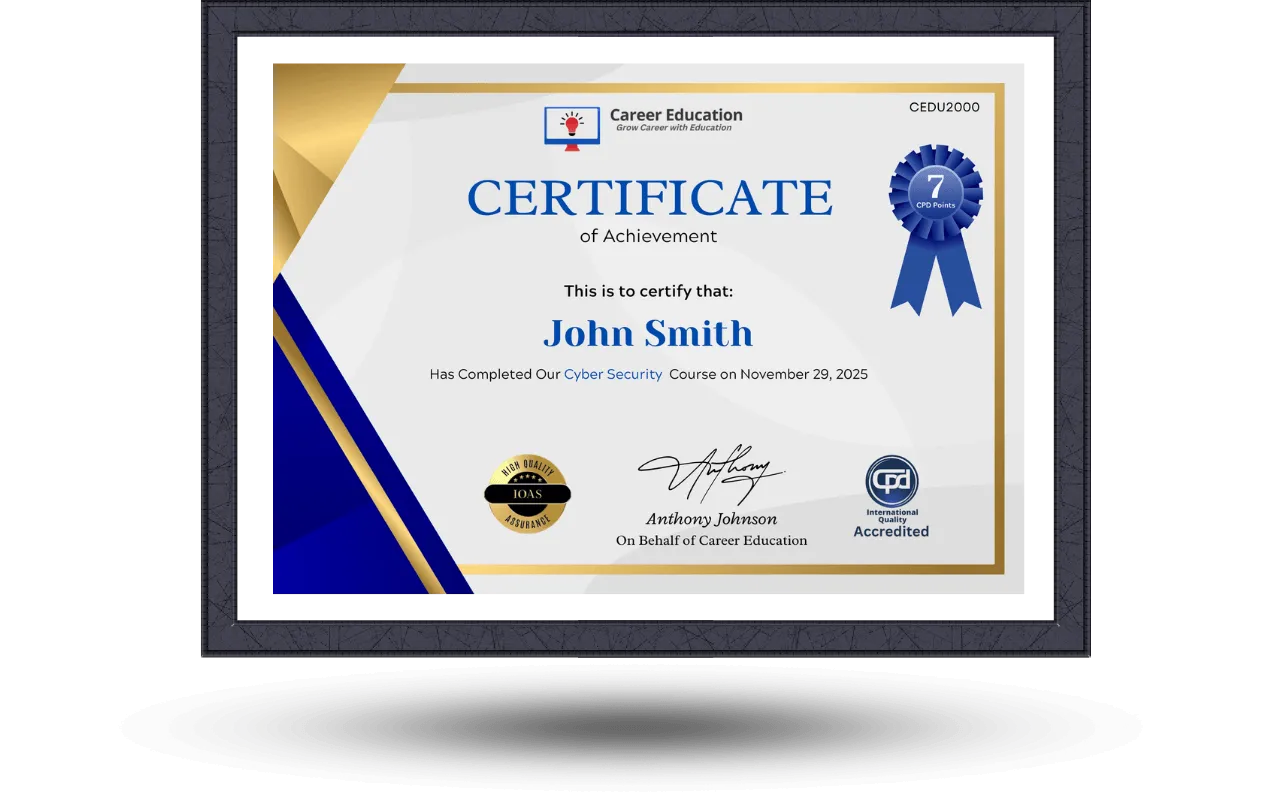
Upon completion of any course, all students are entitled to a CPD IQ Accredited e-certificate that will be issued by Career Education signifying the completion of your course.
After you complete the course and assignment, you will be eligible to order a free certificate accredited by CPD International Quality by completing the form below.
Hardcopy certificates and transcripts are also available for a small additional fee. More information is disclosed upon course completion.
Similar Courses




Frequently Asked Questions
The lifetime membership includes unlimited access to all courses, resources, and updates for a one-time fee.
You can purchase the membership directly from our website using a secure checkout process.
Yes, selected courses can be downloaded for offline access through our mobile app.
Yes, all future updates and new courses are included at no extra cost.
Yes, we offer a 30-day money-back guarantee if you are not satisfied with the membership.