
94%
OFF
OFF
Particle Physics Fundamentals
- Lifetime Access
- All Levels
- PDF Certificate
£296
£19
14-Day Money-Back Guarantee
Learn With Confidence









Particle Physics Fundamentals
Explore the Building Blocks of Matter and the Forces That Shape Our Universe
What is everything around us really made of? From the atoms in our bodies to the stars, planets, and galaxies across the universe, matter is built from incredibly small particles governed by fundamental forces and interactions. Particle Physics Fundamentals introduces you to the fascinating world of subatomic particles and the scientific principles used to understand the structure and behaviour of matter.
Designed to build knowledge progressively, this course explores elementary particles, atomic nuclei, nuclear physics, particle accelerators, radiation detectors, and the Standard Model. Whether you are developing your scientific knowledge, preparing for further study, or simply interested in understanding how modern physics explains the universe, this course provides a structured foundation in particle physics.
By completing Particle Physics Fundamentals, you can develop a clearer understanding of concepts that form the basis of modern particle and nuclear physics and gain the confidence to explore more advanced topics.
What Is Particle Physics?
Particle physics is the branch of physics concerned with understanding the smallest known components of matter and the fundamental interactions between them. While everyday objects appear solid and continuous, they are made from atoms, which themselves contain smaller constituents. At an even deeper level, scientists study elementary particles and the forces that govern their interactions.
Particle physics helps answer fundamental questions about nature, including what matter is made of, how particles interact, and why the universe behaves the way it does.
Particle Physics Fundamentals gives learners an opportunity to explore these ideas step by step. Rather than approaching advanced concepts without context, the course begins with an introduction to particle physics before progressing through increasingly specialised areas.
What You Will Learn
The course curriculum covers seven important areas of particle and nuclear physics:
Module 1 – Introduction to Particle Physics
The first module establishes the foundations of the subject. You will be introduced to particle physics and its role in modern science, helping you develop the background knowledge needed for the later modules.
Understanding the foundations is important because particle physics involves concepts that may initially seem unfamiliar. This introductory stage provides a starting point from which you can explore the microscopic world with greater confidence.
By completing this module, you can begin to understand the purpose and scope of particle physics and appreciate why scientists study fundamental particles and their interactions.
Module 2 – Elementary Particles
What are the fundamental components of matter? The elementary particles module takes you further into the microscopic structure of the universe.
You will explore the concept of elementary particles and develop an understanding of the different particles that form the foundation of the modern particle physics framework. This provides valuable preparation for understanding how particles interact and how they are organised within established scientific models.
The outcome of this module is a stronger conceptual understanding of the particles that scientists use to describe the fundamental structure of matter.
Module 3 – The Nucleus
The atomic nucleus is central to both nuclear physics and our understanding of matter. In this module, you will explore the nucleus and its importance within atomic and subatomic physics.
Learning about the nucleus helps connect concepts from atomic structure with the broader principles of particle and nuclear physics. You can develop an understanding of why the nucleus is important and how its properties contribute to the behaviour of atoms and matter.
This knowledge also provides a foundation for the following module, which focuses more specifically on nuclear physics.
Module 4 – Nuclear Physics
Nuclear physics examines the properties and behaviour of atomic nuclei. This module expands your understanding beyond the basic structure of the nucleus and introduces you to the wider field of nuclear physics.
By studying this area, you can gain a better appreciation of the processes and principles associated with atomic nuclei and understand how nuclear physics connects with the broader study of matter and energy.
This module is particularly useful for learners who want to understand how particle physics overlaps with related areas of modern physics.
Module 5 – Particle Accelerators
Particle accelerators are among the most important tools used in experimental particle physics. They enable researchers to investigate particles and interactions under carefully controlled conditions.
In this module, you will explore particle accelerators and their role in scientific research. Understanding these instruments provides insight into how theoretical ideas in particle physics can be investigated through experimentation.
You will gain a clearer appreciation of the relationship between scientific theory and experimental research and understand why particle accelerators are essential to modern particle physics.
Module 6 – Radiation Detectors
Detecting particles and radiation is a fundamental part of experimental physics. Scientists need specialised equipment to observe and measure the results of particle interactions.
This module introduces radiation detectors and their importance in particle physics research. You will explore their role in detecting and studying radiation and subatomic particles.
By completing this module, you can better understand how experimental scientists gather information about particles that cannot simply be observed using everyday instruments.
Module 7 – The Standard Model
The course concludes with one of the most important frameworks in modern particle physics: the Standard Model.
The Standard Model provides a theoretical framework for describing many of the known elementary particles and their fundamental interactions. Bringing together knowledge from earlier modules, this final section helps you understand how individual concepts fit into a broader scientific picture.
Studying the Standard Model can give you a valuable overview of how modern particle physics describes the fundamental components of the universe.
Develop a Stronger Understanding of Modern Physics
One of the key benefits of Particle Physics Fundamentals is its structured approach. The curriculum moves from introductory concepts through elementary particles and nuclear physics before exploring experimental tools and the Standard Model.
This progression can help you connect different areas of knowledge rather than viewing them as isolated subjects.
You can develop an understanding of:
-
The foundations and scope of particle physics
-
Elementary particles and their significance
-
The structure and importance of the atomic nucleus
-
Core concepts within nuclear physics
-
The purpose and role of particle accelerators
-
How radiation detectors support experimental research
-
The role of the Standard Model in modern particle physics
Build Knowledge That Supports Further Learning
Particle physics is a broad and continually developing field. A strong foundation can make it easier to approach more advanced scientific material in the future.
Particle Physics Fundamentals is designed to help you establish that foundation. By working through the curriculum, you can become familiar with important terminology, concepts, scientific frameworks, and experimental technologies.
The course can therefore serve as a useful starting point for learners who want to continue exploring areas such as advanced particle physics, nuclear science, experimental physics, astrophysics, or related scientific disciplines.
Who Can Benefit From Particle Physics Fundamentals?
This course can be valuable for learners with an interest in physics and the fundamental structure of the universe. It may be suitable for:
-
Students interested in developing their understanding of modern physics
-
Science enthusiasts curious about elementary particles
-
Learners considering further study in physics or related subjects
-
Professionals who want to broaden their scientific knowledge
-
Individuals interested in nuclear and particle physics
-
Anyone looking for a structured introduction to fundamental particle concepts
You do not need to become a particle physicist to benefit from learning about the subject. Understanding the principles behind matter, particles, radiation, and fundamental interactions can provide a fascinating perspective on the physical world.
Why Study Particle Physics?
Particle physics represents one of humanity’s efforts to understand nature at its most fundamental level. Research in this field has contributed to our understanding of matter, energy, radiation, and the forces that influence the universe.
Studying particle physics can also encourage valuable analytical and scientific thinking skills. You learn to look beyond what is immediately visible and consider the underlying principles that explain observable phenomena.
Through Particle Physics Fundamentals, you can explore these ideas in a logical progression and develop a broader appreciation of the science behind some of the most advanced research in the world.
A Practical Foundation for Scientific Curiosity
Learning particle physics is not simply about memorising names or definitions. It is about understanding relationships between concepts.
For example, learning about elementary particles can help you understand the Standard Model. Exploring the nucleus provides context for nuclear physics. Studying particle accelerators and radiation detectors shows how researchers investigate theoretical concepts experimentally.
This interconnected approach can make the subject more meaningful and help you develop a clearer overall picture of modern particle physics.
Your Learning Outcomes
After completing Particle Physics Fundamentals, you should have developed a broad foundational understanding of particle and nuclear physics.
You can expect to:
-
Understand the fundamental purpose and scope of particle physics
-
Recognise the significance of elementary particles
-
Develop knowledge of the atomic nucleus
-
Explore key concepts associated with nuclear physics
-
Understand the scientific role of particle accelerators
-
Learn why radiation detectors are important in experimental research
-
Become familiar with the Standard Model
-
Connect theoretical concepts with experimental approaches
-
Build a foundation for further exploration of modern physics
These outcomes can help you approach additional learning with greater confidence and a stronger conceptual foundation.
Take the Next Step Into Particle Physics
The universe is made up of fundamental components that are far smaller than anything we can see with the naked eye. Understanding those components has challenged scientists for generations and continues to drive research today.
Particle Physics Fundamentals gives you the opportunity to explore this fascinating field through a structured seven-module curriculum. From the introduction to particle physics and elementary particles through to nuclear physics, particle accelerators, radiation detectors, and the Standard Model, the course brings together essential concepts that can help you understand the foundations of modern particle science.
If you are ready to expand your scientific knowledge and discover more about the fundamental building blocks of matter, Particle Physics Fundamentals can provide an engaging starting point for your learning journey.
Enrol today and begin exploring the particles, nuclei, technologies, and scientific models that help us understand the universe at its most fundamental level.
Course Modules
Course Content
Module 1 – [Introduction to Particle Physics]
-
Lesson 1 – [Introduction to Particle Physics]
Module 2 – [Elementary Particles]
Module 3 – [The Nucleus]
Module 4 – [Nuclear Physics]
Module 5 – [Particle Accelerators]
Module 6 – [Radiation detectors]
Module 7 – [The Standard Model]
What our students say
Excellent
4.9 average
158 Reviews

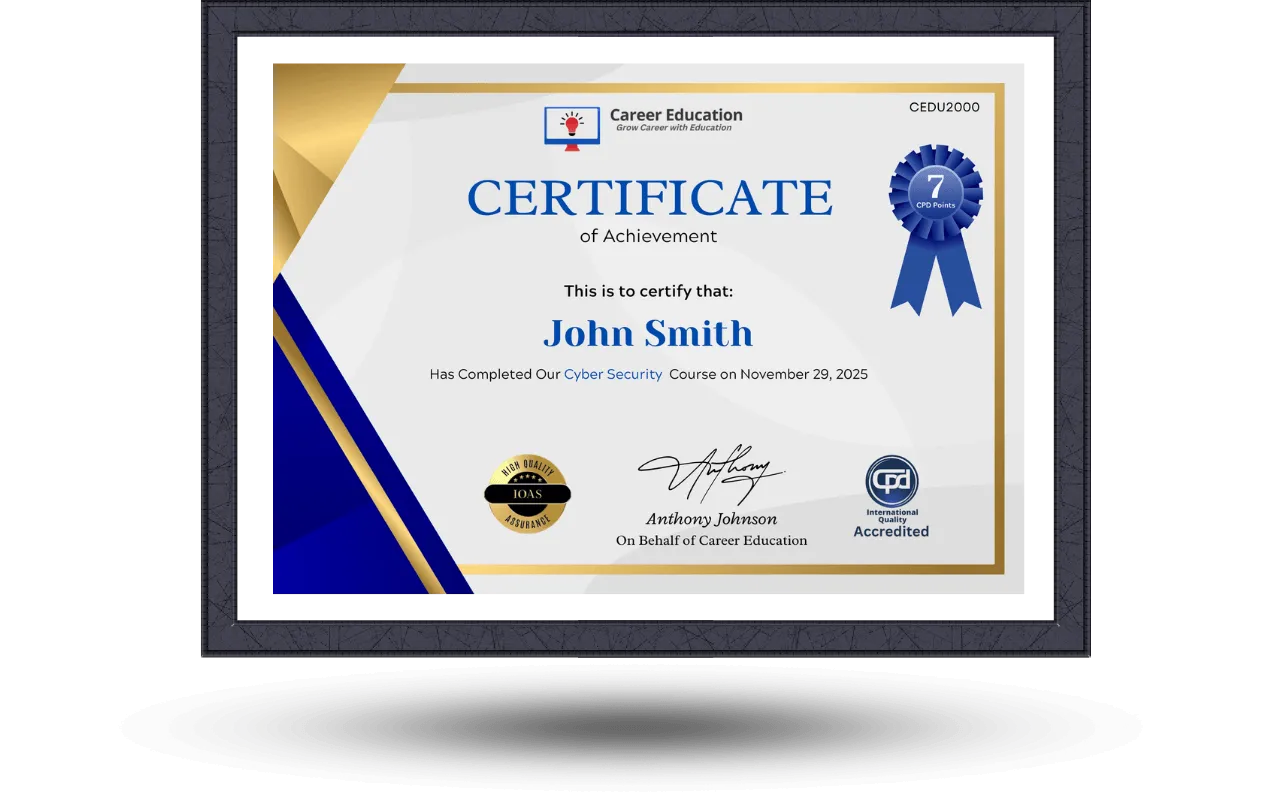
Earn an Accredited Certificate
Upon completion of any course, all students are entitled to a CPD IQ Accredited e-certificate that will be issued by Career Education signifying the completion of your course.
After you complete the course and assignment, you will be eligible to order a free certificate accredited by CPD International Quality by completing the form below.
Hardcopy certificates and transcripts are also available for a small additional fee. More information is disclosed upon course completion.
Similar Courses




Frequently Asked Questions
The lifetime membership includes unlimited access to all courses, resources, and updates for a one-time fee.
You can purchase the membership directly from our website using a secure checkout process.
Yes, selected courses can be downloaded for offline access through our mobile app.
Yes, all future updates and new courses are included at no extra cost.
Yes, we offer a 30-day money-back guarantee if you are not satisfied with the membership.