
94%
OFF
OFF
MSP – Successful Programme Management
- Lifetime Access
- All Levels
- PDF Certificate
£296
£19
14-Day Money-Back Guarantee
Learn With Confidence






MSP – Successful Programme Management Course
Overview
The MSP – Successful Programme Management course is designed to help professionals develop the knowledge, skills, and practical capabilities required to successfully manage complex programmes and deliver strategic business transformation. Based on the principles of Managing Successful Programmes (MSP), this comprehensive training provides a structured approach to programme leadership, governance, benefits realisation, stakeholder engagement, risk management, and organisational change.
Modern organisations increasingly rely on programmes to deliver major improvements, digital transformation, operational changes, and strategic objectives. However, managing multiple projects, resources, risks, and stakeholders within a programme environment requires specialist knowledge and effective leadership. The MSP – Successful Programme Management course equips learners with the tools and frameworks needed to plan, control, and successfully deliver programmes that create measurable value.
This course is suitable for aspiring programme managers, project professionals, business leaders, transformation specialists, and anyone involved in strategic change initiatives. Through practical modules, real-world examples, and exam preparation, learners will gain confidence in applying MSP concepts across both public and private sector environments.
By completing the MSP – Successful Programme Management course, learners will understand how to establish strong programme governance, develop effective business cases, manage benefits, control risks, lead transformational change, and improve programme performance from initiation through closure.
Course Description
The MSP – Successful Programme Management course provides a complete learning journey covering essential and advanced programme management principles. It explores the full programme lifecycle and introduces learners to proven MSP frameworks that support successful delivery of organisational change.
Unlike traditional project management approaches that focus on individual projects, programme management focuses on coordinating multiple related projects and activities to achieve broader strategic outcomes. This course helps learners understand how programmes create value by aligning projects with organisational goals, managing dependencies, and ensuring benefits are successfully realised.
Throughout the MSP – Successful Programme Management course, learners will explore programme governance structures, leadership responsibilities, financial planning, procurement strategies, sustainability considerations, digital transformation programmes, and complex programme environments.
The course also covers practical approaches for managing stakeholders, communication strategies, conflict resolution, cultural change, and professional ethics. Learners will develop the ability to analyse programme challenges and apply effective solutions using MSP methodologies.
The final stages of the course focus on advanced programme management practices, including maturity assessment, crisis management, case studies, practitioner exam preparation, and a mastery workshop designed to consolidate learning through practical application.
What You Will Learn From The MSP – Successful Programme Management Course
By completing the MSP – Successful Programme Management course, learners will be able to:
-
Understand the foundations and purpose of MSP within the UK programme management environment.
-
Apply MSP principles to support successful programme delivery.
-
Establish effective programme governance frameworks and decision-making structures.
-
Lead programmes with confidence using strategic leadership techniques.
-
Manage the complete programme lifecycle from initiation to closure.
-
Develop strong programme mandates, briefs, and business cases.
-
Design programme blueprints aligned with organisational objectives.
-
Create effective benefits management strategies.
-
Engage stakeholders and build strong communication approaches.
-
Manage programme risks, issues, resources, and dependencies effectively.
-
Apply quality management techniques to improve programme outcomes.
-
Understand financial appraisal, budgeting, procurement, and commercial management.
-
Support transformational change and organisational improvement.
-
Implement integrated assurance and programme controls.
-
Manage digital transformation programmes and emerging technologies.
-
Apply MSP approaches within public and private sector environments.
-
Improve programme maturity and organisational capability.
-
Integrate agile approaches within MSP frameworks.
-
Resolve conflicts and negotiate successful outcomes.
-
Measure programme performance and evaluate benefits realisation.
-
Apply professional standards, ethics, and compliance requirements.
-
Prepare effectively for the MSP Practitioner examination.
Course Curriculum
Module 1: Introduction to MSP (UK Context)
This module introduces the foundations of MSP and explains its importance within the UK programme management environment. Learners will explore the purpose of programme management, key concepts, and how MSP supports strategic organisational change.
Module 2: MSP Principles
Learners will study the core MSP principles that guide successful programme delivery. This module explains how principles support decision-making, governance, adaptability, and achieving sustainable outcomes.
Module 3: MSP Governance Framework
This module explores programme governance structures, roles, responsibilities, and accountability. Learners will understand how effective governance enables better control and strategic alignment.
Module 4: Programme Leadership
Learners will develop leadership skills required to manage complex programmes, motivate teams, influence stakeholders, and drive successful transformation.
Module 5: The Programme Lifecycle
This module covers the complete programme lifecycle, including programme definition, delivery, transition, and closure stages.
Module 6: Programme Mandate and Brief
Learners will understand how to develop programme mandates and briefs that clearly define objectives, scope, expected outcomes, and strategic alignment.
Module 7: Blueprint Design
This module focuses on designing programme blueprints that describe future organisational states and guide transformation activities.
Module 8: Business Case Development
Learners will explore how to create strong business cases that demonstrate value, feasibility, investment requirements, and expected benefits.
Module 9: Benefits Management Strategy
This module explains how to identify, plan, track, and realise programme benefits to ensure successful outcomes.
Module 10: Stakeholder Engagement
Learners will develop strategies for identifying stakeholders, managing expectations, and building effective relationships.
Module 11: Programme Organisation
This module explores programme structures, governance teams, roles, and responsibilities required for successful delivery.
Module 12: Risk and Issue Management
Learners will understand how to identify, assess, manage, and respond to programme risks and issues.
Module 13: Quality Management
This module covers quality planning, assurance, control methods, and continuous improvement approaches.
Module 14: Financial Management
Learners will explore financial planning, budgeting, cost control, and financial decision-making within programmes.
Module 15: Procurement and Commercial Management
This module introduces procurement processes, supplier relationships, contracts, and commercial considerations.
Module 16: Change Management Foundations
Learners will understand the principles of managing organisational change and supporting successful adoption.
Module 17: Transformational Flow
This module examines how programmes create transformation through coordinated activities, strategic alignment, and effective delivery.
Module 18: Integrated Assurance
Learners will explore assurance approaches that provide confidence in programme performance, governance, and outcomes.
Module 19: Information Management
This module covers programme information management, reporting structures, documentation, and communication systems.
Module 20: Programme Controls
Learners will learn how to establish effective controls for monitoring progress, performance, costs, and risks.
Module 21: Dependency Management
This module explains how to identify and manage relationships between projects, activities, and programme components.
Module 22: Resource Management
Learners will explore resource planning, allocation, capability management, and workforce optimisation.
Module 23: Sustainability and ESG
This module introduces sustainability principles and Environmental, Social, and Governance (ESG) considerations within programmes.
Module 24: Digital Transformation Programmes
Learners will explore managing technology-driven programmes and implementing digital transformation strategies.
Module 25: Public Sector Programmes
This module focuses on programme management approaches within government and public sector environments.
Module 26: Private Sector Programmes
Learners will understand how MSP principles apply within commercial organisations and private sector transformation initiatives.
Module 27: Portfolio Interface
This module explains the relationship between programmes and organisational portfolios to support strategic investment decisions.
Module 28: Advanced Benefits Realisation
Learners will explore advanced techniques for measuring, maintaining, and maximising programme benefits.
Module 29: Complex Programme Environments
This module prepares learners to manage uncertainty, complexity, competing priorities, and large-scale programmes.
Module 30: Programme Maturity and Capability
Learners will learn how to assess programme maturity and improve organisational programme management capability.
Module 31: Agile within MSP
This module explores how agile principles can be integrated with MSP approaches to support flexible delivery.
Module 32: Managing Cultural Change
Learners will understand how to influence organisational culture and support successful behavioural change.
Module 33: Communication Strategy
This module covers communication planning, reporting, stakeholder messaging, and engagement techniques.
Module 34: Legal and Regulatory Compliance
Learners will explore compliance requirements, regulatory responsibilities, and governance obligations.
Module 35: Conflict Resolution and Negotiation
This module develops skills for managing disagreements, negotiating solutions, and maintaining productive relationships.
Module 36: Performance Measurement
Learners will explore performance indicators, measurement techniques, and programme evaluation methods.
Module 37: Innovation and Emerging Trends
This module examines innovation, emerging technologies, and future trends affecting programme management.
Module 38: Programme Closure
Learners will understand how to formally close programmes, confirm outcomes, and transition responsibilities.
Module 39: Lessons Learned and Knowledge Transfer
This module focuses on capturing lessons, sharing knowledge, and improving future programme delivery.
Module 40: Ethics and Professional Standards
Learners will explore ethical decision-making, professional behaviour, and responsibilities of programme managers.
Module 41: Advanced Financial Appraisal
This module covers advanced approaches to financial analysis, investment evaluation, and programme value assessment.
Module 42: Programme Crisis Management
Learners will develop strategies for responding to programme challenges, disruptions, and critical situations.
Module 43: Case Studies (UK)
This module examines practical UK-based programme management scenarios and real-world applications of MSP principles.
Module 44: MSP Practitioner Exam Preparation
Learners will receive guidance and preparation support for the MSP Practitioner examination.
Module 45: Mastery Workshop and Capstone
The final module combines all learning through practical exercises, scenario analysis, and a comprehensive programme management capstone activity.
Who Is This Course For?
The MSP – Successful Programme Management course is ideal for:
-
Aspiring programme managers looking to develop professional programme management skills.
-
Project managers moving into programme leadership roles.
-
Business transformation professionals.
-
Change managers and organisational development specialists.
-
PMO professionals seeking advanced knowledge.
-
Senior managers responsible for strategic initiatives.
-
Professionals involved in large-scale projects and transformation programmes.
-
Individuals preparing for MSP certification and practitioner-level knowledge.
Whether you are starting your programme management journey or looking to enhance your existing skills, this course provides practical knowledge that can be applied across different industries.
Course Requirements
There are no strict prerequisites required to enrol on the MSP – Successful Programme Management course. However, learners may benefit from having:
-
Basic understanding of project or business management concepts.
-
Interest in organisational change and strategic delivery.
-
Experience working within project, business, or operational environments.
The course is designed for both beginners and experienced professionals who want to build a deeper understanding of successful programme management.
Career Path and Opportunities
Completing the MSP – Successful Programme Management course can support career development in a wide range of programme and transformation roles.
Potential career opportunities include:
-
Programme Manager
-
Senior Programme Manager
-
Transformation Manager
-
Project Manager
-
PMO Manager
-
Change Manager
-
Business Transformation Consultant
-
Portfolio Manager
-
Programme Coordinator
-
Strategic Delivery Manager
Organisations across industries require professionals who can manage complex change initiatives, coordinate multiple projects, and deliver strategic benefits. The knowledge gained from this course can help learners improve their professional confidence, enhance leadership capability, and contribute effectively to successful organisational transformation.
Frequently Asked Questions
What is the MSP – Successful Programme Management course?
The MSP – Successful Programme Management course is a comprehensive programme management training course designed to teach learners how to manage complex programmes, deliver strategic outcomes, and apply MSP principles effectively.
Who should take this course?
This course is suitable for programme managers, project professionals, business leaders, change specialists, PMO professionals, and anyone involved in organisational transformation.
Does this course cover MSP Practitioner preparation?
Yes. The course includes dedicated MSP Practitioner exam preparation to help learners understand key concepts and develop confidence before assessment.
What skills will I gain from this course?
You will gain skills in programme governance, leadership, benefits management, risk management, stakeholder engagement, financial planning, change management, and strategic delivery.
Can this course help with career progression?
Yes. The MSP – Successful Programme Management course can support career progression by developing advanced programme management knowledge required for leadership and transformation roles.
Will I receive a certificate after completing the course?
Yes, learners who successfully complete the course can receive a certificate of completion demonstrating their knowledge and commitment to professional development.
The MSP – Successful Programme Management course provides a complete pathway for professionals who want to master programme delivery, lead transformational initiatives, and develop the expertise required to manage successful programmes in today’s complex business environment.
Course Modules
Course Content
Module 1_ Introduction to MSP (UK Context).
-
Lesson 1_ Introduction to MSP (UK Context).
Module 2_ MSP Principles.
Module 3_ MSP Governance Framework.
Module 4_ Programme Leadership.
Module 5_ The Programme Lifecycle.
Module 6_ Programme Mandate and Brief.
Module 7_ Blueprint Design.
Module 8_ Business Case Development.
Module 9_ Benefits Management Strategy.
Module 10_ Stakeholder Engagement.
Module 11_ Programme Organisation.
Module 12_ Risk and Issue Management.
Module 13_ Quality Management.
Module 14_ Financial Management.
Module 15_ Procurement and Commercial Management.
Module 16_ Change Management Foundations.
Module 17_ Transformational Flow.
Module 18_ Integrated Assurance.
Module 19_ Information Management.
Module 20_ Programme Controls.
Module 21_ Dependency Management.
Module 22_ Resource Management.
Module 23_ Sustainability and ESG.
Module 24_ Digital Transformation Programmes.
Module 25_ Public Sector Programmes.
Module 26_ Private Sector Programmes.
Module 27_ Portfolio Interface.
Module 28_ Advanced Benefits Realisation.
Module 29_ Complex Programme Environments.
Module 30_ Programme Maturity and Capability.
Module 31_ Agile within MSP.
Module 32_ Managing Cultural Change.
Module 33_ Communication Strategy.
Module 34_ Legal and Regulatory Compliance.
Module 35_ Conflict Resolution and Negotiation.
Module 36_ Performance Measurement.
Module 37_ Innovation and Emerging Trends.
Module 38_ Programme Closure.
Module 39_ Lessons Learned and Knowledge Transfer.
Module 40_ Ethics and Professional Standards.
Module 41_ Advanced Financial Appraisal.
Module 42_ Programme Crisis Management.
Module 43_ Case Studies (UK).
Module 44_ MSP Practitioner Exam Preparation.
Module 45_ Mastery Workshop and Capstone.
What our students say
Excellent
4.9 average
158 Reviews

Earn an Accredited Certificate
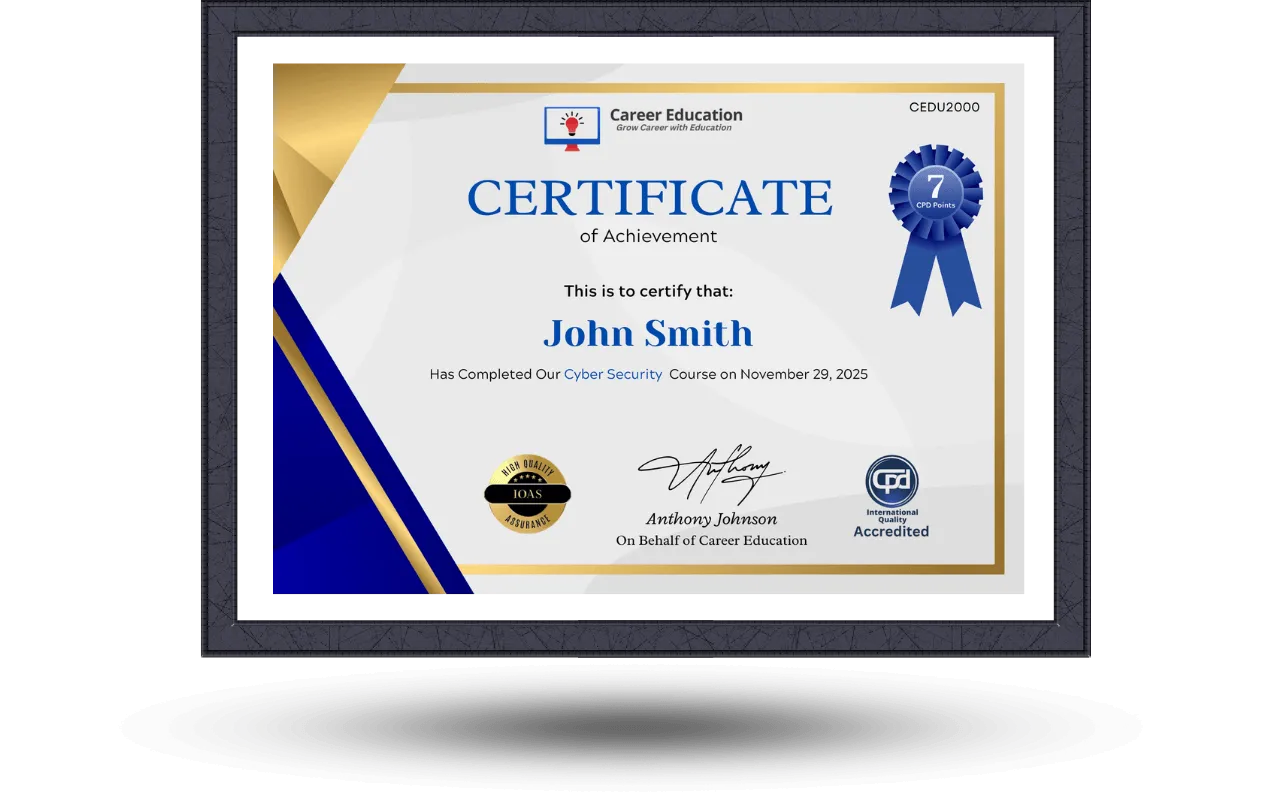
Upon completion of any course, all students are entitled to a CPD IQ Accredited e-certificate that will be issued by Career Education signifying the completion of your course.
After you complete the course and assignment, you will be eligible to order a free certificate accredited by CPD International Quality by completing the form below.
Hardcopy certificates and transcripts are also available for a small additional fee. More information is disclosed upon course completion.
Similar Courses



Frequently Asked Questions
The lifetime membership includes unlimited access to all courses, resources, and updates for a one-time fee.
You can purchase the membership directly from our website using a secure checkout process.
Yes, selected courses can be downloaded for offline access through our mobile app.
Yes, all future updates and new courses are included at no extra cost.
Yes, we offer a 30-day money-back guarantee if you are not satisfied with the membership.