
94%
OFF
OFF
Mastering Balanced Scorecard Performance Management
- Lifetime Access
- All Levels
- PDF Certificate
£296
£19
14-Day Money-Back Guarantee
Learn With Confidence









# Mastering Balanced Scorecard Performance Management
## Turn Strategy into Measurable Performance, Strategic Alignment and Sustainable Organisational Results
Organisations need more than ambitious goals to achieve lasting success. They need a clear way to translate strategy into measurable objectives, track performance, identify gaps and ensure that teams are working towards shared priorities. Without a structured performance-management approach, strategic plans can remain disconnected from everyday operations.
**Mastering Balanced Scorecard Performance Management** is designed to help professionals understand how the Balanced Scorecard (BSC) can connect organisational strategy with practical performance measurement. The course explores how to design a Balanced Scorecard framework, align strategic objectives, establish meaningful performance measures, implement BSC across different organisational contexts, use technology and automation effectively, and manage organisational change.
The Balanced Scorecard provides a broader perspective on organisational performance by considering multiple dimensions rather than relying exclusively on financial results. By bringing together strategic objectives, performance indicators, targets and initiatives, organisations can develop a clearer view of what is driving progress and where improvement is needed.
This course takes an outcome-focused approach, helping learners develop practical knowledge they can apply when contributing to strategy, performance management, planning and organisational improvement.
Whether you are a manager, business leader, performance professional, strategy specialist, consultant or aspiring organisational-performance practitioner, **Mastering Balanced Scorecard Performance Management** can help you build the knowledge required to use BSC principles more effectively.
# Why Learn Mastering Balanced Scorecard Performance Management?
A strong strategy needs a strong execution framework.
Organisations often have strategic plans containing multiple objectives, but employees may struggle to understand how their daily activities contribute to those objectives. Performance information may also exist across different departments without providing a coherent picture of organisational progress.
The Balanced Scorecard can help bridge this gap.
By linking strategic objectives with measurable outcomes and initiatives, organisations can create greater visibility across their priorities.
**Mastering Balanced Scorecard Performance Management** helps learners understand how this approach can support strategic alignment, performance monitoring and continuous improvement.
# What You Will Learn
The course consists of seven modules that progressively develop your understanding of Balanced Scorecard Performance Management.
## Module 1 – Introduction to Balanced Scorecard (BSC)
The course begins with **Introduction to Balanced Scorecard (BSC)**.
You will explore the purpose and principles of the Balanced Scorecard and understand why organisations use structured performance-management frameworks.
The module introduces the relationship between organisational strategy and performance measurement.
You will explore how traditional performance measurement can sometimes focus heavily on financial results while overlooking other factors that influence long-term success.
The Balanced Scorecard commonly considers four interconnected perspectives:
* Financial performance.
* Customer or stakeholder outcomes.
* Internal processes.
* Learning and growth.
You will consider how these perspectives can provide a more balanced view of organisational performance.
The module also explores the importance of connecting objectives, measures, targets and strategic initiatives.
By completing this module, you will have a stronger foundation in BSC concepts and understand how the framework can support strategy execution.
## Module 2 – Designing a Balanced Scorecard Framework
A Balanced Scorecard needs to reflect an organisation’s actual strategy.
In **Designing a Balanced Scorecard Framework**, you will explore how organisations can develop a structured framework around their strategic priorities.
You will consider how to identify strategic objectives and connect them to appropriate measures.
The module explores important considerations such as:
* Strategic priorities.
* Objectives.
* Key performance indicators.
* Targets.
* Strategic initiatives.
* Cause-and-effect relationships.
* Accountability.
You will also consider why performance measures need to be meaningful and relevant rather than simply easy to collect.
A poorly designed scorecard can create unnecessary reporting and distract teams from strategic priorities.
The course therefore encourages learners to focus on measures that provide useful insight into performance and decision-making.
By completing this module, you will better understand the principles involved in designing a Balanced Scorecard that supports organisational objectives.
## Module 3 – Strategic Alignment with BSC
A performance framework is most useful when everyone understands how their work contributes to organisational strategy.
**Strategic Alignment with BSC** explores how the Balanced Scorecard can help connect organisational goals with departmental and individual priorities.
You will consider how strategic objectives can be translated into more focused goals for different areas of an organisation.
The module explores the importance of alignment across:
* Organisational strategy.
* Departments.
* Teams.
* Individual responsibilities.
* Strategic initiatives.
You will also consider how communication can help employees understand the organisation’s strategic direction.
When people understand what matters most and how their work contributes to wider objectives, organisations can improve focus and coordination.
By completing this module, you will develop greater awareness of how BSC principles can support strategic alignment and organisational consistency.
## Module 4 – Performance Measurement with BSC
Measurement is central to effective performance management.
In **Performance Measurement with BSC**, you will explore how organisations can select and use performance indicators to monitor strategic progress.
You will consider the difference between measures that describe past performance and indicators that may provide insight into future performance.
The module highlights the importance of choosing indicators that are:
* Relevant.
* Understandable.
* Measurable.
* Strategically connected.
* Actionable.
* Appropriately monitored.
You will also explore the importance of targets and performance thresholds.
Effective measurement should not simply produce reports. It should help decision-makers understand what is happening and determine where action may be required.
By completing this module, you will be better prepared to understand how meaningful performance measures can support informed management decisions.
## Module 5 – Implementing BSC in Different Organisational Contexts
Organisations differ in size, structure, purpose and operating environment.
**Implementing BSC in Different Organisational Contexts** explores how Balanced Scorecard principles can be adapted to different organisational situations.
You will consider how implementation may vary between different types of organisations, departments and operating environments.
The module highlights the importance of understanding organisational culture, strategic priorities, available resources and stakeholder expectations.
You will also explore why a Balanced Scorecard should not simply be copied from another organisation.
A useful scorecard reflects the specific strategy and performance needs of the organisation using it.
By completing this module, you will develop a more flexible understanding of BSC implementation and recognise the importance of contextual adaptation.
## Module 6 – Technology and Automation in BSC
Modern performance management increasingly relies on technology.
In **Technology and Automation in BSC**, you will explore how digital tools can support Balanced Scorecard reporting, monitoring and analysis.
Technology can help organisations collect performance information, automate reporting, visualise trends and provide stakeholders with more timely access to information.
You will consider potential applications such as:
* Digital dashboards.
* Automated reporting.
* Performance databases.
* Data integration.
* Visual performance tracking.
* Alerts and notifications.
* Management information systems.
The module also highlights the importance of data quality, governance and appropriate system design.
Automation can make reporting more efficient, but technology does not automatically create good performance management. The underlying objectives and measures still need to be relevant.
By completing this module, you will better understand how technology can support more efficient and responsive Balanced Scorecard processes.
## Module 7 – Change Management and BSC
Introducing a new performance-management approach can involve significant organisational change.
**Change Management and BSC** explores how organisations can support successful adoption of Balanced Scorecard practices.
You will consider why employees may resist new measurement systems and how communication, involvement and leadership can help address concerns.
The module explores important change-management considerations, including:
* Leadership support.
* Stakeholder engagement.
* Communication.
* Training.
* Implementation planning.
* Feedback.
* Continuous improvement.
* Monitoring adoption.
You will also consider how BSC implementation can become an ongoing management process rather than a one-time project.
By completing this module, you will develop greater awareness of the human and organisational factors that influence successful BSC adoption.
# Practical Outcomes of the Course
The goal of **Mastering Balanced Scorecard Performance Management** is to help learners develop practical knowledge that can support strategy execution and performance improvement.
After completing the course, you will be better prepared to:
* Explain the fundamentals of the Balanced Scorecard.
* Understand the major BSC perspectives.
* Connect strategy with performance management.
* Identify strategic objectives.
* Understand the role of KPIs.
* Develop meaningful performance measures.
* Establish appropriate targets.
* Connect strategic initiatives with organisational priorities.
* Support stronger strategic alignment.
* Understand performance-monitoring processes.
* Evaluate the relevance of performance indicators.
* Recognise the importance of actionable performance data.
* Understand BSC implementation considerations.
* Adapt BSC principles to different organisational contexts.
* Explore technology-supported performance management.
* Understand the role of dashboards and automation.
* Recognise the importance of data quality.
* Support communication around performance objectives.
* Understand change-management considerations.
* Contribute to continuous performance improvement.
# Who Is This Course For?
**Mastering Balanced Scorecard Performance Management** can be valuable for professionals involved in organisational strategy, performance and business improvement.
It may be particularly relevant to:
* Business managers.
* Senior leaders.
* Strategy professionals.
* Performance managers.
* Business analysts.
* Project managers.
* Operations managers.
* Management consultants.
* HR and people professionals.
* Finance professionals.
* Quality and improvement specialists.
* Department heads.
* Team leaders.
* Entrepreneurs.
* Professionals developing strategic-management skills.
The course can also benefit professionals who want to better understand how strategic objectives can be translated into measurable performance.
# Turn Strategy into Measurable Objectives
A strategy becomes more useful when people understand what needs to be achieved and how progress will be assessed.
The Balanced Scorecard provides a structured approach for translating strategic priorities into objectives, measures and initiatives.
**Mastering Balanced Scorecard Performance Management** helps learners understand this connection.
# Create a More Balanced View of Performance
Financial results are important, but they do not always provide the complete picture.
Customer outcomes, internal processes, employee capabilities and organisational learning can also influence long-term performance.
The Balanced Scorecard encourages organisations to consider these interconnected areas.
This broader perspective can help leaders understand not only what results have been achieved, but also some of the factors influencing future performance.
# Improve Strategic Alignment
Organisational strategy can lose effectiveness when departments and teams pursue disconnected priorities.
A well-designed BSC can help create stronger connections between strategic objectives and operational activities.
Employees can gain a clearer understanding of how their responsibilities contribute to wider organisational goals.
# Choose Better Performance Measures
More metrics do not necessarily mean better performance management.
Too many indicators can create reporting burdens and make it difficult to identify what really matters.
The course encourages learners to think critically about whether a measure is relevant, useful and connected to strategy.
# Support Better Decision-Making
Performance data becomes valuable when it informs action.
A well-designed performance-management system can help leaders identify trends, recognise performance gaps and focus attention on areas requiring improvement.
The course helps learners understand how BSC measures can support more informed management discussions.
# Adapt the BSC to Your Organisation
Every organisation has different priorities.
A scorecard that works for one organisation may not work for another.
The course explores why successful implementation requires consideration of organisational strategy, culture, structure and operating environment.
# Use Technology More Effectively
Digital dashboards and automated reporting systems can improve the accessibility and timeliness of performance information.
However, technology should support a clear performance strategy rather than replace one.
The course helps learners understand how technology can complement Balanced Scorecard processes.
# Manage Change Successfully
Performance-management systems can influence how people work and how success is evaluated.
Introducing new measures can therefore create uncertainty or resistance.
Understanding communication, training, leadership and stakeholder involvement can help organisations manage the transition more effectively.
# Build a Culture of Continuous Improvement
Balanced Scorecard Performance Management should not be viewed simply as a reporting exercise.
When used effectively, performance information can support learning, discussion and continuous improvement.
Organisations can use performance insights to review assumptions, refine priorities and identify opportunities for better results.
# Strengthen Leadership Visibility
Leaders need reliable information to understand whether strategic priorities are progressing.
A clear scorecard can provide a structured view of performance and highlight areas requiring management attention.
This can help leadership teams focus conversations on strategic outcomes rather than isolated operational statistics.
# Develop a Performance-Focused Mindset
Effective performance management is not just about numbers.
It involves creating a shared understanding of organisational priorities, encouraging accountability and using information to support better decisions.
**Mastering Balanced Scorecard Performance Management** helps learners develop this broader perspective.
# Take the Next Step Towards Strategic Performance Excellence
Organisations need a practical connection between strategy and execution.
**Mastering Balanced Scorecard Performance Management** provides a structured learning experience covering Balanced Scorecard fundamentals, framework design, strategic alignment, performance measurement, organisational implementation, technology and automation, and change management.
By completing the course, learners can develop a stronger understanding of how BSC principles can support strategy execution, performance visibility, organisational alignment and continuous improvement.
Whether you are responsible for business strategy, performance management, operations, leadership or organisational development, this course can help you build practical knowledge for connecting strategic priorities with measurable outcomes.
**Start Mastering Balanced Scorecard Performance Management today and develop the knowledge to design meaningful performance frameworks, align teams with strategic objectives, evaluate performance effectively and support a stronger culture of strategic execution.**
Course Modules
Course Content
Module 1_ Introduction to Balanced Scorecard (BSC)
-
Lesson 1_ Introduction to Balanced Scorecard (BSC)
Module 2_ Designing a Balanced Scorecard Framework
Module 3_ Strategic Alignment with BSC
Module 4_ Performance Measurement with BSC
Module 5_ Implementing BSC in Different Organizational Contexts
Module 6_ Technology and Automation in BSC
Module 7_ Change Management and BSC
What our students say
Excellent
4.9 average
158 Reviews

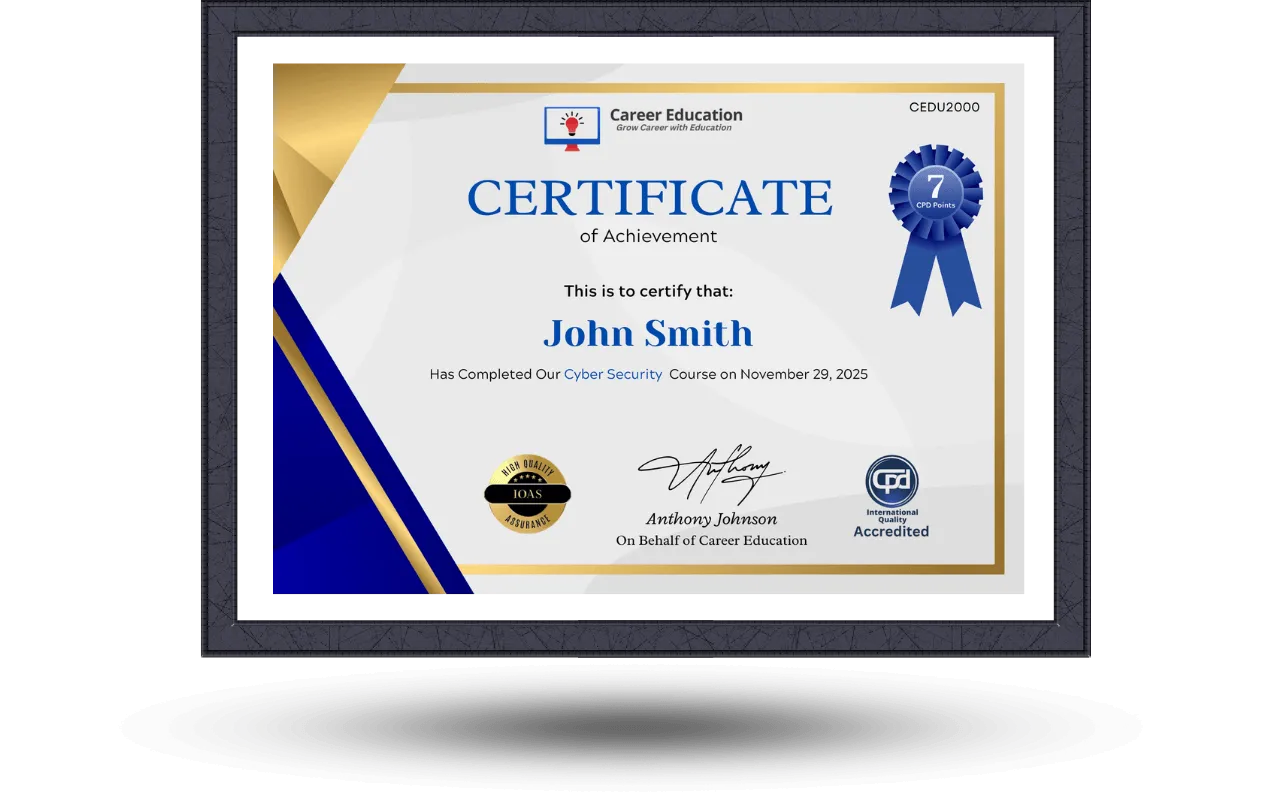
Earn an Accredited Certificate
Upon completion of any course, all students are entitled to a CPD IQ Accredited e-certificate that will be issued by Career Education signifying the completion of your course.
After you complete the course and assignment, you will be eligible to order a free certificate accredited by CPD International Quality by completing the form below.
Hardcopy certificates and transcripts are also available for a small additional fee. More information is disclosed upon course completion.
Similar Courses




Frequently Asked Questions
The lifetime membership includes unlimited access to all courses, resources, and updates for a one-time fee.
You can purchase the membership directly from our website using a secure checkout process.
Yes, selected courses can be downloaded for offline access through our mobile app.
Yes, all future updates and new courses are included at no extra cost.
Yes, we offer a 30-day money-back guarantee if you are not satisfied with the membership.