
94%
OFF
OFF
Business Marketing Training
- Lifetime Access
- All Levels
- PDF Certificate
£296
£19
14-Day Money-Back Guarantee
Learn With Confidence









Here is a comprehensive, SEO-focused sales page for **Business Marketing Training**, built around all eight modules and focused on practical, outcome-driven skills.
# Business Marketing Training
Build the knowledge and practical skills needed to understand customers, develop stronger marketing strategies and support business growth with **Business Marketing Training**.
Marketing is at the heart of almost every successful business. Whether a company sells physical products, digital services, professional expertise or consumer experiences, it needs to understand its market and communicate its value effectively.
Great products do not automatically guarantee commercial success. Businesses need to know who their customers are, what those customers want, how competitors are positioned and what makes their own offering different. They also need to make informed decisions about pricing, promotion, distribution, branding and sales.
Our **Business Marketing Training** course provides a structured introduction to these essential areas of modern marketing.
Across eight comprehensive modules, you will explore business marketing fundamentals, market research and analysis, product development and positioning, pricing strategies, promotion and advertising, distribution and logistics, branding and brand management, and sales and sales management.
The course is designed to help learners develop a broader understanding of how different marketing activities work together. Instead of looking at marketing as a single activity, you will explore it as a connected business process that begins with understanding the market and continues through to selling products and managing customer relationships.
Whether you are an entrepreneur, business owner, marketing professional, sales professional, manager or aspiring marketer, **Business Marketing Training** can help you develop a stronger foundation for making informed marketing decisions.
## Why Study Business Marketing Training?
Businesses operate in competitive environments.
Customers have more choices, competitors can enter markets quickly and digital channels have made it easier for businesses to reach audiences around the world.
This creates both opportunities and challenges.
Businesses need to understand their customers and communicate their value clearly. They also need to make decisions about which products to offer, how to price them, how to promote them and where customers can access them.
The **Business Marketing Training** course introduces the key principles behind these decisions.
You will explore how market research can inform strategy, how products can be positioned to appeal to specific audiences and how pricing can influence customer perceptions and commercial performance.
You will also examine promotion, advertising, distribution, branding and sales management.
Together, these areas provide a practical foundation for understanding the wider marketing function.
## Course Learning Outcomes
By completing **Business Marketing Training**, you will develop the knowledge to:
* Understand the fundamentals of business marketing.
* Recognise the role marketing plays in business development.
* Explore the importance of understanding customers and markets.
* Conduct more structured market research and analysis.
* Understand the principles of product development.
* Explore product positioning and differentiation.
* Understand different approaches to pricing.
* Explore promotional and advertising strategies.
* Understand the role of distribution and logistics.
* Develop awareness of branding principles.
* Understand the importance of brand management.
* Explore the relationship between marketing and sales.
* Understand fundamental sales management principles.
* Connect different marketing activities into a broader strategy.
* Make more informed marketing decisions.
* Develop a foundation for further study or professional development in marketing.
# Module 1: Introduction to Business Marketing
The first module introduces the fundamentals of business marketing.
You will explore what marketing means within a business environment and why it is important for organisations of different sizes and industries.
Marketing is often associated with advertising, but its role is much broader.
Effective marketing begins with understanding customer needs and continues through product development, pricing, promotion, distribution, branding and sales.
You will explore how these different functions contribute to the overall customer experience and commercial performance of a business.
The module also introduces the importance of having a clear marketing purpose.
Businesses need to understand what they are trying to achieve and who they are trying to reach.
A marketing strategy that lacks a clear audience or objective can result in wasted resources and inconsistent communication.
You will develop awareness of how marketing can support customer acquisition, customer retention, brand awareness and business growth.
By completing this module, you will have a stronger understanding of the role marketing plays within a modern business.
# Module 2: Market Research and Analysis
Good marketing decisions require good information.
Module 2 focuses on market research and analysis.
Before developing a product or launching a campaign, businesses need to understand their market.
Market research can help organisations identify customer needs, market trends, competitor activity and potential opportunities.
You will explore why businesses conduct market research and how research can support decision-making.
Understanding the target customer is particularly important.
Different groups may have different needs, budgets, expectations and buying behaviours.
You will explore how market analysis can help businesses identify relevant customer groups and understand their characteristics.
The module also considers competition.
Businesses rarely operate in isolation.
Understanding what competitors offer can help organisations identify opportunities for differentiation and areas where their own offering could be improved.
You will develop awareness of how research and analysis can reduce uncertainty and provide a stronger foundation for marketing decisions.
By completing this module, you will have a clearer understanding of how market research can influence business marketing strategy.
# Module 3: Product Development and Positioning
A successful marketing strategy needs an offering that provides value to its intended audience.
Module 3 explores product development and positioning.
Product development involves understanding customer needs and translating those needs into products or services that provide meaningful value.
You will explore why customer feedback, market research and competitive analysis can influence product decisions.
The module also introduces product positioning.
Positioning concerns how a product or service is perceived in the minds of its target customers.
A business may position its offering around factors such as quality, convenience, affordability, specialist expertise, innovation or customer experience.
The appropriate positioning depends on the market and audience.
You will explore why businesses need to communicate a clear reason for customers to choose their offering rather than an alternative.
Effective positioning can help differentiate a product and create a stronger connection with its intended audience.
By completing this module, you will understand the importance of developing and positioning products around customer needs and market opportunities.
# Module 4: Pricing Strategies
Pricing is one of the most important commercial decisions a business can make.
Module 4 focuses on pricing strategies.
Price influences customer perceptions, revenue potential and competitiveness.
A price that is too high may discourage potential customers, while a price that is too low may undermine profitability or create perceptions about quality.
You will explore the factors businesses need to consider when developing pricing strategies.
These may include costs, customer demand, competitors, perceived value, market positioning and business objectives.
You will also develop awareness of the relationship between pricing and positioning.
A premium brand may use a different pricing approach from a business competing primarily on affordability.
The right strategy depends on the target market and overall business model.
The module encourages a strategic approach to pricing rather than viewing price as simply a number attached to a product.
By completing this module, you will have a stronger understanding of the principles that influence business pricing decisions.
# Module 5: Promotion and Advertising
Even a strong product needs effective communication.
Module 5 explores promotion and advertising.
Promotion helps businesses communicate with potential and existing customers.
Advertising is one component of promotion, but businesses can use a wide range of channels and techniques to communicate their message.
You will explore how promotional activities can be aligned with marketing objectives and target audiences.
Different audiences may respond to different communication channels.
Businesses may use websites, social media, email marketing, advertising, content marketing, public relations, events or other promotional methods.
The key is selecting approaches that are appropriate for the audience, offer and business objectives.
You will also consider the importance of consistent messaging.
Promotional communications should clearly communicate what the business offers and why it matters to the intended audience.
By completing this module, you will develop greater awareness of how promotion and advertising contribute to business marketing.
# Module 6: Distribution and Logistics
Marketing does not end when a customer decides to buy.
The product or service also needs to reach the customer effectively.
Module 6 explores distribution and logistics.
Distribution concerns how products move from the business to the customer.
Depending on the business model, this may involve physical stores, distributors, wholesalers, online platforms, direct delivery or other channels.
You will explore why distribution decisions are important to customer convenience and business performance.
The right product at the right price may still struggle if customers cannot access it easily.
Logistics also influences the customer experience.
Availability, delivery times and fulfilment can affect customer satisfaction and perceptions of a brand.
The module helps you understand why distribution should be considered as part of the wider marketing strategy.
By completing this module, you will develop a broader understanding of how distribution and logistics support customer access and business operations.
# Module 7: Branding and Brand Management
A strong brand can help a business become recognisable and memorable.
Module 7 focuses on branding and brand management.
A brand is more than a logo.
It can include the identity, values, personality, reputation and overall experience associated with a business.
You will explore why consistent branding can help businesses differentiate themselves in competitive markets.
Brand management involves maintaining and developing how a business is perceived.
This can influence everything from visual identity and communication to customer service and product experience.
You will consider the importance of consistency.
When customers encounter a business across different channels, the overall experience should reinforce a coherent identity.
The module also explores why trust and reputation are important components of brand development.
A business can invest heavily in visual branding, but customer experiences ultimately influence how the brand is perceived.
By completing this module, you will develop greater awareness of how brands are created, communicated and managed.
# Module 8: Sales and Sales Management
The final module focuses on sales and sales management.
Marketing and sales are closely connected.
Marketing can generate awareness and interest, while sales activities can help convert opportunities into customers.
You will explore the role of sales within the wider marketing process.
Effective sales management involves more than simply asking customers to buy.
It can involve understanding customer needs, communicating value, responding to objections, managing relationships and supporting customer decisions.
You will also explore the importance of managing sales activities strategically.
Businesses need to consider sales objectives, performance, customer relationships and the effectiveness of their sales processes.
The module reinforces the relationship between marketing and sales.
A business can invest heavily in marketing, but it also needs effective processes for converting interest into commercial results.
By completing this module, you will have a stronger understanding of the relationship between marketing, selling and business growth.
# Develop Practical Business Marketing Skills
The **Business Marketing Training** course is designed to give you a broad understanding of the key activities involved in business marketing.
## Understand Your Market
Learn why customer and competitor research is essential for making informed marketing decisions.
## Develop Stronger Product Strategies
Explore product development and positioning to better align offerings with customer needs.
## Make Informed Pricing Decisions
Understand the factors that can influence pricing and how price can affect customer perceptions and business objectives.
## Improve Promotional Planning
Explore how businesses can use promotion and advertising to communicate with target audiences.
## Understand Distribution
Develop awareness of how distribution and logistics influence product availability and customer experience.
## Strengthen Brand Awareness
Explore the principles of branding and the importance of maintaining a consistent brand identity.
## Connect Marketing and Sales
Understand how marketing and sales can work together to attract, engage and convert customers.
# Who Is Business Marketing Training For?
**Business Marketing Training** can be suitable for:
* Business owners.
* Entrepreneurs.
* Startup founders.
* Marketing professionals.
* Marketing assistants.
* Sales professionals.
* Sales managers.
* Digital marketers.
* Brand managers.
* Product professionals.
* E-commerce professionals.
* Business development professionals.
* Freelancers.
* Consultants.
* Students.
* Professionals seeking to broaden their business knowledge.
The course can also be useful for beginners who want to develop an understanding of marketing before pursuing more specialised training.
# Useful for Business Owners and Entrepreneurs
Business owners often have to make marketing decisions themselves.
Understanding marketing principles can help entrepreneurs think more strategically about customers, products, pricing, promotion and competition.
Rather than relying entirely on intuition, you can develop a framework for evaluating marketing opportunities and making more informed decisions.
# Build a Foundation for a Marketing Career
If you are considering a career in marketing, **Business Marketing Training** can provide a broad introduction to important marketing functions.
Marketing careers can involve many different areas, including research, product marketing, advertising, branding, digital marketing, sales and business development.
Understanding how these areas connect can help you develop a more complete view of the marketing profession.
# Improve Customer Understanding
Customers are at the centre of marketing.
The course places significant emphasis on understanding markets and developing offerings that provide value.
This customer-focused perspective can help you think beyond simply promoting products and consider why customers choose particular brands, products or services.
# Make Better Marketing Decisions
Marketing decisions can involve significant time and resources.
Research, positioning, pricing, promotion and distribution all influence business performance.
Developing a structured understanding of these areas can help you evaluate decisions more effectively.
# Understand the Complete Marketing Process
One of the key benefits of the **Business Marketing Training** course is its broad coverage.
You will not study marketing in isolation.
Instead, you will explore how different functions connect:
**Market research → Product development → Positioning → Pricing → Promotion → Distribution → Branding → Sales**
Understanding these connections can help you develop a more strategic approach to marketing.
# Develop a Customer-Centred Brand
A strong brand is built through more than advertising.
It develops through the combination of product quality, pricing, communication, customer experience and reputation.
The course helps you understand branding as part of a wider business marketing strategy.
# Support Business Growth
Effective marketing can create opportunities for businesses to attract new customers, strengthen relationships with existing customers and differentiate themselves from competitors.
The **Business Marketing Training** course provides foundational knowledge that can support these objectives.
# Why Choose Business Marketing Training?
The **Business Marketing Training** course provides a structured eight-module learning journey covering:
1. Introduction to Business Marketing.
2. Market Research and Analysis.
3. Product Development and Positioning.
4. Pricing Strategies.
5. Promotion and Advertising.
6. Distribution and Logistics.
7. Branding and Brand Management.
8. Sales and Sales Management.
This comprehensive structure allows you to explore the major components of business marketing from initial market analysis through to customer acquisition and sales.
The course is designed to provide practical knowledge that can be applied to business planning, marketing activities and professional development.
# Take the Next Step in Your Marketing Development
Marketing is not simply about advertising a product.
It is about understanding customers, creating value, communicating effectively and making strategic decisions that support business objectives.
The **Business Marketing Training** course provides a structured introduction to these essential principles.
You will explore market research, product development, positioning, pricing, promotion, advertising, distribution, logistics, branding and sales management.
Whether you are building your own business, developing a marketing career or expanding your existing professional skill set, these principles can provide a valuable foundation.
**Enrol in Business Marketing Training today and develop the knowledge to understand markets, position products, make informed pricing decisions, promote your business, strengthen your brand and connect marketing activities with sales and business growth.**
Course Modules
Course Content
Module 1_ Introduction to Business Marketing
-
Lesson 1_ Introduction to Business Marketing
Module 2_ Market Research and Analysis
Module 3_ Product Development and Positioning
Module 4_ Pricing Strategies
Module 5_ Promotion and Advertising
Module 6_ Distribution and Logistics
Module 7_ Branding and Brand Management
Module 8_ Sales and Sales Management
What our students say
Excellent
4.9 average
158 Reviews

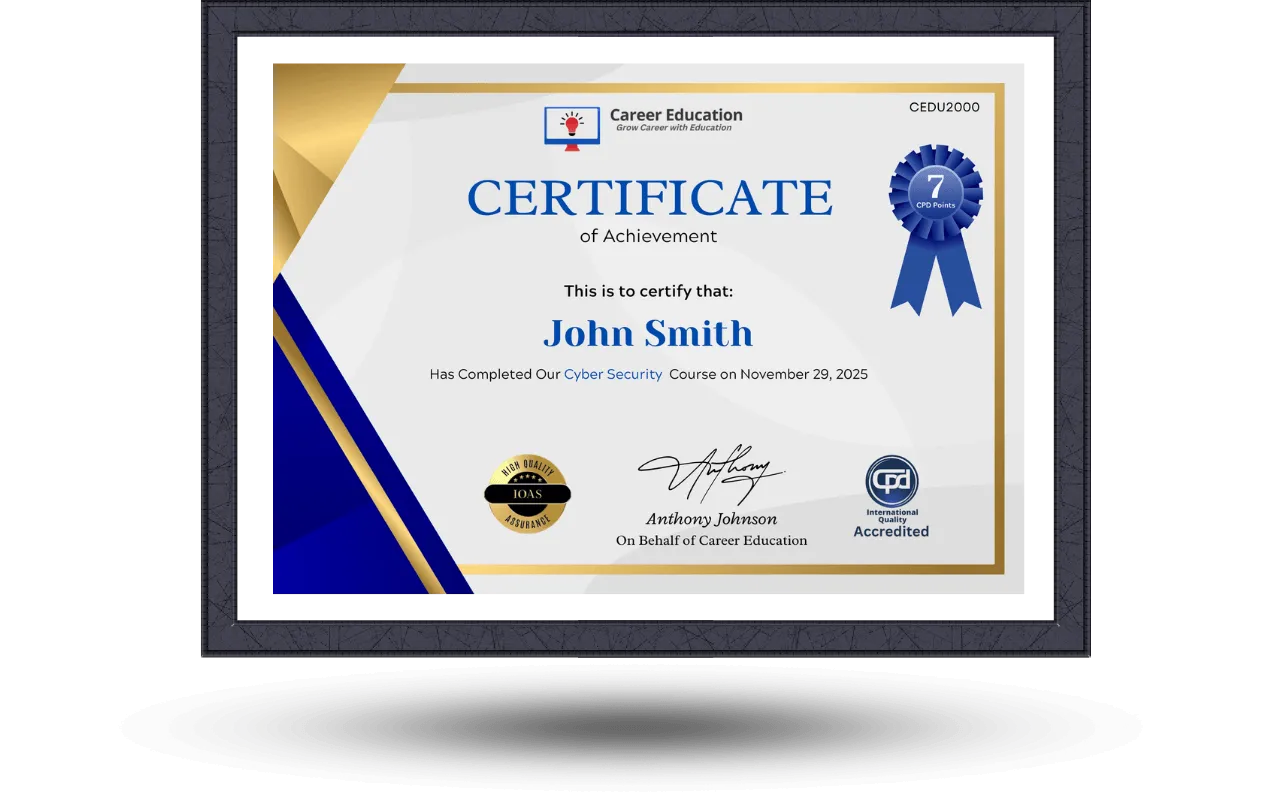
Earn an Accredited Certificate
Upon completion of any course, all students are entitled to a CPD IQ Accredited e-certificate that will be issued by Career Education signifying the completion of your course.
After you complete the course and assignment, you will be eligible to order a free certificate accredited by CPD International Quality by completing the form below.
Hardcopy certificates and transcripts are also available for a small additional fee. More information is disclosed upon course completion.
Similar Courses




Frequently Asked Questions
The lifetime membership includes unlimited access to all courses, resources, and updates for a one-time fee.
You can purchase the membership directly from our website using a secure checkout process.
Yes, selected courses can be downloaded for offline access through our mobile app.
Yes, all future updates and new courses are included at no extra cost.
Yes, we offer a 30-day money-back guarantee if you are not satisfied with the membership.