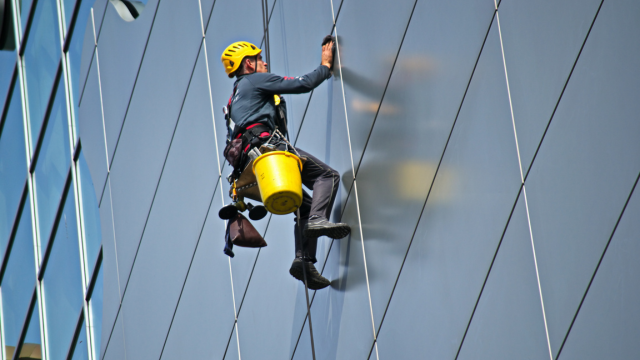

Falls from height remain one of the most serious workplace safety risks in the UK. They can happen during major construction projects, but they can also happen during apparently routine jobs such as changing a light, inspecting a roof, cleaning gutters or reaching stock from a ladder.
So, what is working at height?
In UK health and safety terms, it means working in any place where a person could fall a distance likely to cause personal injury if suitable precautions were not in place. That definition is wider than many people expect. It can include work on roofs, ladders, platforms and scaffolds, but also work close to fragile surfaces, open edges and holes in floors.
Effective safe working at height begins before someone climbs anything. The work should be planned, the risks assessed, safer alternatives considered and suitable equipment selected according to the hierarchy of controls.
This guide explains the main risks of working at height, UK legal responsibilities, equipment selection, ladder and scaffold safety, fragile roofs, the use of a safety harness, emergency planning and practical working at height safety procedures.
What Is Working at Height?
Work at height is work carried out in a place where someone could fall far enough to be injured if precautions were absent.
It is not determined solely by a specific number of metres.
Examples include someone working from a stepladder, a roofer near an unprotected edge, a worker on scaffolding or a maintenance employee above an open floor void.
A worker can also be working at height when the potential fall is below normal ground level. Someone beside an unprotected pit or opening, for example, could fall downward and suffer serious injury.
Similarly, falling through a fragile roof or rooflight counts even if the worker begins on what appears to be a normal working surface.
There is no simple “two-metre rule”
A common misunderstanding is that work only becomes legally significant once somebody is two metres or more above the ground. That is not the general test under the work at height risk management Regulations.
The relevant issue is whether a fall could cause personal injury. A relatively short fall onto machinery, concrete, sharp objects or another hazardous surface can be serious. Working at height risks therefore have to be assessed according to the actual circumstances rather than a single height measurement.
Why Is Working at Height So Dangerous?
Gravity is obvious, but the circumstances leading to falls are often less obvious. Workers may lose balance, overreach, step backwards, use unsuitable equipment or encounter an unexpected fragile surface. Equipment can move or collapse if it is badly selected or installed.
Weather can create another hazard. Rain can make surfaces slippery, while high winds can affect people, materials, ladders and mobile access equipment. Poor visibility can make rooflights or edges harder to identify.
Some incidents also happen because the task feels routine. An employee who has used the same ladder hundreds of times may begin to treat the activity as harmless. Familiarity can reduce attention to changing ground conditions, damage or incorrect positioning.
This is why workplace risk management and height safety need to consider ordinary maintenance as seriously as more obviously dangerous construction work.
The Main Risks of Working at Height
The central risk is falling, but several situations can lead to that outcome.
Unprotected edges
Roof edges, platforms, mezzanines and incomplete floors can expose workers to open drops. Collective protection such as correctly designed guardrails is usually preferable because it protects everyone working in the area without depending on each person attaching individual equipment correctly.
Fragile surfaces
Rooflights, fibre-cement sheets, corroded metal, glass and deteriorated materials may not support a person’s weight. Some rooflights can be difficult to see, particularly when dirty, painted over or weathered.
This creates one of the most dangerous situations in roof work: the worker may believe they are stepping onto a normal solid surface.
Ladders and stepladders
Ladders can slip, move or overturn. Falls can occur because the user overreaches, carries heavy equipment, stands too high or positions the ladder incorrectly.
The answer is not to ban ladders automatically. It is to use them only when the risk and task justify them as part of suitable ladder safety procedures.
Scaffolding
Scaffolds can provide excellent collective protection when properly designed, erected and maintained. They can also create serious hazards if incomplete, overloaded or modified improperly.
Missing guardrails, incomplete decking, unsafe access and weak foundations can all lead to falls.
Mobile elevating work platforms
MEWPs such as scissor lifts and boom-type platforms can provide a safer alternative to ladders for many tasks. They still require appropriate selection and competent use.
Ground conditions, overhead obstacles, traffic, stability, weather and entrapment risks all need consideration as part of effective MEWP safety.
Falling materials
work at height risk management can endanger people below as well as the person carrying out the task. Tools, materials and debris may fall.
Planning should therefore consider exclusion zones, toe boards, secure storage and appropriate tool-control measures where necessary. This is an important part of fall prevention and workplace safety.
UK Regulations for Working at Height
In Great Britain, the work at height risk management Regulations 2005 are the central regulations governing this activity.
They apply to employers and others who control work at height, including some contractors, building owners and facilities managers. The regulations require work to be properly planned and organised.
People involved in the planning, supervision and performance of the work must be competent, or appropriately supervised while being trained. Equipment needs to be suitable for the work, appropriately inspected and maintained.
The rules also require particular attention to fragile surfaces and other work at height hazards.
The three-stage hierarchy
The core legal approach can be understood through three questions.
First: can the work at height risk management be avoided?
Second: if it cannot be avoided, can the fall be prevented?
Third: where the risk cannot be fully prevented, can the distance and consequences of a fall be minimised?
This hierarchy should be followed in order. Jumping directly to a harness when the job could have been completed from ground level misses the fundamental approach required by the regulations.
Step 1: Avoid Working at Height Where Possible
The safest fall is the one that never becomes possible.
Before choosing a ladder, platform or harness, consider whether the task can be redesigned. For example, windows might be cleaned using extending equipment from ground level. Lighting equipment can sometimes be installed on lowering systems so that maintenance takes place without climbing.
Some inspection tasks can be completed through cameras, drones or remotely operated equipment where these are suitable for the environment and task. Components might also be assembled at ground level before being lifted into position.
This part of work at height risk management and fall prevention is frequently overlooked because people begin planning with the assumption that someone must go up. A good assessment tests that assumption first.
Step 2: Prevent Falls
If working at height is necessary, the next aim is to prevent anyone falling.
An existing workplace may already provide appropriate protection. For example, a permanent roof area with suitable guardrails may provide a safe working environment.
Where additional equipment is required, collective fall prevention should generally be considered before personal fall protection. Examples include:
- properly erected scaffolding with guardrails;
- tower scaffolds;
- protected working platforms;
- MEWPs;
- temporary edge protection.
These systems can protect more than one worker at a time. They also depend less on individual actions than a personal harness system.
Collective protection versus personal protection
This distinction is fundamental to working at height safety procedures and fall protection.
Collective protection works without each individual having to take a particular action for the protection to function. A guardrail is a good example.
Personal protection depends on the person using it properly. A worker may need to put on a harness correctly, choose the right connection point and remain attached throughout the relevant task. That introduces more opportunities for human error.
Step 3: Minimise the Consequences of a Fall
Sometimes it is not reasonably practicable to eliminate every possibility of falling. The next priority is to minimise the distance and consequences.
Collective measures can include safety nets and soft-landing systems positioned appropriately beneath the work. Individual measures can include fall-arrest systems.
The design matters. A worker using fall arrest still falls before the system stops them. There must therefore be sufficient clearance below to avoid striking the ground, equipment or another structure.
The anchorage, lanyard length and energy absorber all form part of the system. Simply wearing a harness achieves nothing if it is not connected to a suitable fall protection system.
How to Carry Out a Work at Height Risk Assessment
A suitable risk assessment should reflect the actual work. The assessor needs to consider the task, location, equipment, people and environment.
Important issues include the height of the potential fall, the condition of the surface, how long and how often the job is performed, and whether weather could affect safety.
The assessment should also consider access and exit. A worker may have a safe platform once in position but an unsafe route to reach it.
Tools and materials matter too. A ladder may appear suitable until the task requires somebody to carry heavy equipment and use both hands.
The assessment should therefore consider how the job will actually be carried out rather than just where the person will stand. This forms a key part of effective workplace hazard assessment.
Selecting the Right Work Equipment
There is no universal item of work-at-height equipment that suits every task. Equipment selection should reflect the risk assessment and hierarchy.
A properly guarded scaffold may be appropriate for longer-duration construction work. A MEWP may suit short maintenance work across several locations.
A tower scaffold may be effective for indoor installation where a larger fixed scaffold would be disproportionate. A ladder might be entirely reasonable for low-risk, short-duration work.
Choosing equipment simply because it is already in the van or store is not a sound approach. The question is which option provides suitable protection for the specific task and supports safe working at height.
Ladder and Stepladder Safety
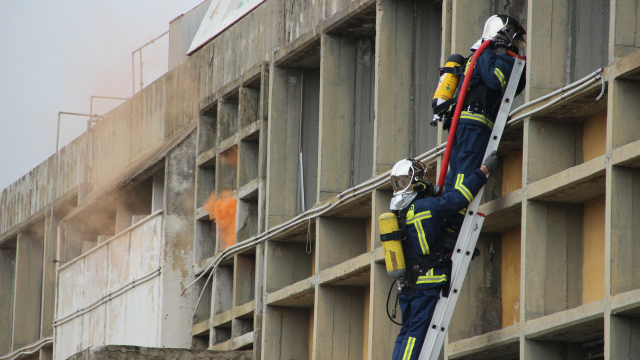
Ladders remain common in workplaces and can be used legally when appropriate. They are most suitable for relatively low-risk, short-duration tasks where more protective equipment is not justified or cannot reasonably be used.
As a practical guide, HSE recommends considering alternatives if somebody would remain on a ladder for more than about 30 minutes at a time.
Before using a ladder
The user should check that the ladder is suitable and in good condition. Feet should not be missing or badly worn. Rungs, stiles and locking mechanisms should be inspected for visible problems.
A damaged ladder should be removed from use rather than repaired casually. The ground needs to be stable and level.
Leaning ladders should normally be secured against slipping. Where reasonably practicable, this means tying them to a suitable point or using another effective stability method.
Position matters
For leaning ladders, HSE recommends the one-in-four rule as a guide to achieving approximately a 75-degree angle.
The ladder should also be long enough for the task. Workers should not compensate for inadequate length by standing on the highest unsafe rungs or placing the ladder on boxes, pallets or other makeshift supports.
Avoid overreaching
The worker’s body should remain between the ladder stiles. If the task lies beyond safe reach, descend and reposition the ladder.
This may feel inefficient, but it is considerably safer than leaning sideways until the ladder becomes unstable. Good ladder use and access safety can significantly reduce fall risks.
Working Safely on Roofs
Roof work needs careful planning even when the task will take only a few minutes. safe working at height access is required, together with a safe area in which to work.
For many roof jobs, suitable edge protection is necessary. Workers also need protection against falling through the roof itself.
Treat roofs as fragile until confirmed otherwise
HSE advises that roofs should be treated as fragile until a competent person confirms they are not. This approach prevents dangerous assumptions.
A sheet may appear strong while having been weakened by age, corrosion or environmental exposure.
Rooflights deserve particular attention. Their appearance can blend into surrounding materials, especially when dirty or weathered.
Where access near fragile surfaces is unavoidable, controls may include platforms, guardrails, fall restraint, fall arrest and safety nets depending on the circumstances. These are important elements of roof safety and fall prevention.
Using a Safety Harness Correctly
A safety harness and fall protection equipment can be an important component of personal fall protection, but it is not automatically the safest first option.
The system needs to be selected and designed for the intended purpose. There is also an important distinction between restraint and arrest.
Fall restraint
A restraint system prevents the worker reaching a position from which they can fall.
For example, the lanyard may be short enough that the person physically cannot reach the roof edge. Because no fall occurs, restraint is generally preferable to fall arrest where it can be used effectively.
Fall arrest
A fall-arrest system is designed to stop a worker after a fall has begun. It can involve a full-body harness, suitable anchorage, connecting equipment and an energy-absorbing component.
Clearance beneath the worker must be adequate. If the fall-arrest system stops the person only after they have already struck the surface below, it has not provided effective protection.
Harnesses need inspection and training
Users should be trained in fitting and connecting the equipment. Harnesses, lanyards and associated components need appropriate inspection and maintenance.
Cuts, damaged stitching, chemical contamination and wear can affect performance. Workers also need to know which anchor points are suitable.
Attaching a good harness to an unsuitable structure does not create a safe fall-protection system.
Competence and Training
The work at height risk management Regulations require people involved in the activity to be competent or, where they are being trained, supervised by somebody competent.
Competence involves the necessary skills, knowledge and experience for the particular task.
There is no rule that everyone using a normal workplace ladder must possess the same formal certificate. However, they need enough competence to recognise when the ladder is suitable, inspect it appropriately and use it safely.
More complex activities require greater competence. Erecting scaffolding, operating certain access equipment or designing fall-protection systems requires specialist knowledge beyond ordinary ladder awareness.
Training should therefore reflect the actual responsibility and level of workplace safety competence required.
Inspection and Maintenance
Work-at-height equipment needs to remain safe working at height throughout its use. Inspection requirements vary according to the equipment and circumstances.
A ladder user should undertake appropriate pre-use checks, while scaffolding and fall-protection equipment can require more formal inspection arrangements.
Equipment should also be stored properly. Leaving harnesses exposed to contaminants, allowing ladders to become damaged in transport or failing to address scaffold defects undermines the control measures established by the risk assessment.
Inspection records may also be legally required in certain situations. A competent person should understand which inspection regime applies to the equipment being used.
Weather and Environmental Conditions
Weather can transform an acceptable job into an unsafe one.
High winds can affect roof workers, ladders, scaffolds and MEWPs. Rain can create slippery surfaces. Ice, snow and extreme heat may also affect equipment and people.
Under the Work at Height Regulations, work should not continue where weather conditions jeopardise health or safety, except for specified emergency-service situations.
This is an important reminder that risk assessments are not fixed documents. Conditions need to be monitored throughout the task as part of ongoing workplace risk assessment and safety management.
Preventing Falling Objects
Safe working at height and falling-object prevention include protecting people below.
Tools and materials can cause severe injuries when dropped. Work areas may need barriers or exclusion zones to keep other people away.
Scaffolds may require toe boards or other containment arrangements. Tools can sometimes be secured where appropriate, particularly during specialist access work.
Materials should not be stored close to unprotected edges where they can be kicked or blown off. Where objects could still fall, head protection may form one part of the wider safety arrangements.
Again, PPE does not replace prevention. Effective work at height safety measures should prioritise eliminating or controlling hazards before relying on personal protective equipment.
Emergency and Rescue Planning
Planning work at height risk management includes planning for emergencies and rescue.
This becomes especially important where personal fall-arrest systems are used.
A worker left suspended in a harness after a fall needs to be recovered promptly.
The plan should therefore answer practical questions before work starts.
Who will carry out the rescue? What equipment is required? Can the injured person be reached safely? Will the rescuers themselves be exposed to another fall?
HSE makes clear that the emergency plan should not simply say “call the fire brigade”.
External emergency services may be required, but relying on them as the only rescue arrangement can introduce critical delay.
The complexity of the rescue plan should match the work.
A straightforward guarded platform may involve relatively simple evacuation arrangements. Rope access or remote roof work can require specialist rescue capability.
Construction and Work at Height
Construction involves particularly significant fall risks.
The work at height risk management Regulations operate alongside the Construction (Design and Management) Regulations 2015 in Great Britain.
Clients, designers, principal contractors and contractors can all influence whether work at height risk management is created and how it is controlled.
Design decisions are particularly important.
If permanent safe working at height access and edge protection are incorporated into a building, future maintenance may become much safer.
If essential plant is installed in an inaccessible roof area without proper access, foreseeable maintenance work becomes more difficult to manage.
Good workplace risk management therefore begins at design stage rather than only when workers arrive with ladders.
Common Work at Height Mistakes
Many serious incidents arise from familiar failures rather than unusual technical problems.
One is selecting a ladder automatically without assessing whether a scaffold, tower or MEWP would provide safer access.
Another is performing a “quick job” without protection because the worker expects to be on the roof for only a few minutes.
Short duration does not remove risk.
Other common errors include failing to identify fragile rooflights, allowing workers to overreach from ladders, leaving open edges unprotected and using fall-arrest harnesses without suitable anchorages or rescue plans.
Poor supervision can also allow unsafe practices to become normal over time.
The fact that a shortcut has not yet caused an injury is not proof that it is safe working at height
A Practical Safe Working at Height Procedure
Although every task requires a specific assessment, an effective sequence normally follows the hierarchy of controls.
Begin by defining the task and identifying every point where a person or object could fall.
Consider whether the work can be completed from ground level.
If height cannot be avoided, assess whether an existing safe working at height workplace can be used. Where it cannot, choose equipment that prevents falls, giving priority to collective measures.
Only after preventative measures have been considered should fall-arrest or other mitigation systems be selected.
Confirm that workers are competent, access is safe working at height and equipment has been inspected.
Review fragile surfaces, openings, weather, power lines, traffic and falling-object risks where relevant.
Establish the rescue arrangements before beginning.
During the job, supervise according to the level of risk and stop work if conditions change.
These working at height safety procedures are more useful than relying on one generic checklist because they follow the logic of eliminating and controlling the risk.
How Employers Can Improve Work at Height Safety

A strong safety system does not depend entirely on workers remembering rules.
Employers should make the safer method practical.
If a worker is regularly expected to perform a task at height but appropriate access equipment is difficult to obtain, shortcuts become predictable.
Equipment availability, scheduling and supervision are therefore part of prevention.
Near misses should also be taken seriously.
If a worker almost falls through a rooflight but catches themselves, the absence of injury should not end the investigation.
The organisation has been given evidence that its controls may be inadequate.
Contractors require coordination as well.
A competent contractor may understand work-at-height techniques but still need information about the client’s roof structure, fragile areas, overhead services or access restrictions.
Good communication between both parties is essential.
Why Safe Working at Height Matters
The consequences of falls are often severe.
Recent HSE prosecutions continue to involve workers suffering brain injuries, fractures and other life-changing harm after falling through roofs and openings.
The organisational consequences can also include lost working time, investigations, enforcement action, prosecution, compensation costs and disruption to projects.
More importantly, many incidents involve risks that were entirely foreseeable.
A fragile rooflight, an open edge or an unsecured ladder is not a new or mysterious hazard.
Effective workplace risk management is about acting on known risks before the incident occurs.
Key Takeaways
What is working at height? It is work in a place where a person could fall a distance liable to cause personal injury if suitable precautions were absent.
There is no general two-metre exemption.
UK work-at-height law places strong emphasis on a hierarchy: avoid the work where reasonably practicable, prevent falls when work at height risk management is necessary, and minimise the distance and consequences of a fall where residual risk remains.
Collective protection such as guardrails, scaffolds and suitable platforms generally takes priority over individual measures.
Ladders remain legal and useful for appropriate low-risk, short-duration work, while roof work and fragile surfaces need particularly careful planning.
A safety harness can be an important component of personal fall protection, but it must form part of a properly designed system and, where fall arrest is used, an effective rescue plan.
FAQ
What is working at height?
What is working at height under UK health and safe working at height law? It is work in any place where a person could fall a distance liable to cause personal injury if precautions were not present.
Examples include ladders, roofs, scaffolds, platforms and work near fragile surfaces or unprotected openings.
Is there a minimum height for the Work at Height Regulations?
There is no general minimum two-metre rule.
The relevant test is whether a person could fall a distance liable to cause injury.
A relatively short fall can be serious depending on the surface and surrounding hazards.
What are the main risks of working at height?
The risks of working at height include falls from edges, ladders, scaffolds and access equipment, as well as falls through fragile roofs or floor openings.
Workers can also be injured by unstable equipment, weather, nearby electricity or falling objects.
People below the work area may therefore also be at risk.
What is the safest way to work at height?
The safe working at height approach is to avoid working at height where reasonably practicable.
Where this cannot be done, use measures that prevent falls, preferably collective controls such as guardrails, scaffolding or suitable access platforms.
Where a residual fall risk remains, use appropriate systems to minimise its distance and consequences.
When can ladders be used at work?
Ladders can be appropriate where a risk assessment finds the work is low risk and short in duration, or where workplace features make more protective equipment impracticable.
HSE suggests considering alternative equipment where the user would remain on a ladder for more than around 30 minutes at a time.
The ladder must also be suitable, stable and used by a competent person.
Is a safety harness always required when working at height?
No.
A safety harness is one form of personal protection and should not automatically be selected before safer collective measures.
Where a harness system is required, the equipment, anchorage, connection method, clearance and rescue arrangements all need to be appropriate.
What is the difference between fall restraint and fall arrest?
Fall restraint prevents a worker reaching a position from which they can fall.
Fall arrest allows a fall to begin but stops the worker before they strike a lower level.
Because restraint prevents the fall entirely, it will generally be preferable where it can effectively control the risk.
Do employees need training to work at height?
People carrying out work at height risk management need competence appropriate to the task or supervision while they develop that competence.
The level of training depends on the work.
Using a low-level stepladder has different requirements from erecting scaffolding, operating specialist access equipment or using complex rope-access systems.
What should a work at height risk assessment include?
Work at height risk management should consider the task, potential fall distance, duration and frequency, surface condition, access, weather, equipment, people involved, falling objects and emergency arrangements.
The assessment should also consider whether the job can be completed without working at height.
Who is responsible for work at height safety?
Employers and other people who control work at height risk management have legal duties to plan and manage it appropriately.
Employees also need to follow training, instructions and safety procedures.
In construction and contractor arrangements, several parties may have responsibilities depending on the work and their level of control.

Conclusion
Understanding what is working at height is the first step towards managing one of the UK’s most serious workplace hazards.
The definition reaches further than roofs and scaffolds. A fall through a fragile surface, from a ladder or into an unprotected opening can all bring work within the relevant safety framework.
Effective work at height risk management should follow the legal hierarchy rather than starting with equipment. Where reasonably practicable, avoid the height altogether. If that cannot be done, prevent falls through safe working areas and suitable collective protection. Only where risk remains should systems be used to minimise the distance and consequences of a fall.
Good working at height safety procedures also require competent people, suitable equipment, inspections, safe working at height access, consideration of weather and protection from falling objects.
Where personal fall protection is necessary, a safety harness must form part of a correctly designed system. Wearing one without suitable anchorage, sufficient fall clearance or a workable rescue plan can create a false sense of security.
Fragile roofs, ladders, open edges and poorly planned maintenance continue to cause serious injuries precisely because these hazards can appear familiar. Safe working at height depends on treating them as foreseeable risks and controlling them before the task begins.
The strongest approach is therefore simple in principle: remove unnecessary work at height, select the safest practical method for what remains, protect everyone exposed to the risk and make sure the plan still works if something goes wrong.