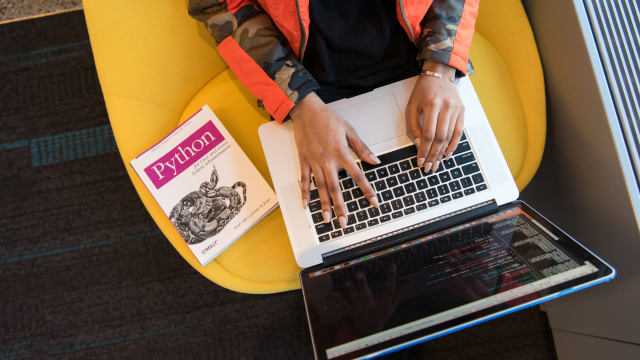

Python Programming for Beginners is an accessible starting point for anyone who wants to learn coding, automate repetitive tasks, analyse data or eventually move into software and technology roles. Python is widely used because its syntax is relatively readable, while the language is capable enough for everything from simple scripts to web applications, data science and artificial intelligence.
You do not need to understand advanced mathematics or computer science before writing your first Python program. The most effective approach is to learn the basic concepts in the right order, practise them regularly and gradually build projects that require you to solve real problems.
This guide explains what Python is, the programming fundamentals beginners should learn, how to practise effectively and what Python programming careers may be available in the UK.
What Is Python Programming?
The Python programming language is a general-purpose programming language used to give computers instructions and build software, applications and digital solutions.
Python programming course UK can be used for tasks such as:
- creating software and web applications;
- automating repetitive or routine processes;
- analysing and visualising data;
- working with databases;
- developing artificial intelligence and machine-learning applications; and
- writing small scripts that simplify everyday computer tasks.
Python’s relatively clear, readable and straightforward syntax is one reason it is frequently chosen as a first programming language. Beginners can start with simple commands and gradually progress towards functions, objects, external packages and complete applications.
As of August 2026, Python 3.14 is the current stable release series. Beginners should learn modern Python 3 rather than using outdated Python 2 tutorials.
Why Is Python a Good Language for Beginners?
Learning your first programming language involves understanding two things simultaneously: the syntax of the language and the logic, reasoning and problem-solving principles behind programming.
Python programming course UK reduces some of the syntax burden and makes code comparatively easy to read.
For example, displaying text can be as simple as:
print(“Hello, world!”)
A beginner can quickly see what the instruction does without dealing with a large amount of surrounding code.
That does not mean Python programming course UK itself is effortless. As projects become more complicated, you still need to understand algorithms, data structures, debugging, software design and other technical concepts.
Its advantage is that beginners can start practising useful programming ideas relatively quickly and develop their coding skills step by step.
Python Programming Fundamentals You Should Learn First

A common mistake is trying to learn advanced libraries, frameworks or tools before understanding basic Python programming course UK.
Build the foundation, base knowledge and core skills first.
Variables and Data Types
Variables allow a program to store information or values.
For example:
name = “Alex”
age = 25
Here, name stores text while age stores an integer.
Early Python programming course UK study should cover common types such as:
- strings;
- integers;
- floating-point numbers;
- Boolean values;
- lists;
- tuples;
- dictionaries; and
- sets.
Understanding data types, values and variables becomes important when programs begin receiving, processing and transforming information.
Operators and Expressions
Operators allow programs to perform calculations, comparisons and logical operations.
Beginners should become comfortable with arithmetic operators such as +, -, * and /, as well as comparison operators including ==, < and >.
Logical operators such as and, or and not become important when programmes need to make decisions or evaluate conditions.
Conditional Statements
Programs often need to behave differently depending on what happens or which condition is met.
Python programming course UK uses statements such as if, elif and else.
age = 20
if age >= 18:
print(“Adult”)
else:
print(“Under 18”)
Learning conditional logic, decision-making and branching is one of the most important steps in moving from isolated commands to useful programs.
Loops
Loops allow instructions to be repeated or executed multiple times.
A for loop might process every item in a list, while a while loop continues until a specified condition changes.
Understanding loops enables you to automate repetitive work rather than writing the same instructions repeatedly.
Functions
Functions organise reusable and repeatable pieces of code.
def greet(name):
return f”Hello, {name}”
Functions become increasingly important as projects grow because they prevent unnecessary repetition and make software easier to understand, organise and maintain.
Errors and Exceptions
Your programs will fail while you learn. That is normal programming practice rather than evidence that you are bad at coding.
Python programming course UK provides error messages, exceptions and tracebacks that help identify problems.
Beginners should learn how to read tracebacks rather than immediately copying an error into a search engine or AI tool. Understanding where and why a program failed is a fundamental developer and debugging skill.
How to Start Learning Python
The best way to learn Python is usually a mixture of structured learning, regular practice and active experimentation.
Watching tutorials without writing code can create the impression that you understand a subject more deeply than you actually do.
A better learning cycle is:
| Stage | What to do |
| Learn | Study one new Python concept |
| Copy | Reproduce a simple example yourself |
| Modify | Change the example and predict what will happen |
| Build | Use the concept in a small project |
| Debug | Work through errors rather than avoiding them |
| Review | Return to difficult topics and practise again |
This cycle gradually develops independent problem-solving, coding and debugging ability.
Step 1: Install Python and Choose an Editor
You can download current Python versions from the official Python website. Beginners should generally work with a supported Python 3 release rather than an old version found in an outdated tutorial.
Python also includes IDLE, a basic editor and interactive development environment.
As your skills develop, you may choose another code editor or integrated development environment. The particular editor matters less than becoming comfortable writing, running and debugging code.
Do not spend your first week comparing development environments instead of learning Python programming course UK.
Step 2: Follow a Structured Beginner Course
A structured course can prevent beginners from jumping randomly between disconnected tutorials, lessons and resources.
When comparing a Python programming course UK learners can access, look at:
- whether it assumes previous coding experience;
- the topics actually covered;
- opportunities for coding practice;
- assessment methods;
- tutor support;
- course-access periods;
- certificate status; and
- whether projects are included.
For an introductory option, Career Education offers a Basic Python Programming course that can be used as part of a structured learning pathway.
A course can provide direction, guidance and a learning framework, but completing one should not be confused with becoming occupationally competent as a programmer. Real progress comes from continuing to code, practise and solve problems after the course ends.
Step 3: Practise Python Regularly
Programming is a practical and skill-based discipline.
Studying for several hours once a month is usually less useful than practising consistently and regularly.
During your first few weeks, small exercises are enough. You might write programs that:
- convert temperatures;
- calculate a shopping total;
- generate a simple password;
- count words in a sentence;
- organise names in a list; or
- calculate basic expenses.
These projects may seem simple, but each forces you to recall syntax, apply programming logic and solve problems without simply copying an instructor. Regular practice gradually builds confidence, familiarity and independent coding ability.
Step 4: Build Small Python Projects
Once the fundamentals become familiar, start building complete projects.
Good beginner ideas include a calculator, quiz application, task tracker, expense tracker, number-guessing game or simple file organiser.
Then gradually tackle projects aligned with your interests.
Someone interested in data might analyse a public dataset. A learner interested in automation could organise files or process spreadsheets. Someone aiming for development work might create a small web application.
Projects transform abstract knowledge into usable skills.
Step 5: Learn Git and Version Control
Beginners sometimes focus exclusively on the programming language, but professional software development involves additional tools.
Git is particularly valuable because it records changes made to code and supports collaborative development.
Once you can build simple Python programming course UK, learn basic Git concepts such as:
- repositories;
- commits;
- branches;
- merging; and
- remote repositories.
You do not need to master advanced Git immediately. Being comfortable with the basics is enough to begin managing your projects more professionally.
Step 6: Choose a Python Specialism
After learning the fundamentals, the Python programming course UK ecosystem becomes much larger.
Your next subjects should depend on what you want to build.
Python for Software Development
If your goal is to become a Python developer, continue developing your knowledge of functions, modules, object-oriented programming, testing, APIs, databases and software architecture.
You may later explore frameworks used to build web applications and backend services.
Python for Data Analysis
Python programming course UK can be used to clean, transform and analyse data.
Popular tools include libraries designed for numerical work, tabular data and visualisation.
You will also benefit from understanding statistics, spreadsheets, SQL and how to communicate findings.
Python for Data Science and Machine Learning

Machine learning builds on programming rather than replacing programming fundamentals.
Before jumping into sophisticated AI libraries, develop confidence with Python itself, data manipulation and basic statistics.
The National Careers Service describes data scientists as professionals who use software, artificial intelligence and machine learning to analyse large amounts of data.
Python for Automation
Automation is one of the most practical reasons to learn Python programming course UK.
Python scripts can potentially automate file processing, data cleaning, repetitive administrative tasks, testing and interactions between software systems.
This can be useful even if you never become a full-time programmer.
What Jobs Use Python in UK Workplaces?
People searching What jobs use Python in UK organisations will find that Python programming course UK skills can appear across several career areas.
Software Developer
Software developers create, test and maintain programs and digital services.
The National Careers Service currently gives the broader software-developer profession an indicative salary range of approximately £30,000 to £75,000, depending on experience.
Not every UK software-development position uses Python programming course UK. Employers may instead require JavaScript, Java, C#, C++, Go or other technologies.
Python becomes most valuable when it matches the employer’s technology stack.
Python Programming for Beginners Developer
A dedicated Python developer commonly works on software where Python programming course UK is one of the principal technologies.
Depending on the organisation, the work may involve backend development, APIs, automation, databases, cloud systems or internal applications.
Job titles vary considerably, so searches should not be limited to “Python Developer”.
Data Analyst
Python programming course UK can be useful in data-analysis roles, alongside tools such as spreadsheets, SQL and business-intelligence platforms.
National Careers Service salary guidance for market-research data analysts currently runs from around £24,000 for starters to £50,000 for experienced professionals.
Python programming course UK alone is unlikely to be enough for many data jobs. Employers may also expect statistical understanding, SQL and the ability to explain findings.
Data Scientist
Data scientists use software, statistics and machine learning to extract useful information, insights and patterns from data.
The National Careers Service currently gives an indicative range of about £32,000 to £83,000 for this occupational profile.
A beginner Python course does not by itself prepare somebody for data science. Mathematics, statistics, data engineering and machine-learning knowledge may also be required.
Automation and Testing Roles
Python can be used to automate software testing, infrastructure tasks, data processing and repetitive technical operations.
Depending on the employer, it may therefore appear in quality engineering, DevOps, cloud, cybersecurity and technical operations roles.
Research and Scientific Computing
Universities, research organisations and technical teams can use Python programming course UK for scientific analysis, modelling, computation and processing research data.
The required subject knowledge will depend heavily on the field. A physics researcher using Python, for example, needs substantially different expertise from a web developer using the same language.
Do You Need a Degree to Become a Python Developer?
Not every development job requires a university degree.
The National Careers Service identifies several possible routes into software development, including university, college, apprenticeships and graduate training schemes.
Employers differ in their expectations. Some may place substantial weight on computer-science education, while others may focus more heavily on technical assessments, portfolios and professional experience.
For self-taught learners, a strong project portfolio can help demonstrate what they can actually build and develop. However, completing tutorials is not the same as commercial experience. Be realistic about the gap between learning beginner Python and performing effectively in a professional development team.
How Long Does It Take to Learn Python?
There is no universal or fixed answer.
You can learn basic syntax relatively quickly, but becoming genuinely capable and confident takes longer.
A learner studying consistently might become comfortable with variables, loops, functions and basic projects within weeks or a few months. Developing the skills needed for professional software, data or automation work may require many months or longer.
Your timeline depends on:
- previous technical experience;
- study frequency;
- project complexity;
- your chosen career path; and
- how much independent problem-solving you practise.
Avoid courses or advertisements that promise guaranteed job readiness after an unrealistically short period.
Common Mistakes Python Beginners Make
One common mistake is trying to memorise everything. Professional programmers regularly consult documentation and reference materials. Focus instead on understanding concepts and knowing how to find reliable information.
Another mistake is jumping into advanced machine learning before understanding functions, collections, modules and debugging.
Tutorial dependence can also become a problem. If every project follows an instructor line by line, you may become good at recognising Python without becoming good at writing it independently.
Finally, do not outsource every difficult problem to an AI assistant. AI tools can help explain errors, clarify concepts or suggest approaches, but beginners still need to understand and verify the code they use.
How to Build a Python Portfolio
A portfolio can demonstrate practical development skills more effectively than a list of courses alone.
Begin with two or three well-finished projects rather than dozens of incomplete repositories.
For each project, make it clear:
- what problem the program solves;
- how to install or run it;
- which technologies you used;
- what you personally implemented; and
- what you would improve next.
As your skills develop, create projects related to the roles you want. A future data analyst might publish a data-cleaning and analysis project. An aspiring backend developer might create an API-backed application. Someone interested in automation might demonstrate a practical workflow script.
Frequently Asked Questions About Python Programming
Is Python difficult for beginners?
Python is generally considered approachable because its syntax is relatively readable and straightforward, but programming still requires logical thinking and regular practice. Beginners should expect errors and confusion while learning. The goal is not to avoid problems but to become progressively better at breaking them down and solving them.
Do I need maths to learn Python?
You do not need advanced mathematics to begin Python programming. Basic arithmetic is sufficient for many beginner exercises and software projects. More advanced mathematics or statistics becomes important for particular areas such as data science, scientific computing, quantitative finance and some forms of machine learning.
What is the best way to learn Python?
The best way to learn Python is to combine structured instruction with regular hands-on practice. Learn one concept, reproduce examples, modify them, build something small and debug the problems you encounter. Progressively working on independent projects is generally more valuable than continuously watching tutorials without writing your own code.
Can I learn Python online?
Yes. Python is particularly suitable for online study because the official documentation, tutorials, coding environments and courses are easily accessible. A structured online course can provide direction and guidance, but you should spend substantial time actually writing and running code rather than only consuming video or written lessons.
How long does it take to learn Python programming?
Basic syntax may take several weeks of regular practice, while professional competence typically takes considerably longer. There is no fixed number of hours that makes somebody a developer. Your background, learning intensity, projects and chosen specialism all influence the timeframe.
Can Python help me get a job in the UK?
Python can contribute to employability in software, data, automation and other technical roles, but knowing Python alone does not guarantee employment. Employers may also expect problem-solving skills, Git, databases, testing, frameworks, mathematical knowledge or previous experience depending on the vacancy.
Is a Python course certificate enough to become a developer?
No. A course certificate can document learning or assessed completion, but it does not automatically demonstrate professional software-development competence. Employers are likely to care about the underlying skills, projects, technical interviews and experience as well as education or certificates.
What should I learn after basic Python?
Your next step depends on your goal. Development learners might study object-oriented programming, testing, APIs and databases. Data-focused learners might move towards SQL, statistics and data libraries. Whatever pathway you choose, continue practising core Python rather than immediately abandoning the fundamentals.
Is Python still worth learning in 2026?
Yes. Python remains actively developed, with Python 3.14 as the current stable release series in August 2026. It continues to support software development, data analysis, automation, scientific computing and AI-related work. However, career value depends on combining the language with skills relevant to a particular role.

Conclusion
Python Programming for Beginners works best when treated as the start of a practical learning journey rather than a shortcut to a technology career.
Begin with the core programming fundamentals: variables, data types, conditions, loops, functions and error handling. Practise them repeatedly, build small projects and gradually learn professional tools such as Git, testing and databases.
The Python programming language can support several different pathways, from automation and data analysis to becoming a Python developer. There are also diverse Python programming careers in which Python may form part of a wider technical skill set.
A structured course can make the first stage easier, but the strongest evidence of learning is what you can understand, debug and build independently. If you consistently combine study with practical coding, Python can provide a strong foundation for progressing into more specialised areas of computing and technology.