

Professional housekeeping is much more than cleaning a room quickly. It requires organisation, hygiene awareness, attention to detail, safe use of products and equipment, time management and the ability to maintain the same standard repeatedly even when the workload is demanding.
For anyone starting with Housekeeping Skills for Beginners, the most useful approach is to understand both the practical and professional sides of the job.
A housekeeper may need to prepare bedrooms, handle linen, clean bathrooms, restock supplies, report maintenance problems and respond appropriately to guest requests. In hotels, the work also connects directly with reception, maintenance, laundry and wider guest-service teams.
Beginners often ask what are housekeeping skills and whether they can be learned without previous hotel experience. The answer is yes. Many core abilities can be developed through structured training and workplace practice. However, professional competence comes from applying those skills consistently and safely rather than simply knowing a list of cleaning tasks.
This guide explains basic housekeeping skills, duties, safety, hotel standards, CV examples, training routes and the housekeeping career path available in the UK.
What Are Housekeeping Skills?
What are housekeeping skills? They are the practical, organisational and interpersonal abilities needed to maintain clean, safe, orderly and welcoming environments. In other words, housekeeping duties and responsibilities involve the knowledge, competence and everyday techniques required to keep a space hygienic, presentable and well maintained.
Cleaning is one part of housekeeping, but the role is broader. A professional housekeeper needs to understand how to organise tasks, select suitable products, manage time, recognise hazards, protect guest belongings and identify defects that need attention from another department.
In hospitality, presentation matters as well. A room can technically be clean while still looking poorly prepared because pillows are inconsistent, supplies are missing or furniture has been left out of place. Professional housekeeping therefore involves both hygiene and standards, cleanliness and presentation.
Basic Housekeeping Skills Every Beginner Should Learn
The best basic what are housekeeping skills create a strong foundation before more specialised techniques are added. These fundamental abilities help beginners develop confidence, consistency and good working habits.
Cleaning systematically
Professional housekeeping duties and responsibilities normally work according to a method rather than moving randomly between tasks. A clear sequence helps reduce missed areas and unnecessary repetition.
For example, work may progress from higher surfaces towards floors or from cleaner areas towards more contaminated areas, depending on organisational procedures. The exact system varies between workplaces.
What matters is consistency. A systematic method also makes quality checking easier because the worker knows what should have been completed at each stage.
Making beds properly
In hotel housekeeping duties and responsibilities, bed presentation has a significant effect on the appearance of a room. Housekeepers may need to strip used linen, inspect mattresses and bedding, fit clean sheets and prepare duvets, pillows or other items according to hotel standards.
This sounds simple until it needs to be repeated efficiently across many rooms. Speed should develop through good technique rather than skipping checks.
Bathroom cleaning
Bathrooms require particular hygiene attention. Housekeepers need to clean and disinfect appropriate surfaces according to workplace procedures, remove waste, replace towels and toiletries and check that fixtures appear clean and functional.
Different chemicals may be required for different tasks. Mixing products without authorisation can be dangerous. Professional workers follow product instructions and employer procedures rather than experimenting with combinations.
Dusting and surface care
Different materials require different treatments. A product suitable for ceramic surfaces may not be appropriate for wood, stone, glass or certain metals.
housekeeping duties and responsibilities surfaces helps protect both cleanliness and the property itself. This is one of the first places where professional knowledge separates housekeeping from simply wiping everything with the same cleaner.
Hotel Housekeeping Skills
Hotel what are housekeeping skills involve additional standards because guest accommodation has to be prepared consistently for paying customers.
A room attendant often works against a daily schedule. Some rooms need full departure cleaning. Others may require service while the guest remains in residence.
Priorities can change according to arrivals, early check-ins or operational needs. Good hotel housekeepers therefore develop strong routines while remaining flexible and adaptable.
They also need to understand privacy. A guest room contains personal belongings. Housekeepers should never inspect, move or discuss belongings unnecessarily and must follow workplace procedures regarding valuable items or anything unusual discovered in a room.
Guest awareness
Housekeepers may not spend as much time with guests as reception staff, but their behaviour still affects customer service.
A guest might ask for towels, directions or help with an issue. The housekeeper should respond politely and either assist within their role or direct the request to the appropriate department.
Professionalism includes knowing when not to guess. If a guest asks about a policy or service outside the housekeeper’s knowledge, passing the request to reception is better than giving incorrect information.
Housekeeping Duties and Responsibilities
Specific housekeeping duties and responsibilities depend on the workplace. In hotels and housekeeping duties and responsibilities accommodation settings, common tasks can include:
- cleaning guest rooms;
- changing bed linen;
- replacing towels;
- restocking toiletries and supplies;
- cleaning bathrooms;
- vacuuming or cleaning floors;
- managing used linen;
- cleaning corridors and communal areas;
- responding to basic guest requests; and
- reporting damage or maintenance problems.
Supervisors take on additional responsibilities. They may allocate rooms, check completed work, manage supplies, train staff, inspect standards and communicate with front office or maintenance teams.
At management level, housekeeping can also involve budgets, staffing, procurement, productivity and departmental planning.
Attention to Detail
Attention to detail is one of the most important essential housekeeping skills. Guests often notice small things.
A hair left in a bathroom, fingerprint on a mirror or missing towel can undermine the impression created by an otherwise clean room.
Attention to detail does not mean spending unlimited time on every surface. It means knowing which checks matter and developing a reliable routine.
A good housekeeper notices both cleanliness and condition. A broken light, damaged socket, dripping tap or loose fitting may not be a cleaning problem, but it still needs reporting.
Housekeeping staff are often the employees who see guest rooms most closely and can therefore identify maintenance problems early.
Time Management
Housekeeping is usually performed within operational deadlines. Hotel rooms need to be ready for arriving guests. Public areas need cleaning without unnecessarily disrupting customers. Laundry needs to move through a daily cycle.
Time management is therefore a core skill. The strongest workers do not simply rush. They plan.
This can involve preparing the housekeeping trolley correctly, reducing unnecessary journeys for missing supplies and completing tasks in an efficient sequence.
Good preparation saves time without reducing standards.
Productivity should not override safety
Workplaces may set expected room-cleaning times or daily workload targets. Those targets need to remain realistic.
A worker should not ignore chemical procedures, lift housekeeping duties and responsibilities unsafely or leave wet floors uncontrolled simply to finish faster.
Professional housekeeping balances efficiency with safety and quality.
Housekeeping Hard Skills
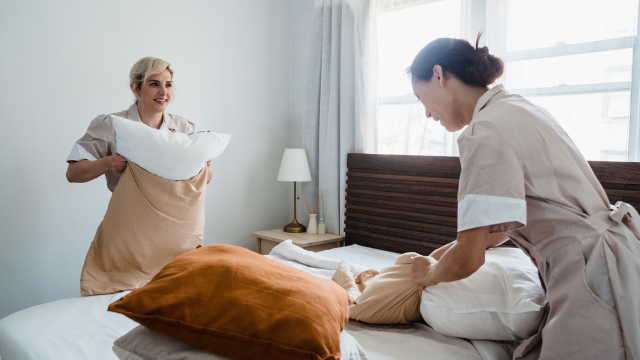
Housekeeping hard skills are technical or task-based abilities that can be taught and demonstrated. Examples include:
- using cleaning tools and machines correctly;
- applying cleaning products according to instructions;
- bed making;
- laundry handling;
- room preparation;
- stock control;
- surface cleaning;
- waste handling;
- basic infection-control practices; and
- using housekeeping or hotel software where relevant.
Hard skills vary with the workplace.
A room attendant in a small guesthouse may use mainly manual equipment. A housekeeping duties and responsibilities in a large hotel may work with central laundry systems, digital room-status applications and specialist machinery.
Healthcare housekeeping can involve more demanding infection-control procedures than ordinary hospitality cleaning.
Workers should therefore avoid assuming that experience in one setting automatically makes them competent in every other setting.
Housekeeping Soft Skills
Housekeeping soft skills relate more to how someone approaches work and housekeeping duties and responsibilities interacts with others. They include reliability, communication, discretion, teamwork, flexibility and professionalism.
Reliability
Hotels depend on housekeeping schedules. A team becomes difficult to manage when staff frequently arrive late or fail to communicate absences properly.
The National Careers Service specifically notes that employers value hardworking, honest and reliable applicants.
Discretion
Housekeepers work in private spaces. Confidentiality and respect are essential.
Staff should not discuss guest information or personal belongings casually with colleagues or outsiders.
Teamwork
Housekeeping is rarely completely independent. One room attendant may need help with a large task.
Supervisors coordinate priorities. Reception needs room-status updates. Maintenance teams respond to faults.
Strong teamwork, cooperation and communication improve the entire operation.
Flexibility
A normal schedule can change quickly. A guest may request an early room clean. A spill may require immediate attention.
An unexpected large departure group may increase workload. Professional housekeepers housekeeping duties and responsibilities adapt while continuing to follow standards.
Safe Use of Cleaning Chemicals
Chemical safety is an important part of housekeeping.
Some cleaning products can cause skin irritation, dermatitis, asthma, chemical burns or eye injuries. The HSE requires employers to assess and control exposure to hazardous substances under COSHH where applicable.
For housekeepers, practical safety can include:
- following dilution instructions;
- using the correct product for the task;
- wearing required protective equipment;
- storing products correctly;
- ensuring suitable ventilation; and
- knowing what to do if exposure or a spill occurs.
Never transfer chemicals casually into unlabelled containers. Never assume that mixing two cleaning products will make them stronger.
Some combinations can create dangerous gases or reactions. Training and workplace procedures should determine how products are used.
Slips, Trips and Floor Safety
Cleaning can actually create hazards while trying to remove them. Wet floors are an obvious example.
A smooth floor that has just been mopped may become much more slippery than before cleaning. Trailing vacuum leads can create trip hazards. Cleaning trolleys can obstruct walkways.
HSE guidance stresses that cleaning needs to be planned so that pedestrians are protected.
Depending on the environment, controls can include restricting access, cleaning in sections, working during quieter times and ensuring floors are left dry.
Warning signs can help communicate a hazard but do not physically stop someone entering the area.
A good housekeeper therefore thinks about the people around the cleaning activity, not only the surface being cleaned.
Manual Handling and Physical Fitness
Housekeeping can be physically demanding. housekeeping duties and responsibilities Workers may bend, reach, push trolleys, handle linen and repeatedly make beds.
Poor technique can contribute to strain. Employers should assess relevant manual-handling risks and use suitable work methods and equipment.
Workers should also report situations where a task cannot reasonably be completed safely alone.
Being physically capable does not mean lifting everything without assistance. Good professional practice includes knowing when to use equipment or ask for help.
Hygiene and Cross-Contamination
Professional cleaning is not simply making something look clean. The cleaning process itself needs to avoid spreading contamination.
Equipment used for one area may need to be kept separate from equipment used elsewhere. Organisations may use colour-coded cloths or tools to help prevent cross-contamination.
Workers should follow the system used by their employer.
Hand hygiene also matters. Gloves do not eliminate every hygiene requirement. Workers need to understand when gloves should be changed and when hands should be washed according to the task and workplace procedures.
The more sensitive the environment, the more structured those hygiene controls may become.
Laundry Skills
Laundry is a major part of many housekeeping operations.
Workers may need to separate used and clean linen, housekeeping duties and responsibilities check items for damage, process laundry or coordinate with an external laundry provider.
Organisation matters because linen shortages can disrupt the entire hotel.
Used linen should not be handled as though it were clean. Clean items also need suitable storage.
At supervisory level, managers may monitor linen stock, replacement rates and losses.
Laundry therefore combines hygiene, logistics and inventory control.
Inventory and Stock Control
Housekeeping departments use large quantities of supplies. These can include cleaning products, linen, toiletries, bin liners, tissues and guest amenities.
Poor inventory management creates two opposite problems. Too little stock can disrupt operations. Too much ties up money and storage space.
Housekeeping staff should record use accurately and report low supplies according to workplace systems.
Supervisors may establish minimum stock levels and monitor usage patterns.
Unexpectedly high consumption may indicate waste, inaccurate recording or another issue that needs investigation.
Room Inspection and Quality Control
A professional housekeeping system needs some form of quality control.
Supervisors often inspect rooms after cleaning. The objective is not to catch employees doing something wrong. It is to maintain a consistent standard.
A good inspection checks both cleanliness and readiness.
Are required amenities present? Is the room arranged correctly? Has any maintenance issue been missed? Are surfaces visibly clean? Does anything smell unusual?
Feedback should be specific. Saying “the room isn’t good enough” teaches little.
Explaining that the mirror was marked and two towels were missing housekeeping duties and responsibilities makes improvement possible.
Housekeeping Skills List for Beginners
A practical housekeeping skills list for someone preparing for work might include:
- room cleaning;
- bed making;
- bathroom hygiene;
- safe product use;
- laundry handling;
- vacuuming and floor care;
- waste disposal;
- stock replenishment;
- time management;
- attention to detail;
- customer service;
- teamwork;
- maintenance reporting;
- confidentiality; and
- health and safety awareness.
You do not need to claim mastery of all of these before applying for an entry-level role.
The aim is to understand which skills you genuinely have and which need further development.
Housekeeping Skills for Resume and CV Writing
People searching for hwhat are housekeeping skills for resume often make the mistake of copying a generic list into their application.
UK employers will normally expect a CV rather than something specifically labelled a résumé, but the principle is the same.
Show evidence.
Instead of writing:
“Excellent housekeeping skills.”
You could write:
“Prepared guest bedrooms and bathrooms to company standards while rhousekeeping duties and responsibilities estocking linen and amenities and reporting maintenance faults.”
If you have no hotel experience, use transferable evidence.
For example:
“Maintained cleanliness and presentation standards in a customer-facing workplace and followed safe chemical-handling procedures.”
Do not claim experience you do not have.
A short, accurate example is stronger than a long list of unsupported skills.
How to Learn Housekeeping Skills
If you are wondering how to learn what are housekeeping skills, combine theory with practice.
Start by understanding the correct principles.
Learn how different cleaning products work, why contamination controls matter and how housekeeping tasks are organised.
Then practise.
Bed making, cleaning techniques and room preparation improve through repetition.
Workplace supervision is particularly valuable because experienced housekeepers can identify inefficiencies that beginners may not notice.
You should also learn the standards of the specific employer.
A hotel chain may have precise room presentation requirements that differ from another brand.
Professional housekeeping is therefore partly transferable skill and partly workplace-specific procedure.
Housekeeping Skills Training
Good basic housekeeping skills training should cover more than cleaning techniques.
A beginner benefits from learning about:
- hygiene;
- equipment;
- chemicals;
- laundry;
- room preparation;
- safety;
- inventory;
- guest service; and
- communication.
Practical assessment is particularly useful because knowing the steps and performing them correctly are different things.
An online course can explain principles.
It cannot by itself demonstrate how well someone cleans a room under real workplace conditions.
Employers should therefore provide appropriate induction, instruction and housekeeping duties and responsibilities supervision for the actual environment and equipment being used.
Learning Through the Career Education Course
Career Education’s Housekeeping Skills and Practices course provides one introductory option for learners who want structured foundation knowledge.
The course contains nine modules covering:
- housekeeping fundamentals;
- cleaning tools and techniques;
- laundry;
- room setup and maintenance;
- health, safety and hygiene;
- inventory management;
- different housekeeping environments;
- sustainable practice; and
- managing housekeeping staff.
This breadth is useful because it presents housekeeping as an operational function rather than just a sequence of cleaning jobs.
For someone new to the sector, that can help explain how individual tasks connect.
However, introductory online learning should be combined with practical instruction what are housekeeping skills where the learner wants to work professionally.
Safe use of actual workplace chemicals, equipment and procedures needs to reflect the employer’s own risk assessment and operating system.
Apprenticeship Routes in England
For someone who wants structured work-based learning, what are housekeeping skills England currently has relevant hospitality apprenticeship options.
The Level 2 Hospitality Accommodation Team Member apprenticeship is approved for starts and typically lasts 12 months before assessment.
It is broader than housekeeping alone.
Learners work housekeeping duties and responsi bilities functions such as guest services, food and beverage and housekeeping.
The housekeeping element includes cleaning guest accommodation and public areas,what are housekeeping skills COSHH awareness and safe waste handling.
This can provide a strong introduction to hotel operations as a whole.
Workers progressing into supervision may consider the Level 3 Hospitality Supervisor apprenticeship, which includes a housekeeping-supervisor pathway.
The current standard includes assigning work, monitoring cleanliness and identifying maintenance or repair requirements.
These are occupational apprenticeships rather than generic online certificates.
Housekeeping Career Path
The housekeeping career path can begin with entry-level cleaning or room-attendant work and progress towards significant operational responsibility.
A typical pathway might look like:
Room attendant or housekeeping assistant → senior room attendant → housekeeping supervisor → head housekeeper → accommodation services or housekeeping manager.
Progression is not identical in every organisation.
Some employees move into front office, events, training or wider hotel operations.
The National Careers Service specifically identifies head housekeeper and accommodation services manager as progression options.
Larger hotels can provide more specialist structures.
Small hotels may offer broader responsibilities earlier because fewer people cover the whole operation.
Moving Into Housekeeping Supervision
Becoming a supervisor requires a change in mindset.
You are no longer responsible only for your own rooms.
You become responsible for helping the team achieve the department’s standards.
That requires planning.
Which rooms need to be prioritised?
Who has the right experience for particular tasks?
Where is additional support needed?
Supervisors also need confidence when giving feedback.
Avoid correcting people publicly unless immediate safety requires intervention.
Professional coaching is more effective when it explains what needs changing and why.
Good supervisors also listen to staff.
Room attendants often know exactly which procedures or equipment create recurring delays.
Becoming a Housekeeping Manager
Housekeeping managers deal with a wider business function.
They may oversee recruitment, rotas, budgets, productivity, linen contracts, suppliers and performance standards.
Communication with other departments becomes essential.
If housekeeping is delayed, reception needs accurate room-status information.
If maintenance work is planned, housekeeping may need to coordinate access.
Managers also need to understand the financial impact of their department.
Labour, linen, chemicals and guest supplies all create significant costs.
Reducing cost intelligently is different from simply buying the cheapest product.
An inexpensive chemical that performs poorly may increase labour time and provide worse results.
Management requires looking at the whole system.
Sustainable Housekeeping
Sustainable practice is becoming more relevant across hospitality.
Housekeeping teams influence water use, energy, laundry volume, chemicals and waste.
Hotels may reduce unnecessary towel or linen changes where guests choose to participate.
Cleaning-product selection and dosing can also reduce waste where appropriate.
Sustainability should not undermine hygiene.
The goal is to remove unnecessary consumption while still meeting required standards.
Better inventory management can contribute too.
Using products before they expire and avoiding excessive supply orders reduces both cost and waste.
Technology in Modern Housekeeping
Digital systems are increasingly changing hotel housekeeping.
Room attendants may receive assignments through mobile devices.
Supervisors can see room status in real time.
Maintenance faults may be reported electronically instead of on paper.
This improves communication between housekeeping and reception.
It also means basic digital confidence is becoming more useful.
Senior housekeeping workers may need to use hotel systems, spreadsheets, rota software and inventory platforms.
This is one reason housekeeping should not be dismissed as an occupation requiring no technical development.
The role changes as hotels become more connected.
Housekeeping in Different Workplaces

basic hhousekeeping duties and responsibilities are transferable, but workplaces are not identical.
Hotels focus heavily on guest presentation and turnaround.
Hospitals and healthcare environments can have stricter infection-prevention requirements.
Residential properties may involve highly personalised client preferences.
Commercial facilities can focus more on public or workplace spaces.
Holiday parks may involve cabins, lodges or shared facilities.
A housekeeper moving between sectors should therefore expect additional training.
Knowing how to clean effectively in a hotel does not automatically provide competence in specialised clinical cleaning.
Common Beginner Mistakes
One common mistake is using too much product.
More chemical does not automatically mean better cleaning.
It can leave residue, waste supplies and increase exposure.
Another mistake is cleaning without a system.
This creates repeated work and missed areas.
Beginners may also underestimate preparation.
A well-stocked housekeeping trolley can make the difference between an efficient room and repeated trips back to the supply cupboard.
Another mistake is failing to report damage because it seems unrelated to cleaning.
A housekeeper should not attempt repairs outside their role, but identifying the problem is part of good housekeeping.
Finally, do not confuse speed with professional competence.
Good housekeeping becomes faster through experience and organisation.
It should not become faster by removing safety or quality checks.
Is Housekeeping a Good Career?
Housekeeping can be a strong career for people who enjoy practical work, clear results and hospitality.
Entry barriers can be relatively accessible.
Direct applications are possible for some roles, and employers often value reliability and attitude alongside previous experience.
The work can also provide routes into supervision and management.
However, it can be physically demanding.
Shift work, weekends and high occupancy periods may create pressure.
Someone considering the occupation should therefore evaluate the real working environment rather than assuming housekeeping is simply casual cleaning work.
Professional hotels rely heavily on the department.
A guest may never meet the general manager.
They will almost certainly notice the condition of their room.
Key Takeaways
Housekeeping Skills for Beginners should include both technical cleaning abilities and professional workplace behaviours.
The main essential basic housekeeping skillss include systematic cleaning, bed making, hygiene, product safety, time management, attention to detail, teamwork and guest awareness.
Housekeeping hard skills cover practical abilities such as cleaning methods, laundry, room preparation, equipment use and stock handling.
Housekeeping soft skills include reliability, discretion, communication, adaptability and teamwork.
Professional housekeeping also involves safety. COSHH, chemical exposure, wet floors and other workplace hazards need appropriate controls and training.
England currently has Level 2 and Level 3 hospitality apprenticeship routes that can include housekeeping work and progression.
FAQ
What are housekeeping skills?
What are housekeeping skills? They are the practical and interpersonal abilities used to maintain clean, safe and well-organised environments. Examples include cleaning, bed making, laundry, product safety, attention to detail, time management and customer service.
What are the most important basic housekeeping skills?
Important basic basic housekeeping skills include systematic cleaning, correct use of equipment and products, bed making, bathroom cleaning, laundry handling, waste disposal and organisation. Reliability and attention to detail are equally important.
What are housekeeping duties and responsibilities?
Common housekeeping duties and responsibilities include cleaning rooms, replacing linen and towels, restocking supplies, cleaning bathrooms and communal areas, handling laundry, responding appropriately to guest requests and reporting maintenance problems.
What are the main hotel housekeeping skills?
Important hotel basic housekeeping duties and responsibilities include efficient room turnaround, guest privacy, consistent presentation, bed making, bathroom hygiene, communication with reception and maintenance reporting.
What are housekeeping hard skills?
Housekeeping hard skills include practical techniques such as floor care, cleaning equipment use, room preparation, laundry management, stock control, bed making and safe chemical handling.
What are housekeeping soft skills?
Housekeeping soft skills include communication, teamwork, reliability, discretion, flexibility, time management and the ability to maintain standards under pressure.
What housekeeping skills should I put on my CV?
Useful housekeeping skills for resume or CV sections include room cleaning, bed making, safe chemical handling, stock replenishment, laundry, customer service and maintenance reporting—but only include abilities you genuinely possess. Where possible, support skills with examples from previous work.
How can I learn housekeeping skills with no experience?
If you want to know how to learn housekeeping duties and responsibilities, start with structured introductory learning and practise core tasks. Entry-level hotel roles, workplace induction and apprenticeships can provide hands-on experience. Online learning can support theory but should not replace practical instruction.
Is housekeeping skills training necessary?
Some form of housekeeping duties and responsibilitiesg is highly valuable because professional work involves safety, hygiene, chemicals, equipment and workplace procedures. Employers should also provide the information, instruction and supervision appropriate to the actual tasks and risks.
What is the housekeeping career path?
A common housekeeping career path begins with room attendant or housekeeping assistant roles before progressing to senior housekeeper, supervisor, head housekeeper or accommodation services manager. Experience can also lead into training, front office or wider hotel operations.

Conclusion
Housekeeping Skills for Beginners provide a foundation for much more than cleaning.
Professional housekeeping combines hygiene, presentation, organisation, safety and customer service. Workers need to know how to clean effectively, handle linen and supplies, prepare rooms and recognise maintenance issues while protecting their own health and the safety of other people.
The most valuable housekeeping skills list therefore includes both practical and behavioural abilities. Cleaning methods, equipment use and laundry are important housekeeping hard skills, while reliability, communication and discretion are equally important housekeeping soft skills.
For anyone exploring how to learn housekeeping skills, structured training can provide a useful starting point. Career Education’s Housekeeping Skills and Practices course introduces cleaning, laundry, room maintenance, safety, stock control, sustainability and supervision. It can support foundation learning, but real professional competence develops through practical workplace instruction and experience.
There are also structured career routes. England’s Level 2 Hospitality Accommodation Team Member apprenticeship includes housekeeping alongside wider accommodation responsibilities, while the Level 3 Hospitality Supervisor standard supports progression towards supervisory work.
Housekeeping can therefore become much more than an entry-level job. With strong hotel housekeeping skills, consistent performance and appropriate housekeeping skills training, a worker can progress into supervision, management or broader hospitality operations.
The best starting point is simple: learn the correct method, work safely, build reliable habits and treat every room as part of the guest’s overall experience.