
94%
OFF
OFF
Six Sigma Management Essentials
- Lifetime Access
- All Levels
- PDF Certificate
£296
£19
14-Day Money-Back Guarantee
Learn With Confidence






Six Sigma Management Essentials
Six Sigma Management Essentials is a practical, outcome-focused online course designed to help managers, team leaders, supervisors, business professionals, and aspiring quality leaders understand how Six Sigma can be applied to improve processes, reduce waste, minimise defects, control costs, and achieve more consistent business performance.
In today’s competitive business environment, organisations cannot rely on guesswork or inefficient processes. Managers need the ability to identify problems, understand performance data, investigate root causes, implement meaningful improvements, and maintain those improvements over time. Six Sigma Management Essentials provides a structured introduction to the principles and methodology managers can use to approach process improvement with greater confidence and discipline.
Rather than focusing only on theory, this course introduces the DMAIC framework—Define, Measure, Analyse, Improve, and Control—and explains how each phase contributes to sustainable process improvement. You will also explore how Lean principles can be integrated with Six Sigma to create a more efficient approach to operational excellence.
Whether you are responsible for teams, operations, quality, customer service, production, administration, projects, or business performance, this course can help you develop a more systematic approach to solving workplace problems.
What Is Six Sigma Management Essentials?
Six Sigma Management Essentials introduces the core concepts behind Six Sigma and shows how managers can use its structured methodology to improve organisational performance.
Six Sigma is a data-driven approach to process improvement. It focuses on reducing variation, identifying defects, improving consistency, and creating processes that deliver better results for customers and organisations.
For managers, understanding Six Sigma does not necessarily mean becoming a statistical specialist. It means learning how to ask better questions, define problems accurately, use evidence to understand performance, identify the real causes of problems, support effective solutions, and establish controls that prevent problems from returning.
The course provides an accessible foundation for applying these principles in real-world management environments.
What You Will Learn
By completing Six Sigma Management Essentials, you will develop a clearer understanding of:
-
The fundamental principles of Six Sigma
-
The benefits of Six Sigma for organisations and management teams
-
The DMAIC process and how its stages work together
-
How to define business and process problems effectively
-
How to establish clear improvement objectives
-
How measurement supports better decision-making
-
How to analyse process performance and identify root causes
-
How to approach improvement opportunities systematically
-
How to maintain improvements through effective controls
-
How Lean principles can complement Six Sigma
-
How process improvement can support efficiency, quality, customer satisfaction, and business performance
The knowledge gained throughout the course can help you approach operational challenges with a more structured, evidence-based mindset.
Course Curriculum
Module 1: Introduction to Six Sigma and Its Benefits
Lesson 1: Introduction to Six Sigma and Its Benefits
The course begins by introducing the fundamental concepts of Six Sigma and explaining why organisations use structured process improvement methodologies.
You will explore the purpose of Six Sigma, its role in improving quality and consistency, and the importance of reducing process variation. You will also consider how effective process management can influence customer satisfaction, operational efficiency, costs, productivity, and overall organisational performance.
This module establishes the foundation for the rest of the course and helps you understand how Six Sigma fits into modern management and continuous improvement.
By the end of this module, you will be able to:
-
Explain the basic concept of Six Sigma
-
Understand why organisations use Six Sigma methodologies
-
Identify potential benefits of structured process improvement
-
Recognise the relationship between process quality and business performance
-
Understand the importance of data-driven management decisions
Module 2: Define Phase
The Define phase establishes the foundation for a successful improvement project. If a problem is poorly defined, even an excellent solution may fail to address the actual business need.
In this module, you will learn how to clearly identify improvement opportunities and establish a meaningful problem statement. You will explore how managers can clarify project objectives, identify relevant stakeholders, establish project scope, and understand what success should look like.
The Define phase encourages managers to move beyond vague statements such as “performance needs to improve” and instead establish a clear understanding of what is happening, why it matters, and what the improvement effort should accomplish.
By the end of this module, you will be able to:
-
Define process improvement problems more clearly
-
Establish appropriate improvement objectives
-
Understand the importance of project scope
-
Identify relevant stakeholders
-
Connect improvement projects with organisational priorities
-
Create a stronger foundation for the remaining DMAIC phases
Module 3: Measure Phase
You cannot effectively improve what you do not understand or measure. The Measure phase focuses on establishing a reliable picture of current process performance.
In this module, you will explore the importance of collecting relevant information and using appropriate performance measures. You will learn why accurate measurement is essential for understanding the current state of a process and evaluating whether future improvements have actually delivered results.
From a management perspective, measurement provides a foundation for making decisions based on evidence rather than assumptions.
You will develop an appreciation for the relationship between processes, performance indicators, data, and improvement objectives.
By the end of this module, you will be able to:
-
Understand the purpose of the Measure phase
-
Identify relevant process performance measures
-
Recognise the importance of reliable data
-
Establish a clearer picture of current performance
-
Use measurement to support management decisions
-
Create a baseline against which improvements can be evaluated
Module 4: Analyse Phase
Once the current process has been measured, the next step is understanding why problems are occurring.
The Analyse phase focuses on investigating process performance and identifying the underlying causes of problems. Instead of immediately implementing solutions, you will learn the importance of examining evidence and distinguishing symptoms from root causes.
This approach can help managers avoid repeatedly treating the same problems without addressing what is actually causing them.
You will explore structured approaches to analysing processes and understanding relationships between causes and outcomes. The emphasis is on developing a problem-solving mindset that encourages investigation before action.
By the end of this module, you will be able to:
-
Investigate problems more systematically
-
Distinguish symptoms from potential root causes
-
Understand why root-cause analysis matters
-
Use evidence to support problem-solving
-
Evaluate possible causes of process problems
-
Make more informed improvement decisions
Module 5: Improve Phase
After identifying the underlying causes of process problems, the Improve phase focuses on developing and implementing better ways of working.
In this module, you will explore how managers can move from analysis to action. You will consider how potential solutions can be evaluated, selected, implemented, and assessed.
Effective improvement is not simply about making a process different. It is about making it better in a measurable and sustainable way.
You will learn to consider factors such as practicality, resources, risks, stakeholder involvement, and expected outcomes when evaluating improvement opportunities.
By the end of this module, you will be able to:
-
Identify opportunities for process improvement
-
Develop practical improvement strategies
-
Evaluate potential solutions
-
Consider risks and implementation challenges
-
Support teams during improvement initiatives
-
Focus improvement efforts on measurable business outcomes
Module 6: Control Phase
A successful improvement is only valuable if the organisation can maintain it.
The Control phase focuses on sustaining improvements and preventing processes from returning to their previous state. This is particularly important for managers because improvements often fail when new processes are not monitored, documented, communicated, or supported effectively.
You will explore the importance of ongoing monitoring, standardisation, accountability, and performance tracking. The module highlights how managers can help embed successful improvements into everyday operations.
By the end of this module, you will be able to:
-
Understand the purpose of the Control phase
-
Support the sustainability of process improvements
-
Monitor ongoing process performance
-
Recognise when corrective action may be required
-
Encourage consistency in improved processes
-
Build stronger foundations for continuous improvement
Module 7: Lean Six Sigma Integration
The final module introduces the integration of Lean principles with Six Sigma.
While Six Sigma focuses heavily on reducing variation and improving quality, Lean focuses on creating value and reducing activities that do not contribute to customer or organisational value. Combining these approaches can provide managers with a broader framework for improving operational performance.
You will explore how Lean and Six Sigma can complement each other and how organisations can use their combined principles to pursue efficiency, quality, consistency, and continuous improvement.
This module helps bring the course together by showing how structured problem-solving and waste reduction can work alongside one another.
By the end of this module, you will be able to:
-
Understand the relationship between Lean and Six Sigma
-
Recognise the importance of reducing waste
-
Identify opportunities for greater process efficiency
-
Understand how Lean principles complement DMAIC
-
Consider integrated approaches to operational improvement
-
Apply a broader continuous-improvement mindset
Who Is This Course For?
Six Sigma Management Essentials is suitable for professionals who want to understand process improvement from a practical management perspective.
It may be particularly valuable for:
-
Managers and team leaders
-
Supervisors and department heads
-
Operations professionals
-
Quality and compliance professionals
-
Project managers
-
Business owners and entrepreneurs
-
Process improvement professionals
-
Administrative and service managers
-
Production and manufacturing professionals
-
Professionals preparing for greater management responsibility
-
Anyone interested in continuous improvement and operational excellence
You do not need to be an advanced statistics expert to benefit from this course. It is designed to provide a practical understanding of Six Sigma concepts and their relevance to management and workplace improvement.
What Outcomes Can You Expect?
The value of Six Sigma Management Essentials lies in developing practical improvement capabilities that can be transferred to different workplace environments.
After completing the course, you should have a stronger ability to approach operational challenges methodically rather than reacting to problems without understanding their causes.
You will understand how to move through a structured improvement cycle—from defining the problem and measuring current performance to analysing causes, implementing improvements, and establishing controls.
This can help you:
Make More Evidence-Based Decisions
Instead of relying entirely on assumptions or personal opinions, you can develop a stronger appreciation for using process information and performance data to support decisions.
Identify Problems More Clearly
A well-defined problem provides a much stronger starting point for improvement. You will learn why clarity and scope matter when addressing operational challenges.
Improve Your Problem-Solving Approach
The DMAIC framework provides a structured way to investigate problems and move towards appropriate solutions.
Support Operational Efficiency
By understanding process performance and Lean Six Sigma principles, you can identify opportunities to reduce unnecessary activities, improve consistency, and make better use of available resources.
Strengthen Quality Management
Six Sigma provides a systematic approach to reducing variation and improving process consistency, helping managers think more carefully about quality and customer expectations.
Sustain Improvements
The Control phase reinforces the importance of maintaining successful changes rather than treating improvement as a one-time activity.
Develop a Continuous-Improvement Mindset
Perhaps most importantly, Six Sigma Management Essentials encourages a mindset in which processes are regularly examined, measured, improved, and controlled.
Why Learn Six Sigma as a Manager?
Managers have a critical role in determining whether improvement initiatives succeed. They allocate resources, establish priorities, communicate expectations, support teams, monitor performance, and help organisations respond to problems.
Understanding Six Sigma can therefore provide managers with a valuable framework for approaching improvement initiatives.
Instead of simply asking, “How can we fix this problem?”, Six Sigma encourages a more structured sequence of questions:
What exactly is the problem?
How are we performing today?
Why is the problem happening?
What improvement could address the underlying causes?
How will we know the improvement worked?
How will we ensure the improvement continues?
This structured approach can help transform problem-solving from an informal activity into a repeatable management process.
Build a Stronger Foundation for Operational Excellence
Organisations that want sustainable performance improvements need more than isolated ideas. They need processes, measurement, accountability, and a culture that supports continuous improvement.
Six Sigma Management Essentials provides an accessible introduction to the concepts managers can use to contribute to that environment.
By learning the DMAIC methodology and understanding the relationship between Six Sigma and Lean, you can become better prepared to participate in improvement projects, communicate with quality and operations teams, evaluate process challenges, and contribute to more effective organisational decision-making.
The course also encourages you to look at problems from a process perspective. Rather than automatically blaming individuals when performance falls short, you can begin examining whether processes, systems, resources, communication, measurement, or other factors may be contributing to the outcome.
That shift in perspective can support more constructive and sustainable improvement.
Start Your Six Sigma Learning Journey
You do not need to wait until you are leading a major transformation project to benefit from Six Sigma thinking. The principles introduced in Six Sigma Management Essentials can be relevant whenever you are trying to improve a process, reduce errors, understand performance, increase efficiency, or deliver more consistent results.
From the initial Define phase through Measure, Analyse, Improve, and Control, you will develop an understanding of how structured improvement can be approached step by step. The addition of Lean Six Sigma integration then broadens your perspective by connecting quality improvement with waste reduction and operational efficiency.
If your goal is to become a more systematic problem-solver, make better use of performance information, support continuous improvement, and contribute more effectively to operational excellence, Six Sigma Management Essentials can provide a valuable foundation.
Enrol in Six Sigma Management Essentials today and develop the knowledge to approach workplace improvement with greater structure, clarity, confidence, and measurable focus.
Course Modules
Course Content
Module 1_ Introduction to Six Sigma and its Benefits
-
Lesson 1_ Introduction to Six Sigma and its Benefits
Module 2_ Define Phase
Module 3_ Measure Phase
Module 4_ Analyze Phase
Module 5_ Improve Phase
Module 6_ Control Phase
Module 7_ Lean Six Sigma Integration
What our students say
Excellent
4.9 average
158 Reviews

Earn an Accredited Certificate
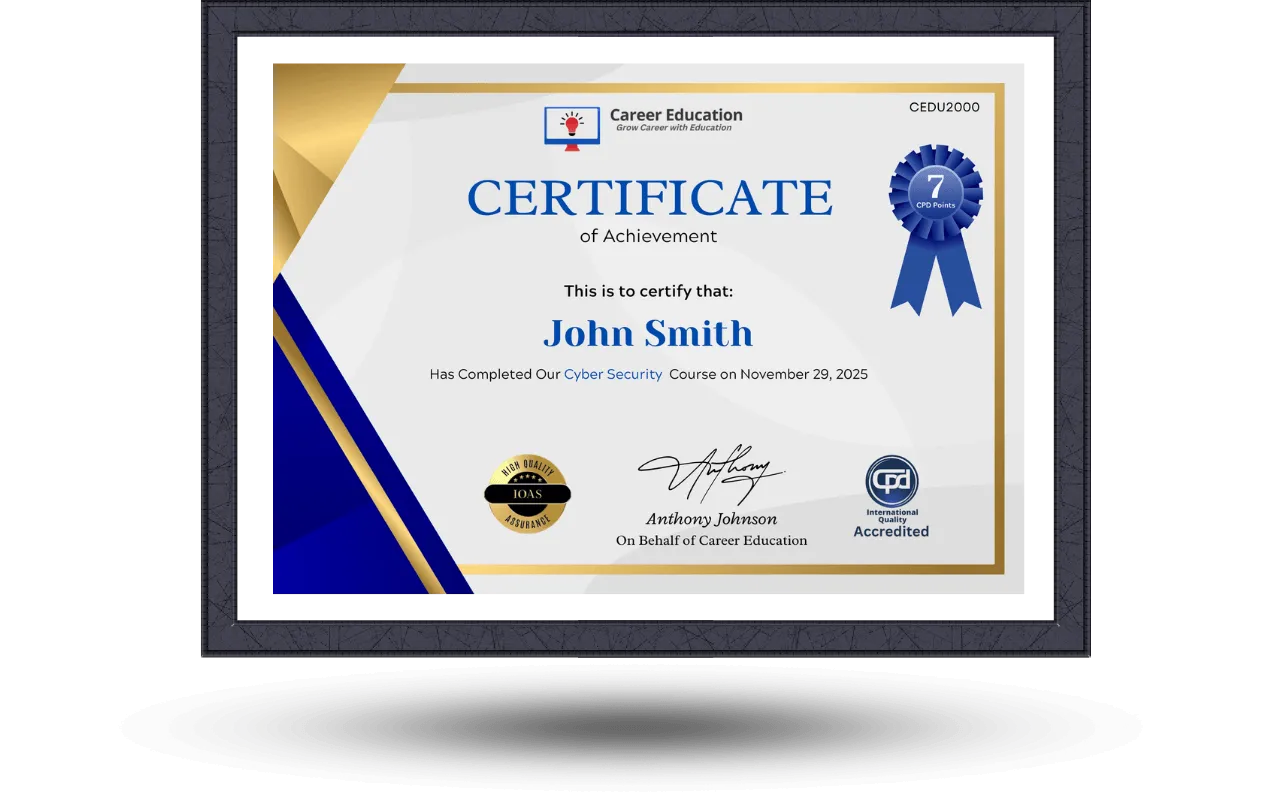
Upon completion of any course, all students are entitled to a CPD IQ Accredited e-certificate that will be issued by Career Education signifying the completion of your course.
After you complete the course and assignment, you will be eligible to order a free certificate accredited by CPD International Quality by completing the form below.
Hardcopy certificates and transcripts are also available for a small additional fee. More information is disclosed upon course completion.
Similar Courses




Frequently Asked Questions
The lifetime membership includes unlimited access to all courses, resources, and updates for a one-time fee.
You can purchase the membership directly from our website using a secure checkout process.
Yes, selected courses can be downloaded for offline access through our mobile app.
Yes, all future updates and new courses are included at no extra cost.
Yes, we offer a 30-day money-back guarantee if you are not satisfied with the membership.