
94%
OFF
OFF
Risk Management Course
- Lifetime Access
- All Levels
- PDF Certificate
£296
£19
14-Day Money-Back Guarantee
Learn With Confidence





Risk Management Course
Build the Knowledge to Identify, Assess and Manage Risk with Greater Confidence
Every organisation faces uncertainty. Changes in markets, technology, regulations, operations, supply chains, finances and customer expectations can create risks that affect business performance. Some risks may be relatively minor, while others can disrupt operations, damage reputation, increase costs or prevent organisations from achieving their objectives.
Effective risk management helps organisations prepare for uncertainty rather than simply reacting when problems occur.
The Risk Management Course is designed to provide learners with a structured foundation in risk management principles, risk assessment, risk analysis, mitigation strategies, stakeholder communication and advanced risk management techniques. The course also explores industry-specific approaches to managing risk, helping learners understand how risk management principles can be adapted to different working environments.
Whether you are a manager, business professional, project professional, entrepreneur, aspiring risk specialist or someone looking to strengthen your professional knowledge, this course provides a practical starting point for understanding how organisations can identify and respond to uncertainty.
You will explore the complete risk management process, from understanding what risk means through to assessing potential threats, selecting mitigation strategies, communicating risk effectively and applying more advanced techniques.
Why Risk Management Matters
Risk is present in virtually every organisation and industry.
A business may face financial risks caused by changing markets. A construction project may encounter safety, cost or scheduling risks. A technology company may need to consider cybersecurity and data-related risks. A supply chain may be affected by supplier disruption or transportation problems.
The ability to identify potential risks early can help organisations make better-informed decisions.
Risk management does not mean eliminating every possible risk. In many situations, risk cannot be completely removed. Instead, effective risk management involves understanding uncertainty, evaluating potential consequences and deciding how risks should be treated.
The Risk Management Course introduces this structured approach.
You will develop knowledge that can help you:
-
Understand fundamental risk management concepts.
-
Identify potential sources of risk.
-
Assess and analyse risks.
-
Evaluate potential impacts and consequences.
-
Develop appropriate risk mitigation strategies.
-
Understand different risk response techniques.
-
Communicate risk information effectively.
-
Engage relevant stakeholders in risk-related decisions.
-
Explore advanced approaches to risk management.
-
Understand how risk management can vary between industries.
What You Will Learn
The course consists of six comprehensive modules:
-
Introduction to Risk Management
-
Risk Assessment and Analysis
-
Risk Mitigation Strategies and Techniques
-
Risk Communication and Stakeholder Engagement
-
Advanced Risk Management Techniques
-
Industry-Specific Risk Management
Each module develops an important part of your overall understanding of risk management.
Module 1 – Introduction to Risk Management
The first module provides an Introduction to Risk Management, establishing the foundation for the rest of the course.
The introductory lesson introduces the fundamental concepts associated with risk and risk management.
You will explore why organisations need to understand uncertainty and how risk management can support decision-making and organisational objectives.
Risk management can be relevant to strategic planning, projects, daily operations and long-term business development.
This module helps you understand that risk is not limited to negative events. Uncertainty can create threats, but it can also create opportunities. Effective risk management therefore involves understanding the broader environment in which decisions are made.
You will develop a foundation for recognising different types of risk and understanding why a structured approach is important.
By completing this module, you should have a clearer understanding of the purpose of risk management and its role within organisations.
Module 2 – Risk Assessment and Analysis
Once potential risks have been identified, organisations need to understand them.
Module 2 focuses on Risk Assessment and Analysis, introducing methods for evaluating risks and their potential consequences.
Risk assessment helps organisations determine which risks may require the greatest attention.
Not every risk has the same likelihood or impact. Some risks may be unlikely but potentially severe, while others may be more likely but have relatively limited consequences.
Risk analysis provides a framework for examining these factors.
Through this module, you will develop awareness of how risks can be assessed, prioritised and considered within decision-making processes.
You will understand why reliable risk information is important and why risk assessment should be based on appropriate evidence and assumptions.
This knowledge can help you approach risk more systematically rather than relying solely on intuition.
Module 3 – Risk Mitigation Strategies and Techniques
Identifying a risk is only one part of effective risk management.
Module 3 explores Risk Mitigation Strategies and Techniques, helping learners understand how organisations can respond to identified risks.
Different risks may require different responses.
Depending on the circumstances, organisations may seek to avoid a risk, reduce its likelihood or impact, transfer aspects of the risk or accept it within defined boundaries.
This module introduces the importance of selecting an appropriate response based on the characteristics of the risk and the organisation’s objectives.
You will develop a stronger understanding of why risk mitigation needs to be planned rather than improvised after an incident occurs.
The module also helps you recognise that mitigation strategies should be proportionate and practical.
By completing this section, you will have a clearer foundation for thinking about how organisations can reduce exposure to threats and prepare for potential consequences.
Module 4 – Risk Communication and Stakeholder Engagement
Risk management is not solely an analytical activity.
People need to understand risks in order to make informed decisions.
Module 4 focuses on Risk Communication and Stakeholder Engagement, exploring the importance of sharing relevant risk information with the people who need it.
Stakeholders may have different responsibilities, perspectives and levels of risk awareness.
For example, senior managers may need a strategic overview, while operational teams may need more specific information about controls and procedures.
Effective risk communication therefore requires clarity, relevance and appropriate communication methods.
This module helps learners understand why stakeholder engagement is an important part of successful risk management.
You will develop awareness of how communication can support better decision-making and encourage greater organisational awareness of risk.
The module also highlights the importance of ensuring that risk information is communicated responsibly and understood by the relevant stakeholders.
Module 5 – Advanced Risk Management Techniques
Module 5 introduces Advanced Risk Management Techniques, allowing learners to move beyond fundamental concepts and explore more sophisticated approaches to risk management.
As organisations become more complex, their risk environments can also become more interconnected.
A single event may affect several departments, projects or business functions. Risks may interact with one another, making them more difficult to assess and manage.
Advanced risk management techniques can help organisations develop a deeper understanding of these complexities.
This module introduces learners to more developed approaches and encourages broader thinking about uncertainty, risk exposure and organisational resilience.
You will develop an appreciation of how advanced techniques can support more informed risk decisions and strengthen risk management practices.
This module can be particularly valuable for learners who already have some exposure to business, project or operational risk and want to expand their knowledge.
Module 6 – Industry-Specific Risk Management
Risk does not look the same in every industry.
Module 6 focuses on Industry-Specific Risk Management, helping learners understand why risk management approaches need to reflect the environment in which an organisation operates.
For example, a financial organisation may face significant financial, regulatory and market risks. A construction organisation may need to consider project, operational, safety and environmental risks. A technology business may face cybersecurity, data and technology-related risks.
Different industries have different processes, regulations, stakeholders and operating environments.
This module helps you appreciate the importance of adapting risk management principles to specific circumstances.
You will develop a broader understanding of how risk management can be applied across different sectors and why context matters when assessing and responding to risk.
Practical Learning Outcomes
By completing the Risk Management Course, you can develop a broad foundation in professional risk management.
You will be able to:
-
Explain the fundamental principles of risk management.
-
Understand why organisations need structured approaches to risk.
-
Recognise different sources and categories of risk.
-
Understand the purpose of risk assessment.
-
Develop awareness of risk analysis principles.
-
Evaluate the importance of likelihood and potential impact.
-
Understand how risks can be prioritised.
-
Explore risk mitigation strategies.
-
Recognise different approaches to risk response.
-
Understand why risk controls should be proportionate and practical.
-
Explain the importance of risk communication.
-
Recognise the role of stakeholder engagement.
-
Understand how effective communication supports risk decisions.
-
Develop awareness of advanced risk management techniques.
-
Recognise why risk management needs to reflect industry context.
-
Apply foundational risk management principles to professional scenarios.
-
Develop terminology and knowledge to support further study.
-
Approach uncertainty and potential threats in a more structured way.
Develop a Proactive Approach to Risk
One of the key benefits of risk management is the ability to think ahead.
Rather than waiting for an incident to occur, organisations can identify potential problems and consider how they might respond.
The Risk Management Course encourages this proactive approach.
You will explore how risks can be identified, assessed and prioritised before decisions are made.
This can help organisations prepare for uncertainty and develop appropriate responses.
A proactive mindset can also improve decision-making because potential consequences are considered before action is taken.
Improve Your Risk Assessment Skills
Risk assessment is central to effective risk management.
A long list of potential risks does not automatically help an organisation decide what to do. Risks need to be evaluated and prioritised.
Through the risk assessment and analysis module, you will develop awareness of how organisations can compare risks and determine which areas deserve greater attention.
This can help you understand the difference between simply identifying risks and actually analysing them.
Developing this perspective can be valuable in project management, business operations, compliance, health and safety, finance and many other professional environments.
Understand Risk Mitigation
Different risks require different responses.
Some risks may be reduced through stronger controls. Others may be transferred or avoided. In certain circumstances, accepting a level of risk may be appropriate when the potential benefits justify it and the risk remains within acceptable boundaries.
The Risk Management Course introduces these concepts and helps learners understand why risk response should be considered carefully.
Effective mitigation is not about implementing controls simply because they are available. Controls should be relevant to the risk and proportionate to the potential exposure.
This outcome-focused approach can help you understand how mitigation fits into the wider risk management process.
Strengthen Risk Communication
A technically accurate risk assessment is of limited value if the relevant people do not understand it.
Risk information often needs to be communicated to managers, employees, project teams, clients, suppliers, regulators or other stakeholders.
The course explores the importance of communicating risk in a clear and meaningful way.
You will develop greater awareness of why different audiences may require different levels of information and why stakeholder engagement can influence the success of risk management activities.
Explore Advanced Risk Thinking
Modern organisations can face complex and interconnected risks.
Cybersecurity issues can affect operations. Supply chain disruption can affect finances. Regulatory changes can influence strategic decisions. A single major incident can create consequences across multiple areas of an organisation.
The advanced risk management module encourages learners to consider these relationships.
You will gain awareness of why organisations may need more sophisticated methods for understanding complex risk environments.
This can help you develop a broader perspective that goes beyond isolated risks.
Apply Risk Management Across Industries
Risk management is relevant across almost every sector.
Businesses, public organisations, charities, manufacturers, construction companies, technology firms, healthcare organisations and financial institutions all face uncertainty.
However, the risks they face can be very different.
The industry-specific module helps you understand why effective risk management must consider the operating context.
This can help you transfer general risk management principles into different professional environments while recognising that specific requirements may vary.
Who Is This Course For?
The Risk Management Course is suitable for a wide range of learners.
Business Managers
Managers can benefit from understanding how risk affects strategic and operational decision-making.
Project Managers
Project professionals can use risk management knowledge to identify potential threats and consider appropriate responses throughout the project lifecycle.
Operations Professionals
Those responsible for day-to-day operations can develop greater awareness of operational risks and mitigation strategies.
Compliance Professionals
Risk and compliance are closely connected, making risk management knowledge useful for professionals involved in organisational controls and governance.
Entrepreneurs and Business Owners
Business owners can use risk management principles to think more systematically about uncertainty and potential threats to their organisations.
Aspiring Risk Professionals
If you are considering a career in risk management, this course provides a foundation in core concepts and techniques.
Students and Career Changers
The course can also provide an accessible introduction for learners who are considering further study or a career involving business, risk, compliance or project management.
Professionals Seeking Continuing Development
Anyone looking to broaden their professional knowledge can benefit from developing a structured understanding of risk.
Support Your Professional Development
Risk management is increasingly relevant in a business environment characterised by change and uncertainty.
Organisations need professionals who can recognise potential problems, evaluate consequences and contribute to informed decisions.
Developing risk management knowledge can complement skills in management, operations, project management, finance, compliance, supply chain management and many other areas.
The Risk Management Course provides a foundation that can support further learning and professional development.
The course is educational and foundational in nature. It does not replace industry-specific licences, regulated qualifications, professional certification or specialist legal and regulatory advice where these are required.
Learn at Your Own Pace
Online training provides a flexible way to develop professional knowledge around your existing commitments.
You can work through the Risk Management Course progressively and revisit concepts as needed.
Whether you are starting from the beginning or looking to strengthen existing knowledge, the course provides a structured learning journey covering the major stages of risk management.
You can use the knowledge gained as a foundation for further study or as part of your broader professional development.
Build a Stronger Risk-Aware Mindset
Effective risk management is ultimately about making better-informed decisions in the face of uncertainty.
It requires organisations to ask important questions:
What could happen?
How likely is it?
What would the consequences be?
What can we do about it?
Who needs to know?
How can we monitor and manage the situation?
The Risk Management Course provides a structured introduction to these questions and the processes used to address them.
From risk identification and assessment through to mitigation, communication, advanced techniques and industry-specific applications, the course provides a broad foundation for understanding professional risk management.
Take the Next Step Towards Better Risk Management
Risks cannot always be predicted, and they cannot always be eliminated. However, organisations can become better prepared to recognise, assess and respond to uncertainty.
The Risk Management Course gives you the opportunity to develop that foundation.
You will explore fundamental risk management principles, learn about risk assessment and analysis, examine mitigation strategies, understand the importance of communication and stakeholder engagement, explore advanced techniques and discover why industry context matters.
Whether your objective is career development, workplace learning, business improvement or preparation for further study, this course can help you develop the knowledge and structured mindset needed to approach risk more effectively.
Enrol in the Risk Management Course today and start developing the knowledge to identify risks, assess their potential impact, plan appropriate responses and contribute to more informed organisational decision-making.
Course Modules
Course Content
Module 1_ Introduction to Risk Management
-
Lesson 1_ Introduction to Risk Management
Module 2_ Risk Assessment and Analysis
Module 3_ Risk Mitigation Strategies and Techniques
Module 4_ Risk Communication and Stakeholder Engagement
Module 5_ Advanced Risk Management Techniques
Module 6_ Industry-Specific Risk Management
What our students say
Excellent
4.9 average
158 Reviews

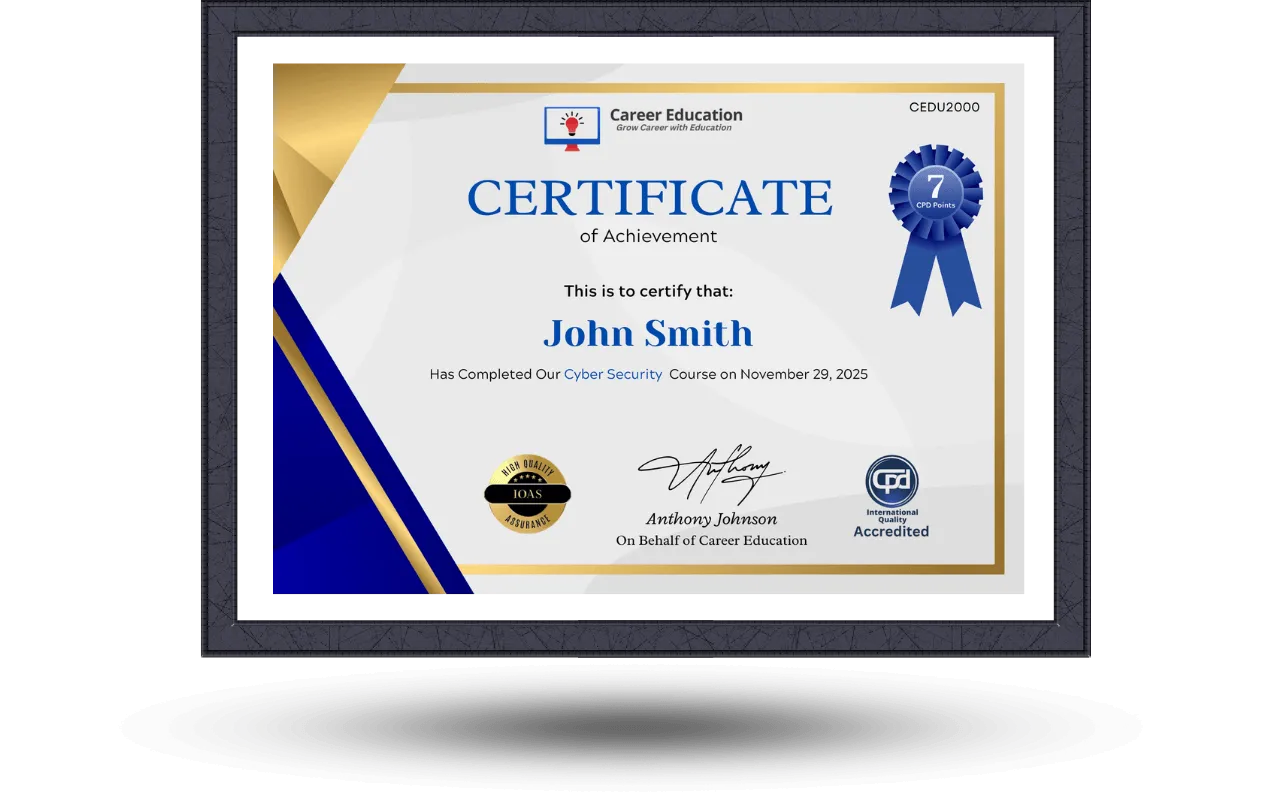
Earn an Accredited Certificate
Upon completion of any course, all students are entitled to a CPD IQ Accredited e-certificate that will be issued by Career Education signifying the completion of your course.
After you complete the course and assignment, you will be eligible to order a free certificate accredited by CPD International Quality by completing the form below.
Hardcopy certificates and transcripts are also available for a small additional fee. More information is disclosed upon course completion.
Similar Courses




Frequently Asked Questions
The lifetime membership includes unlimited access to all courses, resources, and updates for a one-time fee.
You can purchase the membership directly from our website using a secure checkout process.
Yes, selected courses can be downloaded for offline access through our mobile app.
Yes, all future updates and new courses are included at no extra cost.
Yes, we offer a 30-day money-back guarantee if you are not satisfied with the membership.