
94%
OFF
OFF
Java Programming Course: Learn Java from Beginner to Advanced
- Lifetime Access
- All Levels
- PDF Certificate
£296
£19
14-Day Money-Back Guarantee
Learn With Confidence








Build a strong foundation in Java programming and develop the technical knowledge needed to create applications, solve programming problems and understand software development principles. This comprehensive Java programming course is designed for beginners and aspiring developers who want to learn how Java works and progress towards writing more structured and reliable code.
Java is a widely used programming language that supports software development across desktop applications, enterprise systems, web technologies, Android-related development and backend services. Its object-oriented approach, extensive libraries and established development ecosystem make it an important language for learners interested in software engineering.
Learning Java involves understanding more than programming syntax. You need to know how to organise code, work with data, control program execution, create reusable components and handle errors. Understanding object-oriented programming is also essential because it helps developers design applications using classes, objects and relationships between components.
Throughout this course, you will explore Java fundamentals, variables, data types, operators, conditional statements, loops, methods, arrays and object-oriented programming. You will also develop an understanding of exception handling, collections, file operations and basic application development.
As you progress, you will learn how individual programming concepts work together to solve practical problems. This will help you move from writing simple instructions towards developing more organised programs.
By the end, you will have a stronger understanding of Java programming and the principles used in software development. You will be better prepared to practise through independent projects, explore advanced Java topics and continue developing your programming abilities.
What You Will Learn
By completing this course, you will be able to:
-
Understand Java programming fundamentals.
-
Explain how Java applications are developed and executed.
-
Work with variables, data types and operators.
-
Use conditional statements and loops.
-
Create and call methods.
-
Work with arrays and basic data structures.
-
Understand classes, objects and constructors.
-
Apply the principles of object-oriented programming.
-
Understand inheritance, encapsulation and polymorphism.
-
Handle exceptions and common programming errors.
-
Explore Java collections and file handling.
-
Organise code into reusable components.
-
Develop basic Java applications.
-
Understand the foundations of software problem-solving.
Who Is This For?
Complete beginners: Learn Java programming from the fundamentals without requiring previous coding experience.
Aspiring software developers: Build programming knowledge that can support further development in software engineering.
Computer science students: Strengthen your understanding of programming concepts and object-oriented development.
Existing programmers: Explore Java as an additional programming language and compare its structure with other languages.
Career changers: Develop foundational coding skills while exploring software development as a potential career direction.
Technology enthusiasts: Understand how programming languages are used to create applications and solve computational problems.
Students preparing for advanced programming: Establish a foundation before exploring frameworks, application architecture and more complex software projects.
Requirements / Prerequisites
No professional programming experience is required. The course is suitable for learners who are new to Java and want to understand the language step by step.
Basic computer skills will be helpful. Familiarity with using software applications and managing files can make the learning process easier.
A computer with a suitable Java Development Kit (JDK) and code editor or integrated development environment (IDE) will be useful for practising programming exercises. An internet connection will help you access documentation and additional resources.
Basic mathematical reasoning can support your understanding of programming logic, although advanced mathematics is not required for the introductory topics.
The most important requirement is a willingness to practise coding, understand errors and develop solutions through experimentation.
Course Content and Learning Journey
Module 1: Introduction to Java Programming
Explore the history, purpose and applications of Java. Understand how Java is used in software development and become familiar with the basic development environment.
Module 2: Java Setup and Your First Program
Understand the role of the Java Development Kit, compiler and runtime environment. Learn how to create, compile and execute a simple Java program.
Module 3: Variables, Data Types and Operators
Explore how Java stores and processes information. Learn about primitive data types, variables, constants, arithmetic operations, comparison operators and logical expressions.
Module 4: Conditional Statements and Loops
Understand how programs make decisions and repeat instructions. Explore if-else statements, switch structures, for loops, while loops and other control-flow concepts.
Module 5: Methods and Code Reusability
Learn how methods organise program functionality. Explore parameters, return values, method calls and the benefits of dividing larger tasks into smaller reusable sections.
Module 6: Arrays and Data Structures
Understand how arrays store collections of information. Explore array operations, iteration and introductory approaches to organising data within Java applications.
Module 7: Object-Oriented Programming Fundamentals
Explore classes, objects, fields, methods and constructors. Understand how object-oriented programming supports structured application development.
Module 8: Inheritance, Encapsulation and Polymorphism
Learn about important object-oriented programming principles. Explore how classes can inherit behaviour, how data can be protected and how polymorphism supports flexible software design.
Module 9: Exception Handling, Collections and File Operations
Understand how Java handles unexpected situations. Explore exception handling, collection concepts and basic file input and output operations.
Module 10: Building and Improving Java Applications
Bring together the concepts covered throughout the course. Explore how to plan, structure, develop and test basic Java applications while identifying opportunities for further improvement.
Skills You Will Develop
You will develop programming and problem-solving abilities that form an important foundation for software development.
Your understanding of Java syntax will help you write structured programs using variables, operators, conditions, loops and methods. You will also develop knowledge of object-oriented programming, which is essential for organising larger applications into reusable components.
Working with arrays and collections will strengthen your ability to manage information within programs. Exception handling will help you understand how applications respond to unexpected conditions and why error management matters.
You will also develop logical thinking by breaking programming problems into smaller steps. Debugging and testing exercises can improve your ability to identify errors, understand their causes and refine your solutions.
Practical Applications
Java programming knowledge can be applied to a wide range of software development projects.
You may use Java to create simple calculator applications, information management tools, command-line programs and basic record-processing systems.
Java is also used in enterprise software, backend systems, development tools and many established applications. Understanding the language can help you explore these areas as your technical experience grows.
You can also apply your knowledge when learning additional programming concepts, including software architecture, application frameworks, database integration and automated testing.
Developing production-ready software requires further experience with software design, version control, security, testing and deployment.
Career Path
Java programming skills can support progression towards several technology-related roles.
-
Junior Java Developer: Assist with developing and maintaining Java-based applications.
-
Junior Software Developer: Apply programming knowledge to software development tasks.
-
Backend Developer: Progress towards developing server-side application functionality.
-
Application Developer: Contribute to building and maintaining software applications.
-
Software Engineering Assistant: Support programming, testing and development activities.
-
Android Developer: Build on Java knowledge while learning the wider tools and technologies used in Android development.
-
QA Automation Tester: Explore automated testing tools and programming-based quality assurance.
These are potential career directions rather than guaranteed employment outcomes. Employers may require practical project experience, knowledge of development frameworks, database skills and familiarity with professional software development tools.
Why Learn Java?
Java provides a valuable foundation for understanding software development and object-oriented programming. Its established ecosystem and broad range of applications make it a useful language to explore for learners interested in technology careers.
Learning Java can also improve your ability to approach problems logically. You will develop an understanding of how instructions are structured, how data is managed and how different components work together to perform tasks.
These principles are transferable to many other programming languages and development environments.
Conclusion
This Java programming course introduces the essential concepts needed to write, understand and organise Java programs. You will explore programming fundamentals, control structures, methods, arrays, object-oriented programming, exception handling and application development.
By completing the course, you will have a stronger foundation in Java and a clearer understanding of how software is developed. Whether you want to begin programming, strengthen your technical knowledge or prepare for further software development training, this course will help you take the next step.
Course Modules
Course Content
Module 1 – Variables and Basic Operations
-
How to Study This Course
-
Downloading and Setting Up the Development Environment
00:00 -
Variables in Java
00:00 -
Numeric Operations and String Concatenation
00:00 -
Augmented Assignment, Increment, and Decrement Operators
00:00 -
Getting Input from the User
00:00 -
Displaying the Current Time
00:00 -
Practice Assignment
Module 2 – Loops and Conditional Statements
Module 3 – Classes, Objects, and Methods
Module 4 – Working with Arrays
Module 5 – Inheritance and Polymorphism in Java
Module 6 – Abstract Classes and Interfaces
Module 7 – Exception Handling and Text File I/O
Module 8 – Binary Input and Output
Module 9 – Building Java GUI Applications
Module 10 – Java Collections Framework
Module 11 – Multithreading in Java
Module 12 – Java Database Connectivity and Programming
Module 13 – Developing Web Applications with Java Servlets
Module 14 – Building Dynamic Pages with JavaServer Pages (JSP)
Module 15 – JavaServer Faces (JSF) for Web Development
What our students say
Excellent
4.9 average
168 Reviews

Earn an Accredited Certificate
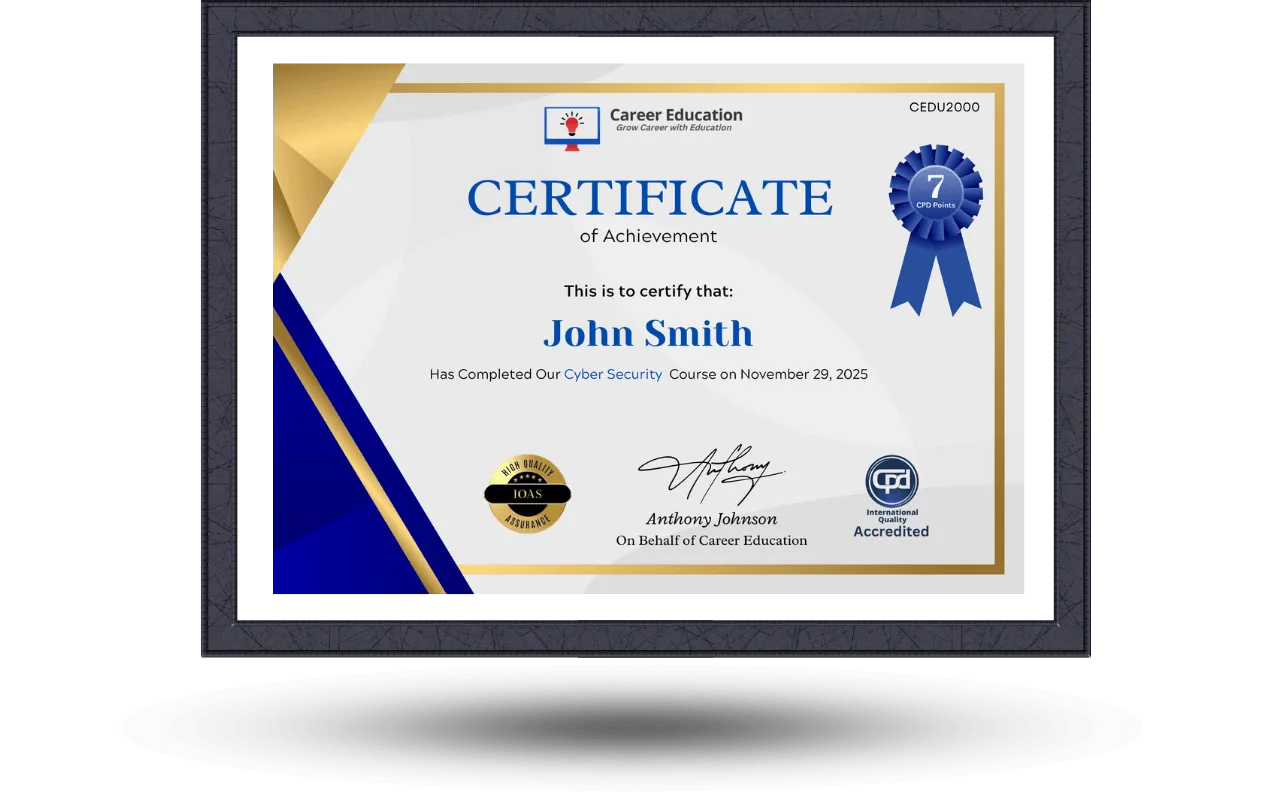
Upon completion of any course, all students are entitled to a CPD IQ Accredited e-certificate that will be issued by Career Education signifying the completion of your course.
After you complete the course and assignment, you will be eligible to order a free certificate accredited by CPD International Quality by completing the form below.
Hardcopy certificates and transcripts are also available for a small additional fee. More information is disclosed upon course completion.
Similar Courses




Frequently Asked Questions
The lifetime membership includes unlimited access to all courses, resources, and updates for a one-time fee.
You can purchase the membership directly from our website using a secure checkout process.
Yes, selected courses can be downloaded for offline access through our mobile app.
Yes, all future updates and new courses are included at no extra cost.
Yes, we offer a 30-day money-back guarantee if you are not satisfied with the membership.