
94%
OFF
OFF
Global Management and Cross-Cultural Leadership Essentials
- Lifetime Access
- All Levels
- PDF Certificate
£296
£19
14-Day Money-Back Guarantee
Learn With Confidence









# Global Management and Cross-Cultural Leadership Essentials
Modern organisations increasingly operate across borders, cultures, time zones, and diverse professional environments. Leaders may manage international teams, work with global clients, negotiate with overseas partners, coordinate multicultural projects, or collaborate with colleagues who have very different communication styles and expectations.
Success in these environments requires more than technical expertise. Effective international leadership depends on cultural awareness, adaptability, communication, emotional intelligence, sound judgement, and the ability to build trust across cultural boundaries.
**Global Management and Cross-Cultural Leadership Essentials** is a practical, outcome-focused course designed to help professionals develop the skills needed to manage effectively in culturally diverse and international environments. The course explores cultural intelligence, global leadership styles, cross-cultural communication, international team management, global negotiation, and cross-cultural decision-making.
Rather than assuming that one management approach works everywhere, this course encourages learners to understand cultural differences, recognise individual perspectives, adapt their approach where appropriate, and create more inclusive working relationships.
Whether you are a manager, team leader, business owner, HR professional, consultant, project manager, entrepreneur, or professional working with international colleagues and clients, **Global Management and Cross-Cultural Leadership Essentials** can help you develop a more flexible and globally minded approach to leadership.
—
## Why Global Management and Cross-Cultural Leadership Essentials Matters
Globalisation has changed how organisations operate.
A team may include employees working from several countries. A manager may report to an international leadership group. A business may serve customers with different cultural expectations. Negotiations may involve people who have very different approaches to authority, time, risk, communication, and decision-making.
Without cultural awareness, even well-intentioned communication can create misunderstandings.
For example, a communication style considered direct and efficient in one culture may be perceived as rude or aggressive in another. Similarly, a person who prefers careful relationship-building before making a decision may be viewed as indecisive by someone accustomed to faster business interactions.
**Global Management and Cross-Cultural Leadership Essentials** helps learners understand these differences without relying on stereotypes or assuming that every individual behaves according to a cultural label.
The focus is on developing curiosity, flexibility, cultural intelligence, and practical leadership skills.
—
# What You Will Learn
By completing the **Global Management and Cross-Cultural Leadership Essentials** course, learners will be able to:
* Explain key principles of global management.
* Understand the importance of cross-cultural leadership.
* Develop greater cultural intelligence.
* Recognise how cultural differences can influence workplace behaviour.
* Adapt leadership approaches to different situations.
* Communicate more effectively across cultures.
* Build trust within multicultural teams.
* Manage geographically distributed teams.
* Support collaboration across time zones.
* Apply practical global negotiation strategies.
* Recognise different approaches to decision-making.
* Reduce misunderstandings in international workplaces.
* Develop greater confidence when leading diverse teams.
* Promote inclusive and respectful professional relationships.
—
# Course Curriculum
## Module 1: Introduction to Global Management and Cross-Cultural Leadership
### Lesson 1: Introduction to Global Management and Cross-Cultural Leadership
The course begins by establishing a foundation in global management and cross-cultural leadership.
Learners will explore what it means to lead and manage in an international environment and why cultural awareness is increasingly important for modern organisations.
The module examines factors that can influence cross-cultural working relationships, including:
* Communication styles
* Workplace expectations
* Leadership preferences
* Attitudes towards authority
* Approaches to teamwork
* Concepts of time
* Decision-making preferences
* Relationship-building
* Approaches to conflict
* Attitudes towards risk
Learners will discover that cultural differences do not automatically create problems. In many cases, diversity can provide valuable perspectives, creativity, problem-solving approaches, and market insight.
The challenge is learning how to work effectively across those differences.
The course also introduces the importance of avoiding cultural assumptions and stereotypes. Culture can influence behaviour, but individuals are shaped by many factors, including personality, experience, education, profession, organisational culture, and personal values.
By completing this module, learners will understand the foundations of global management and the role of cultural awareness in effective leadership.
—
# Module 2: Cultural Intelligence (CQ) and Leadership
Cultural Intelligence, often referred to as CQ, is an important capability for professionals working across cultural boundaries.
This module explores how cultural intelligence can support effective leadership.
Learners will examine key aspects of CQ, including:
* Cultural awareness
* Cultural knowledge
* Motivation
* Adaptability
* Behavioural flexibility
* Self-awareness
The course encourages learners to consider their own cultural assumptions and communication preferences.
A strong culturally intelligent leader does not need to know every detail about every culture. Instead, they develop the ability to recognise differences, ask appropriate questions, remain open-minded, and adapt their behaviour when necessary.
Learners will explore how CQ can help leaders:
* Build trust
* Avoid misunderstandings
* Communicate effectively
* Resolve cultural differences
* Improve collaboration
* Support inclusion
* Develop international relationships
The module also explores the importance of continuous learning.
Cultural intelligence is not simply a collection of facts about different countries. It is an ongoing capability that develops through experience, reflection, listening, and interaction.
By completing this module, participants will understand how cultural intelligence can strengthen global leadership effectiveness.
—
# Module 3: Global Leadership Styles and Approaches
Leadership does not look exactly the same in every environment.
This module explores how leadership expectations can vary across cultures and organisations.
Learners will examine different leadership approaches and consider how factors such as hierarchy, autonomy, collaboration, communication, and organisational expectations can influence leadership relationships.
The course explores leadership characteristics such as:
* Directive leadership
* Participative leadership
* Coaching
* Delegation
* Relationship-focused leadership
* Task-focused leadership
* Transformational approaches
Rather than presenting one style as universally superior, learners will explore the importance of situational flexibility.
For example, a highly autonomous team may respond positively to delegated decision-making, while another team may expect clearer direction and structured guidance.
The module also examines how leaders can adapt without losing consistency or authenticity.
Effective adaptation does not mean changing core values. It can mean adjusting communication, expectations, feedback methods, or decision-making processes to improve understanding.
By completing this module, learners will develop greater awareness of leadership flexibility in global environments.
—
# Module 4: Communication Across Cultures
Communication is one of the most important areas of cross-cultural leadership.
Words can have different meanings depending on context, while tone, body language, silence, formality, and communication speed can also influence how a message is interpreted.
This module explores practical strategies for communicating across cultures.
Learners will examine differences involving:
* Direct and indirect communication
* Formal and informal communication
* Written and verbal communication
* Feedback styles
* Active listening
* Non-verbal communication
* Digital communication
* Meeting etiquette
The course highlights the importance of checking understanding rather than assuming that a message has been interpreted as intended.
Learners will also explore how language differences can affect international communication, even when everyone uses a shared business language.
Clear communication may involve:
* Avoiding unnecessary jargon
* Explaining unfamiliar terms
* Using concise language
* Confirming important details
* Allowing time for questions
* Listening carefully
* Avoiding assumptions
The module also considers the role of technology in international communication.
Video meetings, email, messaging platforms, and collaborative tools have made global communication easier, but they can also create new misunderstandings.
By completing this module, learners will develop practical strategies for clearer and more respectful cross-cultural communication.
—
# Module 5: Managing Global Teams
International teams can provide significant advantages, but they also create unique management challenges.
This module focuses on building and managing effective global teams.
Learners will explore challenges such as:
* Time-zone differences
* Communication barriers
* Different working practices
* Cultural expectations
* Remote collaboration
* Team trust
* Conflict
* Unequal participation
* Different approaches to deadlines
The course examines how leaders can create clear team expectations while respecting cultural and individual differences.
Participants will explore strategies for:
* Establishing communication protocols
* Clarifying responsibilities
* Creating inclusive meetings
* Supporting remote workers
* Managing different time zones
* Encouraging participation
* Building trust
* Recognising contributions
The module also addresses the importance of psychological safety and respectful team communication.
A successful global team is not one where everyone behaves identically. It is one where people understand how to work together despite differences.
By completing this module, learners will be better prepared to support collaboration, accountability, and trust within multicultural teams.
—
# Module 6: Global Negotiation Strategies
Negotiation is a fundamental business skill, and international negotiations can involve additional cultural considerations.
This module explores practical strategies for negotiating across cultures.
Learners will examine areas such as:
* Preparation
* Relationship-building
* Communication
* Trust
* Bargaining approaches
* Decision-making authority
* Time expectations
* Conflict management
* Concessions
* Agreement-building
The course encourages learners to understand that negotiation styles can vary significantly.
Some negotiators may prioritise relationship development before discussing commercial details, while others may prefer to focus immediately on objectives and terms.
Learners will explore the importance of researching the context, understanding the other party’s priorities, and remaining adaptable.
The module also highlights the importance of avoiding cultural stereotypes.
Instead of assuming how someone will negotiate based solely on their nationality or background, professionals should observe, listen, ask questions, and adapt based on the actual situation.
By completing this module, learners will have a stronger foundation for approaching international negotiations with preparation, flexibility, and professionalism.
—
# Module 7: Cross-Cultural Decision Making
Decision-making can become more complex when people from different cultural and professional backgrounds are involved.
This module explores how cultural perspectives can influence decision-making processes.
Learners will consider differences relating to:
* Individual versus group decisions
* Risk tolerance
* Authority
* Consensus
* Speed
* Information gathering
* Accountability
* Long-term versus short-term priorities
The course examines how leaders can create decision-making processes that are both efficient and inclusive.
Participants will explore strategies for:
* Clarifying decision authority
* Defining objectives
* Gathering diverse perspectives
* Evaluating risks
* Encouraging constructive disagreement
* Communicating decisions clearly
* Documenting responsibilities
* Reviewing outcomes
The module also highlights the value of diversity in decision-making.
Different perspectives can help teams identify risks, challenge assumptions, understand customers, and generate alternative solutions.
By completing this module, learners will be better prepared to manage decision-making in culturally diverse environments.
—
# Who Is This Course For?
The **Global Management and Cross-Cultural Leadership Essentials** course is suitable for professionals who work with culturally diverse teams, international customers, global partners, or multinational organisations.
It can benefit:
* Managers
* Team leaders
* Business owners
* Entrepreneurs
* HR professionals
* Project managers
* Consultants
* International business professionals
* Sales professionals
* Marketing professionals
* Coaches
* Trainers
* Remote team leaders
* Professionals preparing for international assignments
The course can also be useful for professionals who want to strengthen their leadership capabilities before taking on international responsibilities.
—
# Practical Learning Outcomes
The course is designed to move beyond theoretical concepts and encourage practical application.
After completing **Global Management and Cross-Cultural Leadership Essentials**, learners will be better prepared to consider questions such as:
**How might cultural expectations influence this situation?**
**Am I making assumptions about another person’s behaviour?**
**How can I adapt my communication without losing clarity?**
**Does my team have clear expectations?**
**How can I encourage participation from different cultures?**
**What approach is most appropriate for this negotiation?**
**How can we make decisions that respect different perspectives?**
These questions can help leaders approach international challenges with greater awareness and flexibility.
—
# Build Cultural Intelligence
Cultural intelligence can help professionals navigate unfamiliar environments with greater confidence.
Instead of reacting immediately to differences, culturally intelligent leaders learn to observe, understand, and adapt.
This can contribute to better relationships and more effective collaboration.
—
# Lead Diverse Teams More Effectively
Global teams bring together different experiences, perspectives, and working practices.
When managed effectively, this diversity can support innovation and problem-solving.
The course provides practical approaches for creating clarity, trust, communication, and accountability across geographically and culturally diverse teams.
—
# Improve Cross-Cultural Communication
Miscommunication can be costly in international business.
The course helps learners recognise differences in communication styles and develop approaches that encourage greater clarity and mutual understanding.
—
# Strengthen International Negotiation Skills
Successful negotiation involves more than securing favourable terms.
Building trust, understanding priorities, managing expectations, and maintaining professional relationships can all contribute to sustainable international business relationships.
—
# Make Better Cross-Cultural Decisions
Diverse teams can produce stronger decisions when different perspectives are encouraged and managed effectively.
The course helps learners develop a structured approach to decision-making while recognising cultural and individual differences.
—
# Develop a More Adaptable Leadership Approach
Global leadership requires flexibility.
A leadership approach that works well in one context may require adjustment in another.
The **Global Management and Cross-Cultural Leadership Essentials** course encourages learners to develop adaptable leadership skills while maintaining professional standards, organisational objectives, and personal integrity.
—
# Enrol in Global Management and Cross-Cultural Leadership Essentials Today
The modern workplace is increasingly interconnected. Professionals are expected to collaborate with people from different cultures, manage international teams, communicate across borders, and make decisions in complex global environments.
**Global Management and Cross-Cultural Leadership Essentials** provides practical learning designed to help professionals meet these challenges with greater confidence.
Through seven focused modules, learners explore global management, cultural intelligence, leadership styles, cross-cultural communication, global team management, negotiation strategies, and decision-making.
By completing the course, participants can develop a stronger understanding of cultural differences, improve their ability to adapt communication and leadership approaches, support multicultural teams, and approach international business interactions more thoughtfully.
The goal is not to memorise cultural stereotypes or assume that everyone from a particular background behaves in the same way. Instead, the course encourages curiosity, respect, flexibility, critical thinking, and effective communication.
Whether you are already working internationally or preparing to take on global responsibilities, this course provides a valuable foundation for developing more effective cross-cultural leadership skills.
**Enrol in the Global Management and Cross-Cultural Leadership Essentials course today and develop the practical skills needed to communicate across cultures, lead diverse teams, negotiate internationally, and make more effective decisions in today’s global business environment.**
Course Modules
Course Content
Module 1_ Introduction to Global Management and Cross-Cultural Leadership
-
Lesson 1_ Introduction to Global Management and Cross-Cultural Leadership
Module 2_ Cultural Intelligence (CQ) and Leadership
Module 3_ Global Leadership Styles and Approaches
Module 4_ Communication Across Cultures
Module 5_ Managing Global Teams
Module 6_ Global Negotiation Strategies
Module 7_ Cross-Cultural Decision Making
What our students say
Excellent
4.9 average
158 Reviews

Earn an Accredited Certificate
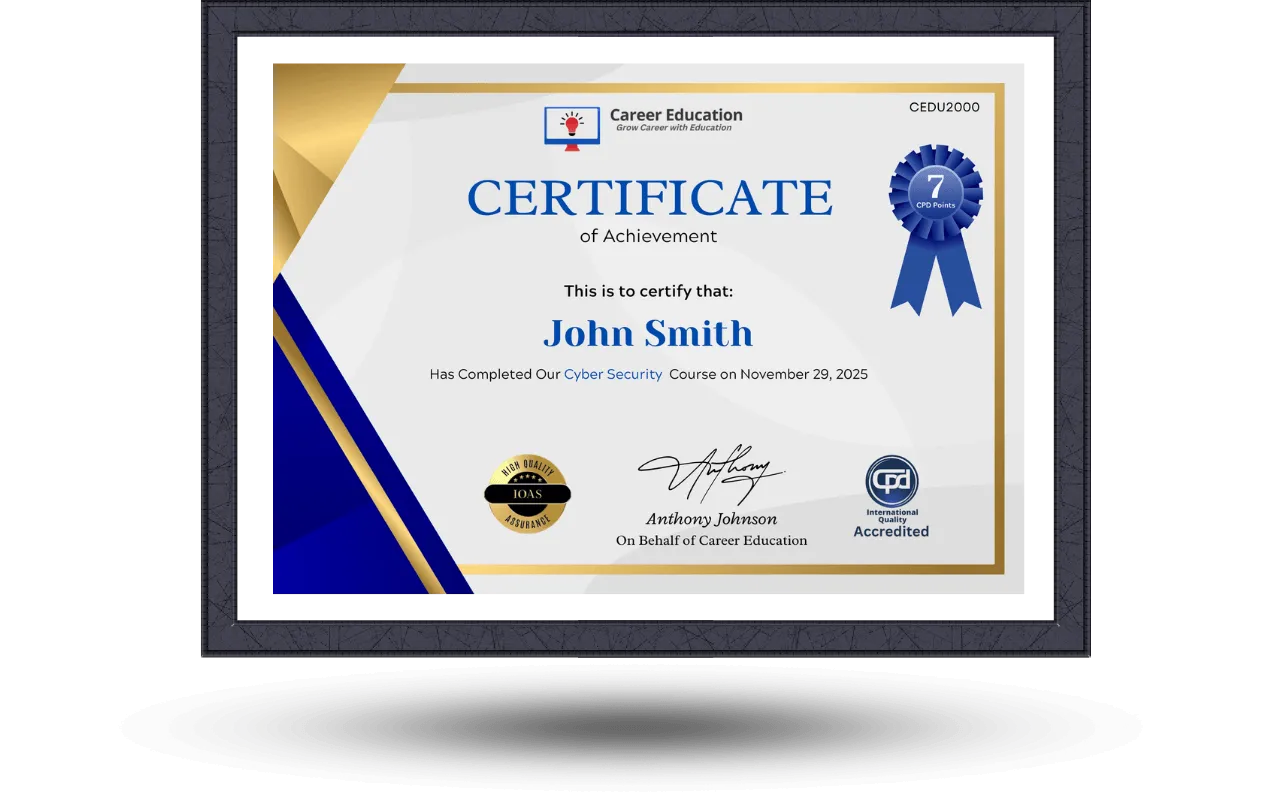
Upon completion of any course, all students are entitled to a CPD IQ Accredited e-certificate that will be issued by Career Education signifying the completion of your course.
After you complete the course and assignment, you will be eligible to order a free certificate accredited by CPD International Quality by completing the form below.
Hardcopy certificates and transcripts are also available for a small additional fee. More information is disclosed upon course completion.
Similar Courses




Frequently Asked Questions
The lifetime membership includes unlimited access to all courses, resources, and updates for a one-time fee.
You can purchase the membership directly from our website using a secure checkout process.
Yes, selected courses can be downloaded for offline access through our mobile app.
Yes, all future updates and new courses are included at no extra cost.
Yes, we offer a 30-day money-back guarantee if you are not satisfied with the membership.