
94%
OFF
OFF
Geology Training
- Lifetime Access
- All Levels
- PDF Certificate
£296
£19
14-Day Money-Back Guarantee
Learn With Confidence








# Geology Training
Explore the forces, materials, processes and history that have shaped our planet with comprehensive **Geology Training**.
Geology is the study of the Earth, its materials, structure, history and the natural processes that continue to transform its surface and interior. From the formation of mountains and oceans to earthquakes, volcanoes, minerals and changing landscapes, geology helps us understand how the planet works and how it has evolved over immense periods of time.
The knowledge gained through geology has applications across numerous fields, including environmental science, construction, engineering, mining, natural resource management, environmental assessment, education and scientific research.
Our **Geology Training** provides a structured introduction to fundamental geological concepts. Across six modules, you will explore the foundations of geology, Earth’s structure and plate tectonics, surface processes, geophysical processes, minerals and Earth materials, geological time and the history of our planet.
Whether you are beginning your study of Earth sciences, interested in natural processes, considering a career connected to geology or simply want to understand more about the planet beneath your feet, this course provides an accessible foundation for further learning.
## Why Study Geology?
Earth is a dynamic planet.
The mountains, valleys, coastlines and rocks we see today are the result of processes that have operated over millions and billions of years. Some processes happen gradually, while others, such as earthquakes and volcanic eruptions, can transform landscapes rapidly.
Geology provides a framework for understanding these changes.
Learning geology can help you understand why different rocks and minerals occur in particular locations, how landscapes develop, what causes tectonic activity and how scientists reconstruct Earth’s history.
The **Geology Training** course introduces these concepts progressively, allowing you to build knowledge from basic geological principles towards more detailed topics involving Earth’s interior, materials and geological history.
## Course Learning Outcomes
By completing the **Geology Training** course, you will develop the knowledge to:
* Explain the fundamental principles of geology.
* Understand the major components and structure of the Earth.
* Explore the principles of plate tectonics.
* Understand how tectonic movement influences Earth’s surface.
* Explore weathering, erosion and other surface processes.
* Understand how landscapes evolve over time.
* Develop awareness of Earth’s interior and geophysical processes.
* Identify fundamental concepts relating to minerals and Earth materials.
* Understand the importance of mineral properties in geological study.
* Explore geological time and methods of understanding Earth’s history.
* Develop a broader understanding of major geological events.
* Appreciate the relationship between geological processes and the landscapes around us.
* Build a foundation for further study in Earth sciences and related disciplines.
—
# Module 1: Introduction to Geology
The first module introduces the fascinating world of geology.
You will explore what geology is, what geologists study and why understanding Earth’s materials and processes is important.
Geology encompasses a broad range of subjects. It examines rocks and minerals, Earth’s structure, geological processes, landscapes and the history of the planet.
The module introduces the fundamental concepts needed to understand these different areas.
You will begin to explore how Earth has changed over geological time and how scientists use evidence from rocks, minerals, landscapes and other geological features to understand those changes.
The module also highlights the relationship between geology and other scientific disciplines.
Geology can overlap with environmental science, geography, physics, chemistry and other Earth sciences.
Developing a basic understanding of geology can therefore provide useful context for many related fields.
You will also consider why geology matters in the modern world.
Knowledge of geological processes can contribute to understanding natural hazards, resources, environmental change and the physical environment in which communities and infrastructure exist.
By completing this module, you will have a strong foundation for the geological concepts explored throughout the rest of the course.
—
# Module 2: Earth’s Structure and Plate Tectonics
The second module explores Earth’s structure and the theory of plate tectonics.
Understanding the structure of our planet is essential for understanding many geological processes.
Earth is composed of several major layers, each with different characteristics and properties. These layers interact in ways that contribute to the dynamic nature of the planet.
You will explore the basic structure of Earth and develop awareness of how scientists study its interior.
The module then introduces plate tectonics, one of the central concepts in modern geology.
Earth’s outer rigid layer is divided into large plates that move over geological time. Their interactions help explain the distribution of many geological features and events.
You will explore how plate boundaries are associated with processes such as mountain building, earthquakes and volcanic activity.
The course helps you understand that Earth’s surface is not static.
Continents and ocean basins have changed position over geological time, and tectonic processes continue to shape the planet today.
By completing this module, you will develop a clearer understanding of why tectonic activity occurs and how it influences Earth’s surface.
—
# Module 3: Surface Processes and Landscape Evolution
The landscapes around us are constantly changing.
Module 3 examines surface processes and landscape evolution, helping you understand how Earth’s surface is shaped by natural forces.
Processes such as weathering, erosion, transportation and deposition can gradually transform rocks and landscapes.
Water, wind, ice and gravity all contribute to the continual reshaping of Earth’s surface.
You will explore how these processes interact and how they can produce different landforms.
Rivers can carve valleys and transport sediment. Glaciers can reshape landscapes. Wind can move and deposit sediment. Coastal processes can alter shorelines.
Over long periods, these processes can produce significant changes.
The module helps you understand the difference between individual surface processes and the larger landscape changes they can create over time.
You will also develop greater awareness of how geological and environmental processes interact.
Understanding landscape evolution can be valuable in fields involving environmental assessment, geography, construction and land management.
By completing this module, you will gain a stronger appreciation of how the landscapes we see today are products of ongoing geological processes.
—
# Module 4: Earth’s Interior and Geophysical Processes
Module 4 takes you deeper into the Earth.
You will explore Earth’s interior and the geophysical processes that influence the planet.
The Earth’s interior cannot be directly observed in the same way as its surface. Scientists therefore rely on evidence from methods such as seismic activity and other geophysical observations to develop models of Earth’s internal structure.
You will explore the importance of these scientific approaches and how they contribute to our understanding of the planet.
The module also examines geophysical processes and their relationship to geological activity.
Earth’s internal heat contributes to dynamic processes that influence tectonic movement and other geological phenomena.
You will develop awareness of how processes occurring deep within Earth can ultimately affect the surface.
This connection between Earth’s interior and its surface is one of the most fascinating aspects of geology.
The module encourages you to consider the planet as an interconnected system in which processes operating at different depths can influence one another.
By completing this module, you will have a broader understanding of Earth’s interior and the geophysical forces that contribute to its dynamic behaviour.
—
# Module 5: Earth Materials and Minerals
Rocks and minerals provide some of the most important evidence used by geologists.
Module 5 explores Earth materials and minerals, helping learners develop a foundation in the materials that make up our planet.
You will explore the fundamental characteristics of minerals and why their properties are important in geological study.
Minerals can be identified and distinguished using characteristics such as composition, structure and physical properties.
Understanding these characteristics can help learners appreciate how geologists examine and classify Earth materials.
The module also introduces the wider significance of geological materials.
Rocks and minerals are not simply scientific objects. They can have important roles in construction, industry, technology and natural resource management.
Geological materials also provide evidence about the conditions under which they formed.
By examining rocks and minerals, scientists can gain insight into geological environments and events that occurred in the past.
The module therefore connects the study of Earth materials with the wider geological processes explored throughout the course.
By completing this module, you will develop greater awareness of the importance of minerals and other Earth materials in understanding our planet.
—
# Module 6: Geological Time and Earth’s History
The final module explores geological time and Earth’s history.
Earth is approximately 4.5 billion years old, meaning that many geological processes operate on timescales far beyond ordinary human experience.
Geologists use the concept of geological time to organise and interpret this vast history.
You will explore how scientists divide Earth’s history into different intervals and how evidence from rocks and fossils can help reconstruct the past.
The geological record provides information about ancient environments, major geological events and changes in life on Earth.
You will develop an understanding of why geological time is essential for interpreting Earth’s development.
The module also encourages you to consider the immense timescales involved in geological processes.
Mountains can rise and erode, oceans can open and close, and climates and ecosystems can change over periods spanning millions of years.
Understanding geological time helps place these changes into context.
By completing this module, you will have a broader understanding of Earth’s history and the evidence scientists use to reconstruct it.
—
# Develop a Deeper Understanding of Earth
The **Geology Training** course is designed to give you a broad foundation in Earth science.
Rather than focusing on one narrow geological topic, it introduces the major concepts needed to understand how Earth works.
From plate tectonics and surface processes to minerals, geophysics and geological time, the course provides a connected overview of the planet.
## Understand Earth’s Structure
Earth’s internal structure provides the foundation for understanding many geological processes.
The course explores the major components of the planet and introduces how scientists develop knowledge about its interior.
## Explore Plate Tectonics
Plate tectonics is one of the fundamental ideas in geology.
Understanding plate movement can help explain earthquakes, volcanoes, mountain ranges and other major geological features.
The course introduces these relationships and helps you understand why Earth’s surface changes over time.
## Understand Landscape Formation
The landscapes we see are the result of interacting geological and environmental processes.
The course explores weathering, erosion, deposition and other processes that shape Earth’s surface.
This can help you interpret the origins and evolution of different landforms.
## Explore Earth’s Internal Processes
Many geological processes begin beneath Earth’s surface.
The course introduces geophysical processes and explains how Earth’s interior can influence activity at the surface.
This provides a more complete understanding of Earth as a dynamic system.
## Develop Mineral Awareness
Minerals are fundamental components of Earth’s crust.
Learning about their characteristics and importance can provide valuable foundations for understanding rocks, geological environments and natural resources.
## Understand Geological Time
Geological processes often occur over immense timescales.
The course introduces geological time and explores how scientists reconstruct Earth’s long and complex history.
—
# Who Is This Geology Training For?
The **Geology Training** course can be suitable for:
* Beginners interested in geology.
* Earth science students.
* Geography students.
* Environmental science learners.
* Engineering students.
* Construction professionals seeking geological awareness.
* Individuals interested in natural resources.
* Environmental professionals.
* Teachers and educators seeking additional subject knowledge.
* Nature and Earth science enthusiasts.
* Anyone interested in understanding how our planet works.
The course is particularly suitable for learners who want an accessible introduction before progressing to more specialised geological study.
## Support Your Academic and Professional Development
Geology has connections with many academic and professional disciplines.
Understanding geological processes can complement studies in geography, environmental science, engineering, construction, natural resources and related areas.
For professionals, geological awareness can also provide useful context when considering landscapes, materials, natural hazards and the physical environment.
The course is designed as a foundation and does not replace practical fieldwork, laboratory experience or specialist professional qualifications where these are required.
## Develop Scientific Thinking
Geology encourages evidence-based thinking.
Geologists examine physical evidence and use observations, measurements and scientific models to understand processes that may have occurred millions or billions of years ago.
Studying geology can therefore help develop an appreciation for how scientific evidence is used to investigate complex questions.
## Understand the World Beneath Your Feet
Every landscape has a geological story.
The rocks beneath a city, the shape of a mountain range, the course of a river and the composition of a coastline can all provide clues about the processes that created them.
The **Geology Training** course gives you the knowledge to begin interpreting these stories.
# Why Choose the Geology Training Course?
The **Geology Training** course provides a six-module learning journey covering:
1. Introduction to Geology.
2. Earth’s Structure and Plate Tectonics.
3. Surface Processes and Landscape Evolution.
4. Earth’s Interior and Geophysical Processes.
5. Earth Materials and Minerals.
6. Geological Time and Earth’s History.
The curriculum progresses logically from fundamental geological concepts to the processes shaping Earth and the evidence used to understand its past.
This approach makes the course suitable for beginners while providing a foundation for further exploration.
## Build a Foundation for Further Study
Geology is an extensive scientific discipline, with specialised areas including mineralogy, petrology, structural geology, sedimentology, geophysics, palaeontology, hydrogeology and environmental geology.
The **Geology Training** course can help you identify the areas that interest you most and provide foundational knowledge before progressing into more specialised learning.
## Start Your Geology Learning Journey Today
Earth is constantly changing.
The mountains, oceans, rocks, minerals and landscapes around us are all part of a much larger geological story that stretches back billions of years.
Understanding that story can change the way you see the natural world.
The **Geology Training** course provides a structured introduction to the principles behind Earth’s structure, plate tectonics, surface processes, geophysical activity, minerals, Earth materials and geological time.
Whether you are studying Earth sciences, exploring a career connected to geology or simply fascinated by the forces that shape our planet, this course gives you an opportunity to build a strong foundation of geological knowledge.
**Enrol in Geology Training today and begin exploring the science behind Earth’s structure, materials, landscapes, geological processes and extraordinary history.**
Course Modules
Course Content
Module 1_ Introduction to Geology
-
Lesson 1_ Introduction to Geology
Module 2_ Earth_s Structure and Plate Tectonics
Module 3_ Surface Processes and Landscape Evolution
Module 4_ Earth_s Interior and Geophysical Processes
Module 5_ Earth Materials and Minerals
Module 6_ Geological Time and Earth_s History
What our students say
Excellent
4.9 average
158 Reviews

Earn an Accredited Certificate
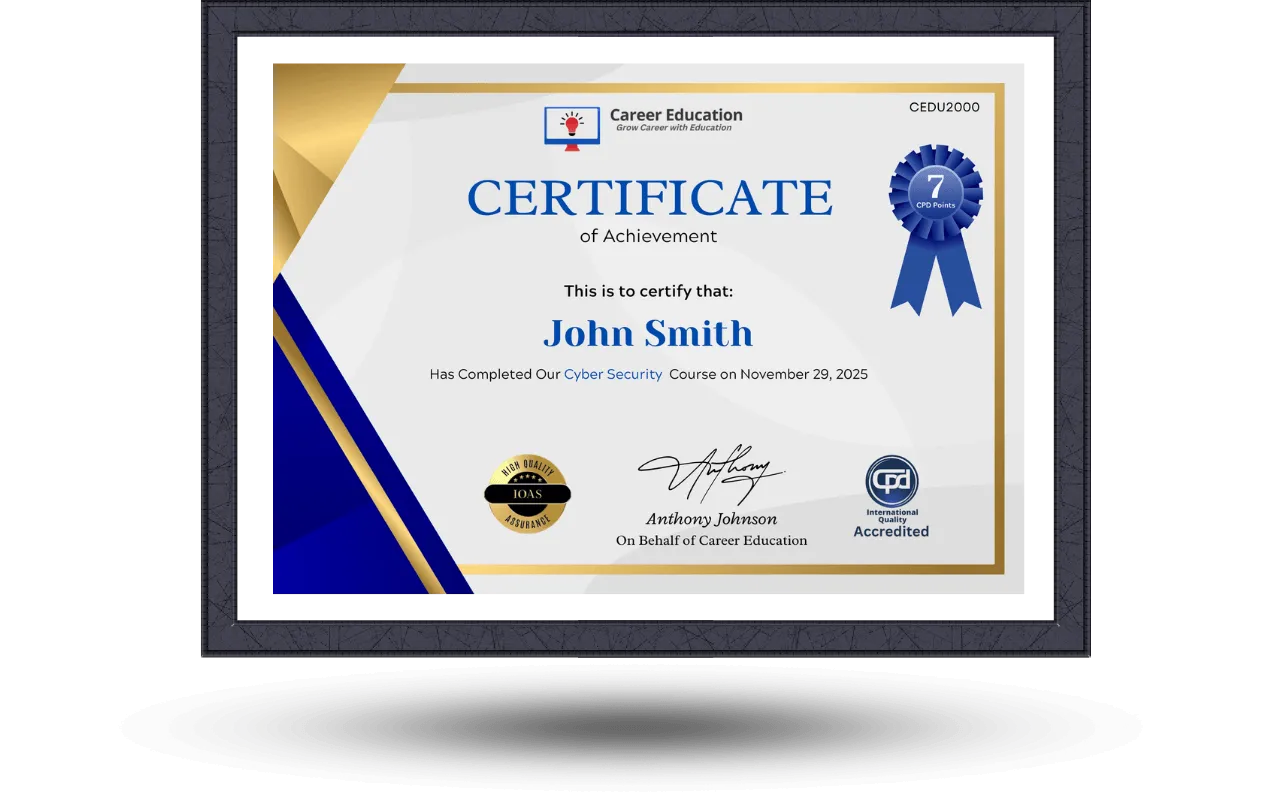
Upon completion of any course, all students are entitled to a CPD IQ Accredited e-certificate that will be issued by Career Education signifying the completion of your course.
After you complete the course and assignment, you will be eligible to order a free certificate accredited by CPD International Quality by completing the form below.
Hardcopy certificates and transcripts are also available for a small additional fee. More information is disclosed upon course completion.
Similar Courses




Frequently Asked Questions
The lifetime membership includes unlimited access to all courses, resources, and updates for a one-time fee.
You can purchase the membership directly from our website using a secure checkout process.
Yes, selected courses can be downloaded for offline access through our mobile app.
Yes, all future updates and new courses are included at no extra cost.
Yes, we offer a 30-day money-back guarantee if you are not satisfied with the membership.