
94%
OFF
OFF
Data Science Course: Python, Machine Learning and Real-World Projects
- Lifetime Access
- All Levels
- PDF Certificate
£296
£19
14-Day Money-Back Guarantee
Learn With Confidence






Develop a comprehensive understanding of data science and learn how to transform raw information into meaningful insights with this practical data science course. Designed for learners who want to understand the complete data science process, this course introduces the tools, analytical techniques and machine learning concepts used to investigate data and solve real-world problems.
Data science combines statistics, programming, analytical thinking and domain knowledge to extract useful information from datasets. Organisations use data science to understand customer behaviour, identify trends, improve operations, forecast outcomes and support evidence-based decisions.
However, working in data science requires more than knowing how to use a programming language or apply an algorithm. You need to understand how data is collected, cleaned, explored, analysed and transformed into useful results. You must also know how to interpret findings and communicate them clearly.
Throughout this course, you will explore the complete data science workflow, including data preparation, exploratory data analysis, visualisation, statistical concepts, Python programming and introductory machine learning. You will develop an understanding of how these techniques work together when investigating practical problems.
The course also focuses on the importance of hands-on projects. Applying analytical concepts to realistic scenarios can help you understand how to approach datasets, identify meaningful patterns and communicate findings.
By the end, you will have a stronger foundation in data science and a clearer understanding of how to approach projects from initial problem definition through to analysis and interpretation.
What You Will Learn
By completing this course, you will be able to:
-
Explain the fundamentals of data science and its applications.
-
Understand the stages of a data science workflow.
-
Explore Python programming for data analysis.
-
Work with data structures and common analytical libraries.
-
Understand data collection and preparation.
-
Identify and handle missing or inconsistent information.
-
Perform exploratory data analysis.
-
Apply introductory statistical concepts.
-
Create visual representations of datasets.
-
Identify trends, relationships and patterns.
-
Understand introductory machine learning methods.
-
Evaluate basic predictive models.
-
Interpret analytical findings.
-
Communicate insights using appropriate visualisations and explanations.
-
Approach data science projects in a structured way.
Who Is This For?
Complete beginners: Develop an understanding of data science concepts and the stages involved in analysing information.
Aspiring data scientists: Build foundational technical and analytical knowledge for further study and practical development.
Students: Explore Python, statistics, visualisation and machine learning as part of your academic or professional development.
Business professionals: Understand how data analysis can support organisational decisions and improve processes.
Data analysts: Expand your knowledge towards data science and introductory predictive modelling.
Python learners: Apply programming skills to practical data analysis and machine learning tasks.
Career changers: Explore data science as a potential technology and analytical career direction.
Requirements / Prerequisites
No professional data science experience is required. The course is designed to introduce the subject progressively and help learners understand the main stages of a data science project.
Basic computer skills are useful. Previous Python programming experience may be beneficial, but beginners who are willing to practise can develop their understanding through the introductory topics.
A basic understanding of mathematics, particularly arithmetic, percentages and introductory statistics, can help you understand analytical concepts. Advanced mathematical knowledge is not required to begin.
Access to a computer and an internet connection will be useful. You may also benefit from using a Python development environment and common data science libraries.
Course Content and Learning Journey
Module 1: Introduction to Data Science
Explore the meaning and purpose of data science. Understand how it combines programming, statistics and domain knowledge to investigate questions and solve practical problems.
Module 2: Understanding the Data Science Workflow
Learn about the stages of a data science project, from identifying a problem and collecting information to preparing datasets, analysing results and communicating findings.
Module 3: Python Programming for Data Science
Explore Python fundamentals and understand how the language supports data analysis. Learn about variables, data types, lists, dictionaries, conditions, loops and functions.
Module 4: Working with Data Using Python Libraries
Understand how libraries such as NumPy and pandas support numerical operations and data manipulation. Explore how datasets can be loaded, inspected, organised and transformed.
Module 5: Data Cleaning and Preparation
Learn why data quality is important. Explore missing values, duplicate records, inconsistent formats and other common data problems. Understand how preparation improves the reliability of analysis.
Module 6: Exploratory Data Analysis and Statistics
Develop techniques for investigating datasets and identifying important characteristics. Explore descriptive statistics, distributions, relationships and introductory statistical reasoning.
Module 7: Data Visualisation and Reporting
Learn how charts and visual representations can make data easier to understand. Explore common visualisation approaches and how to communicate patterns and trends clearly.
Module 8: Introduction to Machine Learning
Understand the relationship between data science and machine learning. Explore supervised and unsupervised learning, introductory classification and regression, and the general model development process.
Module 9: Practical Data Science Projects
Apply the concepts covered throughout the course to realistic analytical scenarios. Explore how to define a problem, prepare a dataset, investigate information, develop analysis and interpret results.
Module 10: Presenting Findings and Developing Your Data Science Skills
Learn how to organise analytical findings into meaningful reports and presentations. Explore how to explain methods, communicate limitations and identify opportunities for further investigation.
Skills You Will Develop
This course will help you develop technical, analytical and communication skills.
Python programming will support your ability to work with datasets and automate analytical tasks. Knowledge of data manipulation will help you organise information, identify quality issues and prepare data for analysis.
Statistical understanding will help you interpret numerical information and recognise patterns. Visualisation skills will allow you to communicate findings through charts and other graphical representations.
You will also develop an introductory understanding of machine learning and predictive modelling. These concepts can help you explore how data is used to build systems that identify patterns and estimate outcomes.
Problem-solving will be an important part of your development. You will learn to approach analytical questions systematically, examine available information and explain what the results may indicate.
Practical Applications
Data science can be applied across numerous industries.
In retail, data analysis can help investigate customer preferences, sales trends and product demand. In finance, analytical methods can support risk analysis, forecasting and the investigation of financial patterns.
Healthcare researchers may use data science to explore large datasets and investigate relationships between different variables. In marketing, analysis can help organisations understand campaign performance and customer engagement.
In logistics and manufacturing, data analysis can support operational planning, quality monitoring and process improvement.
The practical concepts covered in this course can help you understand how these applications work. Real-world implementation requires appropriate data access, domain knowledge, ethical data handling and careful validation.
Career Path
Data science knowledge can support progression towards several analytical and technology-related roles.
-
Junior Data Analyst: Collect, organise and analyse information to support reporting and decision-making.
-
Data Science Assistant: Support data preparation, exploratory analysis and project activities.
-
Junior Data Scientist: Develop further skills in statistical analysis and machine learning.
-
Business Intelligence Analyst: Use data visualisation and reporting to communicate business performance.
-
Python Data Analyst: Apply Python-based tools to data manipulation and analysis.
-
Machine Learning Assistant: Support introductory modelling and evaluation activities.
-
Research Assistant: Work with datasets and analytical methods in research environments.
These are potential career directions rather than guaranteed employment outcomes. Employers may require practical portfolios, stronger statistical knowledge, programming experience and familiarity with additional analytical tools.
Why Learn Data Science?
Data is an important resource for modern organisations, but information only becomes useful when it is understood and interpreted correctly.
Data science helps bridge the gap between raw information and meaningful insights. Learning the complete workflow can help you understand how to approach analytical questions, prepare datasets and communicate findings.
The combination of Python, statistics, visualisation and machine learning also provides a flexible foundation for further technical learning.
Conclusion
This data science course introduces the complete analytical workflow, from understanding a problem and preparing data to exploring patterns, building introductory models and communicating results.
By completing the course, you will have a stronger foundation in Python, data preparation, statistics, visualisation and machine learning. Whether you want to explore a data science career, strengthen your analytical abilities or develop practical projects, this course will help you build the knowledge needed to progress.
Course Modules
Course Content
Getting Started with Confidence
-
1. Welcome To Data Science A-Z™
00:00 -
2. BONUS Learning Paths
Understanding the Fundamentals of Data Science
Section 1: Data Visualisation
Getting Started with Tableau
Using Tableau for Effective Data Mining
Advanced Data Mining Techniques Using Tableau
Section 2: Data Modelling
Statistics Fundamentals Refresher
Introduction to Simple Linear Regression
Understanding Multiple Linear Regression
Exploring Logistic Regression Models
Creating a Reliable Geodemographic Segmentation Model
Evaluating Model Performance
Extracting Valuable Insights from Your Model
Maintaining and Optimising Your Model
Section 3: Data Preparation
Introduction to Business Intelligence (BI) Tools
ETL Phase 1: Data Wrangling Before Loading
ETL Phase 2: Uploading Data with SSIS – A Step-by-Step Guide
Resolving Common ETL Errors in Phases 1 & 2
SQL Programming Essentials for Data Science
ETL Phase 3: Data Wrangling After Loading
Troubleshooting ETL Issues in Phase 3
Section 4: Communication Skills
Effective Collaboration and Teamwork
Presentation Skills for Data Scientists
Assignment Solutions and Explanations
Additional Bonus Lessons
What our students say
Excellent
4.9 average
168 Reviews

Earn an Accredited Certificate
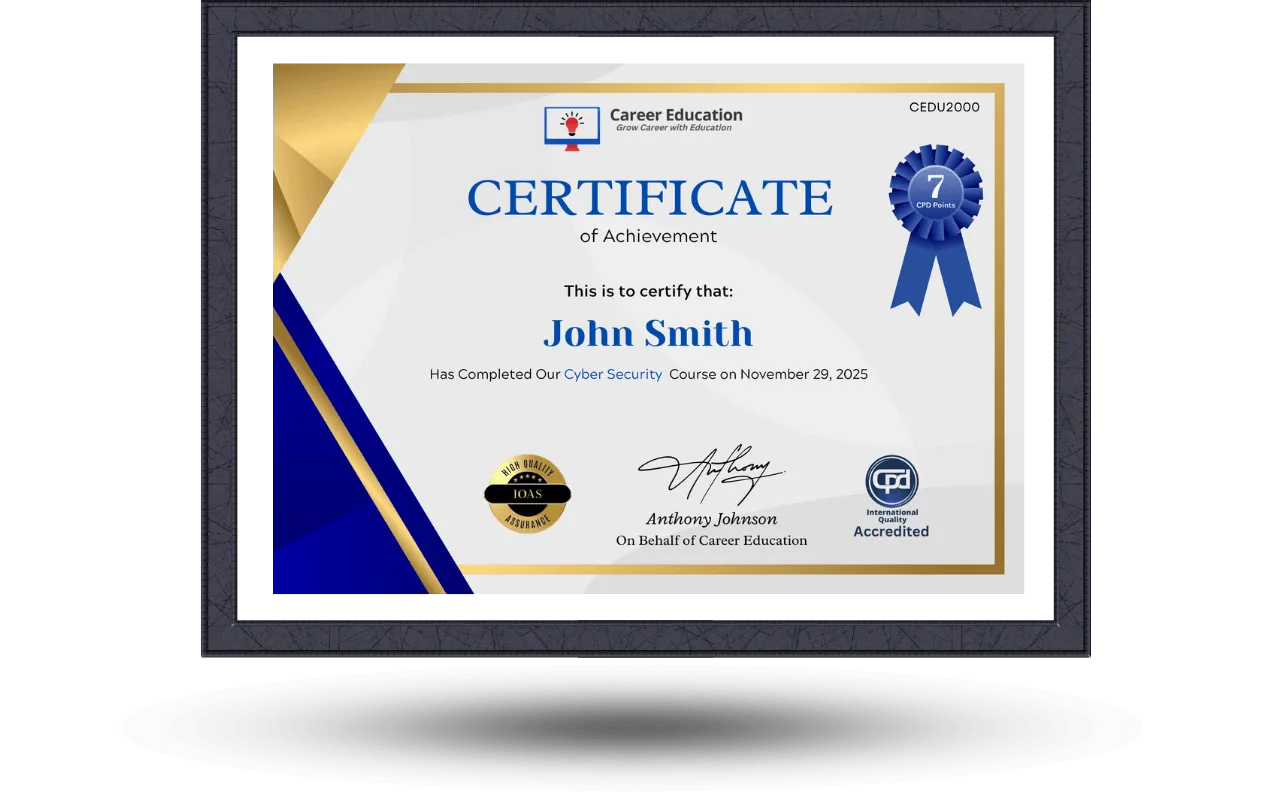
Upon completion of any course, all students are entitled to a CPD IQ Accredited e-certificate that will be issued by Career Education signifying the completion of your course.
After you complete the course and assignment, you will be eligible to order a free certificate accredited by CPD International Quality by completing the form below.
Hardcopy certificates and transcripts are also available for a small additional fee. More information is disclosed upon course completion.
Similar Courses




Frequently Asked Questions
The lifetime membership includes unlimited access to all courses, resources, and updates for a one-time fee.
You can purchase the membership directly from our website using a secure checkout process.
Yes, selected courses can be downloaded for offline access through our mobile app.
Yes, all future updates and new courses are included at no extra cost.
Yes, we offer a 30-day money-back guarantee if you are not satisfied with the membership.