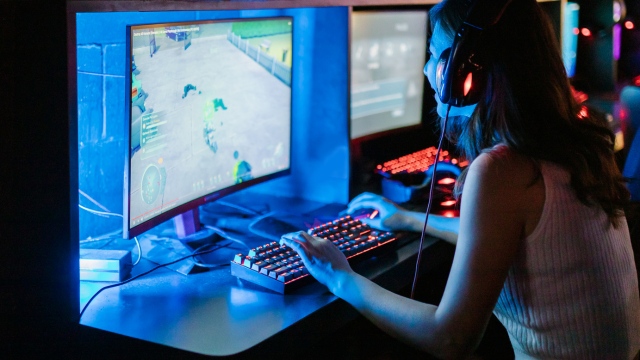

Computer Games and Game Development bring together technology, art, storytelling, psychology and problem-solving in a way few other creative industries do. A finished game may look effortless to the player, yet even a relatively small project can require programmers, designers, artists, animators, audio specialists, testers and producers working through hundreds of interconnected decisions.
Games also vary enormously. A mobile puzzle game may be created by a tiny independent team. A large open-world title can involve hundreds or even thousands of people across several studios. Virtual reality introduces another set of interaction problems, while online games need servers, networking and continuing support long after release.
So How are computer games made? There is no single recipe. Most projects move through concept development, prototyping, production, testing and release, but the details depend on the genre, platform, budget and team.
For people researching how to become a game developer, the good news is that there are many entry points. Programming is one. Game design, 3D art, animation, production, technical art, audio and quality assurance are others. The challenge is identifying which part of video game development genuinely suits your abilities rather than trying to learn everything at once.
What Are Computer Games?
Computer games are interactive software experiences designed for entertainment, challenge, storytelling, competition, creativity or social interaction. In other words, they are digital games that allow users to participate, respond and make choices.
They can run on:
- PCs;
- consoles;
- smartphones;
- tablets;
- handheld systems; and
- virtual or augmented reality devices.
What separates a game from most other media is interaction, or active participation. A film presents a predetermined sequence. A game responds to what the player does.
Pressing a button may move a character, alter a dialogue, fire a weapon, change a strategy or reshape the story. That creates one of the defining challenges of game development: developers are not designing only what the audience sees. They are designing what the audience can do or control.
How Computer Games Evolved
Modern games are the result of decades of changes in computing power, graphics, storage, networking and design thinking.
Early computer games worked within severe hardware limitations, or technical restrictions. Developers had extremely little memory, simple displays and limited processing power.
Those constraints, or limitations, shaped the games themselves.
Arcade games became particularly influential because developers needed experiences that players could understand quickly but wanted to play repeatedly.
Home consoles later moved gaming into living rooms, while personal computers encouraged genres that benefited from keyboards, mice and more flexible hardware.
The 8-bit and 16-bit eras brought increasingly recognisable characters, richer sound and more sophisticated level design. The transition towards 32-bit and 64-bit hardware accelerated 3D gaming.
Internet connectivity then transformed multiplayer experiences. Smartphones changed distribution again by putting games into devices billions of people already carried.
Independent developers benefited from accessible engines and digital storefronts, making it more practical for small teams to reach international audiences.
If you want a structured introduction to these historical changes, Career Education’s Evolution of Computer Games course follows the journey from early computing and arcades through consoles, online play, mobile gaming, indie development and VR/AR.
That history matters because older technical limitations often explain modern design conventions, or established design practices.
How Are Computer Games Made?
How are computer games made? A typical process begins long before somebody starts creating detailed graphics.
The first question is usually conceptual, meaning related to the main idea.
What is the player actually going to do?
A team might begin with an idea such as:
“A cooperative survival game where two players explore an abandoned underwater research station.”
That description still leaves hundreds of questions.
What threatens the players?
How do they move?
What resources do they collect?
Can they communicate freely?
What happens when one player fails?
What makes the experience enjoyable after an hour rather than only during the first five minutes?
Game development turns these questions into systems, or connected gameplay structures.
Stage One: Concept and Game Design
The concept defines the central idea. Designers then start exploring how the experience should work.
They consider the game’s core loop, meaning the repeated cycle of actions players perform throughout the experience.
For a racing game, that may involve choosing a vehicle, racing, earning rewards, improving the vehicle and entering harder races.
For a strategy game, the loop could involve gathering resources, developing territory, building forces and responding to opponents.
A strong core loop does not guarantee a good game development skills. But if the central activity is not enjoyable, beautiful graphics usually cannot rescue it.
Game Mechanics
Mechanics are the rules or systems governing interaction.
Examples include:
- jumping;
- shooting;
- crafting;
- trading;
- stealth;
- dialogue choices;
- resource management; and
- character progression.
Designers need to think about how those mechanics interact, or work together.
One simple mechanic can become interesting when combined with another. A movement ability might also become a combat tool. A limited inventory system can force difficult choices about resources.
Good game development skills design creates meaningful decisions rather than simply adding features.
Stage Two: Prototyping
A prototype, or early working model, tests whether an idea actually works.
It may look terrible. That is fine.
The objective is to answer important questions before the team spends months producing polished assets.
Imagine a developer designing a puzzle game development skills based on reversing gravity.
Instead of modelling beautiful environments immediately, they might create a simple room using blocks and basic colours.
Can the player understand the gravity mechanic?
Does it create interesting puzzles?
Does controlling it feel satisfying?
If the answer is no, the team can change the idea cheaply.
Discovering the same problem after a year of art production would be much more expensive.
Prototyping is therefore one of the most valuable game development skills. It teaches developers to test ideas rather than become attached to descriptions of ideas.
Stage Three: Pre-Production
Once the core concept seems viable, the team needs a clearer plan.
Pre-production may establish the visual direction, technical architecture, production schedule, platform targets and major gameplay systems.
Concept artists explore characters and environments. Designers build levels or systems. Programmers investigate technical risks. Producers estimate how much work the project will require.
This is also where scope, or project size and boundaries, becomes important.
A first-time indie team may dream of creating an online open-world role-playing game development skills with hundreds of characters and endless procedural content.
Technically, some elements might be possible. Producing and testing them to professional quality may not be.
Learning to reduce scope is an underrated development skill.
A small game finished well is much more valuable as a portfolio project than an enormous game that never moves beyond the prototype.
Stage Four: Programming
Programmers turn game rules and systems into functioning software.
Their work can include player controls, physics, artificial intelligence, user interfaces, networking, tools and graphics technology.
Different programming roles specialise further.
A gameplay programmer may implement weapons, character movement or game development skills mechanics.
An AI programmer works on behaviours for computer-controlled characters.
A graphics programmer deals with rendering technology.
A network programmer develops multiplayer systems.
A tools programmer creates software that allows other developers to work more efficiently.
This is why “learn coding” is useful but incomplete advice for somebody interested in programming games. You eventually need to understand what kind of programming problem interests you.
Programming Languages in Game Development
C++ remains particularly important in high-performance game development skills development and is closely associated with Unreal Engine.
C# is widely associated with Unity development.
Other languages and scripting systems appear depending on the studio, engine and platform.
Beginners often worry about choosing the perfect language. That matters less than learning fundamental programming concepts.
Variables, data structures, functions, object-oriented design, debugging and problem-solving transfer between technologies.
A developer who understands programming can learn another syntax. Someone who has memorised a collection of engine tutorials without understanding the underlying logic can struggle when a problem looks different from the tutorial.
Game Engines
A game engine provides systems that developers would otherwise have to build themselves.
Modern engines can handle areas such as:
- rendering;
- physics;
- animation;
- audio;
- input;
- level editing; and
- asset management.
Unreal Engine and Unity are among the most recognisable commercial engines, while Godot and studio-specific proprietary engines are also used.
Epic’s current Unreal Engine 5.8 documentation, for example, introduces developers to C++ programming, Blueprint visual scripting, level creation, assets and cinematics.
The engine is a tool rather than the profession.
Learning where buttons are located in an editor is different from understanding video game development skills development.
Good developers understand why systems work and can solve problems when the engine does not automatically provide the answer.
Stage Five: Game Art
Games need visual assets, or digital creative resources.
Depending on the project, those can include:
- characters;
- environments;
- props;
- textures;
- user-interface graphics;
- visual effects; and
- concept art.
A large studio usually separates these into specialist roles.
A concept artist explores visual ideas. A character artist builds detailed characters. An environment artist creates locations.
A texture or material artist develops surface appearance. A technical artist helps connect artistic goals with engine and performance constraints.
Small indie teams may combine several of these roles.
Art also needs to serve gameplay. A visually realistic corridor can still fail if players cannot understand which door can be opened.
Strong game development skills art guides attention as well as creating atmosphere, or mood.
Animation
Animation gives characters and objects believable movement.
A character may need idle, walking, running, jumping, climbing, attacking and reaction animations.
Those animations also need to transition smoothly.
Modern games can use motion capture, hand animation, procedural methods or combinations of them.
Animation is not merely cosmetic. Timing affects how controls feel.
If an action animation is too slow, the player may feel that the game development skills is unresponsive.
If movement does not communicate weight properly, an enormous creature may appear strangely lightweight.
Game animation therefore exists at the intersection of visual performance and interaction.
Audio and Music

Players often notice game audio most when it goes wrong.
Sound communicates information continuously.
Footsteps can indicate that an enemy is nearby. A changing soundtrack can tell the player that danger has begun before anything appears visually.
Interface sounds confirm actions. Environmental audio establishes atmosphere.
Audio professionals may record, edit and implement sound effects, dialogue and music.
Implementation matters because game development skills audio is interactive.
A film soundtrack plays through a fixed timeline. Game music may need to change dynamically depending on what the player does.
That makes audio another systems problem.
Level Design
Level designers create spaces in which gameplay happens.
They need to understand both architecture and player behaviour.
A good level guides the player without always making the guidance obvious.
Lighting, landmarks, paths and enemy placement can all influence movement.
The designer also controls pacing, or the speed and rhythm of gameplay.
After an intense combat sequence, the player may need a quieter area to explore.
A puzzle may introduce one mechanic in a simple form before combining it with additional complications later.
Level design is therefore not simply decorating a map. It is designing the sequence of experiences inside that space.
User Interface and User Experience
Games need interfaces just like other digital products.
Players need to understand objectives, settings, inventories, health, resources and other information.
Good UI communicates without overwhelming the screen.
Good UX goes further and considers the complete experience.
How easily can a new player understand the controls?
Can text be resized?
Can control bindings be changed?
Can somebody who cannot distinguish certain colours still interpret important information?
Accessibility has become an increasingly important part of modern game development skills design.
A technically playable game is not necessarily equally usable by everyone.
Narrative and Storytelling
Not every game development skills needs a complex story.
Some depend almost entirely on mechanics. Others build detailed worlds involving dialogue, characters and branching narratives.
Interactive storytelling differs from novels and films because the player’s actions can affect pacing or outcomes.
A writer cannot always control exactly when the player encounters information.
Narrative designers therefore work closely with gameplay systems.
A moral choice only becomes meaningful if the player understands the context and consequences.
Long dialogue alone does not create interactive storytelling. The narrative needs to work with the player’s agency, or ability to make meaningful choices.
Production: Keeping the Game Moving
Game producers help organise development.
They coordinate teams, schedules, priorities and resources.
ScreenSkills describes producers as central connectors who help get the right people together, manage budgets and keep production moving despite problems.
This is essential because games contain thousands of dependencies, or connected tasks.
An animator may be waiting for a character model.
A programmer may need final interface designs.
A level designer may need an unfinished gameplay system.
Production helps identify these dependencies before they block the entire team.
Strong producers are not merely people who hold meetings. They make it easier for specialists to complete their work.
Testing and Quality Assurance
game development skills are extraordinarily difficult to test because players can behave unpredictably.
A player may approach a level in the opposite order from what the designer intended, combine abilities unexpectedly or repeatedly interact with an object the team assumed they would ignore.
Quality assurance testers look for technical and gameplay problems.
They reproduce bugs, document what happened and provide enough information for developers to investigate.
QA can include functionality, compatibility, performance, localisation and other specialist testing.
A useful bug report explains:
- what happened;
- what should have happened;
- how to reproduce it; and
- under what conditions it occurred.
Saying “the game broke” provides little help.
Testing is therefore a technical discipline, not simply being paid to play game development skills for fun.
Launch Is Not Necessarily the End
Traditional games were once largely finished when physical copies reached shops.
Modern digital distribution changed that.
Developers can release patches, additional content and major updates after launch.
Online games may operate continuously for years.
That creates new development disciplines around live operations.
Teams may analyse player behaviour, adjust game development skills balance, fix emerging problems and add content.
However, analytics should be used carefully.
If a particular weapon is unpopular, the data tells developers what players are doing. It does not automatically explain why.
Human interpretation remains necessary.
The Rise of Interactive Entertainment
Games now sit within a wider world of interactive entertainment, or participatory digital experiences.
The technology developed for games can also be used in film production, architectural visualisation, training simulations, virtual production and immersive experiences.
The UK government’s Creative Industries Sector Plan specifically highlights spillover from game development skills technology into areas including virtual reality and other sectors.
That makes game-development skills increasingly transferable.
A real-time graphics specialist may work on entertainment software today and virtual production tomorrow.
A game-engine developer may contribute technology used outside conventional game development skills entirely.
The boundaries of the industry are becoming less rigid.
Essential Game Development Skills
The exact game development skills you need depend on your specialism.
A programmer needs much stronger coding and mathematics than a narrative designer.
A character artist needs drawing, modelling and anatomy knowledge that a producer may never use directly.
Several abilities, however, matter across much of the industry, including problem-solving, communication, creativity, teamwork and adaptability.
Problem-solving
game development skills development is essentially continuous problem-solving.
Why does the character fall through the floor only after loading a saved game?
Why does a level feel boring even though all planned mechanics are present?
Why has performance suddenly dropped?
Developers need to investigate causes rather than simply apply random changes.
Collaboration
Games are multidisciplinary.
Programmers work with designers.
Artists work with technical artists.
Writers work with narrative and level designers.
People need enough understanding of other disciplines to communicate without attempting to control work outside their expertise.
Iteration
The first version rarely survives unchanged.
A mechanic may sound excellent on paper and feel terrible when played.
Developers need to change work without treating revision as failure.
Iteration is the process.
Attention to detail
Small problems can have disproportionate effects.
An unclear button, inconsistent animation or badly positioned checkpoint can frustrate players repeatedly.
Polish often comes from solving hundreds of apparently minor issues.
Gaming Careers UK
People researching gaming careers UK should avoid assuming that every employee in a studio is a game development skills designer”.
ScreenSkills currently separates careers across production, design, art, animation, technical art, audio, programming and quality assurance.
That creates many possible routes.
| Career area | Typical focus |
| Game designer | Mechanics, systems, rules and player experience |
| Programmer | Gameplay, tools, graphics, AI, networking or engine technology |
| Game artist | Characters, environments, props, textures or visual concepts |
| Technical artist | Connecting art production with engine and technical constraints |
| Animator | Character and object movement |
| Audio professional | Sound effects, dialogue and interactive music |
| Producer | Schedule, resources, coordination and delivery |
| QA tester | Finding, reproducing and documenting problems |
Large studios usually offer more specialised positions.
Small studios often require people to wear several hats.
How to Become a Game Developer
The question of how to become a game developer becomes much easier once you choose a target role.
If you want programming work, begin with computer science and programming fundamentals.
If you want game design, practise analysing mechanics and creating prototypes.
If you want game development skills art, build drawing, modelling, texturing or animation skills.
Then build actual work.
A portfolio matters because employers want evidence that you can apply what you know.
The National Careers Service specifically recommends creating a portfolio or online demo.
For a programmer, that might include a small game with well-documented code.
For an artist, it might be a focused collection of character or environment work.
For a designer, it could include playable levels, prototypes and explanations of design decisions.
The portfolio should match the job you want.
Do You Need a Games Degree?
Not necessarily.
The National Careers Service recognises university, college, apprenticeship and work-based routes.
game development skills-development and computer-science degrees can provide structured technical education.
Game-art or animation degrees may suit visual careers.
A strong course can also provide collaborative projects and placement opportunities.
But a degree title by itself is not enough.
Employers still need evidence of capability.
Someone with a general computer-science degree and an excellent gameplay-programming portfolio may be more competitive for a programming role than somebody with a games degree but little finished work.
Conversely, some specialised technical careers benefit substantially from deeper mathematics or computer-science education.
Choose education according to the target occupation rather than simply because the course contains the word “games”.
Apprenticeship Routes

England currently has a Level 7 Game Programmer apprenticeship with Game Software Programmer and Game Technology Programmer options.
The typical programme lasts 24 months before its assessment period.
It is designed around actual occupational competence rather than classroom study alone.
However, learners need to note the current funding position.
From 1 January 2026, government funding for Level 7 apprenticeships is generally restricted to people aged 16–21 when training starts, or those under 25 who meet specified EHC-plan or care-related criteria.
The apprenticeship itself remains available for starts, but funding eligibility is therefore not universal.
Other digital apprenticeships may also support routes into games, depending on the employer.
What Is the UK Games Career Outlook?
The UK has an established video-games sector containing major international studios, publishers and independent developers.
Government strategy currently treats video games as a high-potential part of the creative industries.
Skills England also projects strong wider demand across creative and digital priority occupations.
Programmers and software-development professionals are especially important because they are needed across many sectors, not only games.
That creates opportunity but also competition.
The same developer skills sought by a game development skills studio may also be valuable in finance, defence, software or AI companies.
Beginners should therefore avoid interpreting industry-growth projections as a guarantee of a first games job.
Entry-level recruitment can still be competitive.
Portfolio quality, practical experience, technical specialisation and networking can matter significantly.
Salary Expectations
The National Careers Service currently gives an indicative range of approximately £27,000 to £71,000 for computer games developers.
Treat that as broad career guidance rather than a salary promise.
A junior developer in one city can earn very differently from a senior engine programmer at a major studio.
Programming, production and art salaries can also differ substantially.
Freelance and indie income is even less predictable.
A commercially successful game can produce exceptional returns, but many independent projects earn relatively little.
Anyone considering games as a career should therefore plan around employable skills rather than assuming that launching one game will generate significant income.
AI and the Future of Game Development
Generative AI is already changing parts of creative production.
It can help generate concepts, assist coding, create variations and accelerate repetitive tasks.
Skills England expects creative professionals increasingly to spend time directing and refining AI outputs, although it also stresses significant uncertainty over exactly how employment will change.
Games create particularly complicated questions because originality, intellectual property, artistic consistency and technical control matter.
A generated concept image might help brainstorming.
That does not mean it can automatically be shipped commercially without considering rights, studio policy and quality.
AI coding assistants can also suggest code quickly.
Developers still need enough programming knowledge to recognise when that code is inefficient, insecure or simply wrong.
The strongest future skill is likely to be judgement.
Virtual Reality, AR and New Ways to Play
VR and AR represent another branch of modern interactive entertainment.
Virtual reality attempts to place the user inside a digital environment.
Augmented reality places digital content into a view of the physical world.
Both introduce design problems that conventional screen-based games do not face.
Movement needs particular attention because poorly designed VR locomotion can cause discomfort.
Interfaces cannot always rely on ordinary flat menus.
Physical space may become part of interaction.
These technologies have not replaced traditional games, but they continue expanding what developers can build.
Indie Development
Modern engines and digital distribution have made independent development more accessible than it was during the era when physical manufacturing and retail distribution were essential.
That does not mean indie development is easy.
A small team needs to cover development, testing, marketing, community management and business responsibilities with limited resources.
The greatest danger is often scope.
A solo developer may technically be capable of building many systems individually but lack enough time to polish them all.
Successful small projects usually understand their limitations.
A distinctive, focused idea can be stronger than attempting to imitate the scale of a major studio.
Key Takeaways
Computer Games and Game Development combine design, programming, art, animation, audio, testing and production.
A game normally develops through concept work, prototyping, pre-production, full production, testing and release, although different studios organise those stages differently.
Modern game engines make development more accessible, but knowing an engine is not the same as understanding professional video game development.
The most useful game development skills depend on the role. Programmers need coding; artists need visual skills; designers need systems thinking; producers need organisation and communication.
For gaming careers UK, portfolios and practical projects are particularly valuable because they demonstrate what a candidate can actually produce.
AI will change development workflows, but human judgement, problem-solving and creative direction remain central.
FAQ
How are computer games made?
How are computer games made? Most begin with a concept and prototype before moving into design, programming, art, animation, audio, testing and production. Large games may involve hundreds of specialists, while small independent games can be created by one person or a compact team.
What is video game development?
Video game development is the process of creating interactive games for platforms such as PCs, consoles, smartphones and VR systems. It includes disciplines such as programming, game design, art, animation, audio, production and quality assurance.
What skills are needed for game development?
Useful game development skills depend on the intended career. Programming roles need coding and problem-solving, artists need visual-production skills and designers need strong understanding of mechanics and player behaviour. Collaboration, iteration and attention to detail matter across most disciplines.
Do I need to know coding to make games?
Not for every role. Professional studios employ artists, designers, producers, writers, audio specialists and testers who may not be full-time programmers. However, basic technical understanding can be useful, especially for independent development.
Which programming language is best for game development?
There is no single best language. C++ is important in many high-performance and Unreal Engine workflows, while C# is commonly associated with Unity. Beginners should focus first on programming fundamentals rather than choosing a language solely because one particular engine uses it.
How do I become a game developer in the UK?
If you are researching how to become a game developer, choose a specialism, build the relevant technical foundations and create portfolio projects. University, college, apprenticeships and self-directed routes are all possible. Work placements and practical experience can strengthen applications.
Is game development a good career in the UK?
The UK has a substantial games industry and current government strategy supports further creative-sector growth. However, entry can be competitive, particularly for popular creative roles. Career prospects depend on specialism, portfolio, experience, location and wider labour-market conditions.
What gaming careers UK are available?
Gaming careers UK include game programmer, designer, artist, technical artist, animator, audio professional, QA tester, producer and many specialist roles. Larger studios may also employ data analysts, marketers, community teams, finance staff and business professionals.
Do I need a degree to work in game development?
Not always. Employers may accept degrees, apprenticeships, college study or strong evidence of self-taught ability depending on the role. Technical areas may favour substantial computing or mathematical knowledge, while portfolio quality is particularly important across design and visual careers.
Will AI replace game developers?
AI is likely to automate or accelerate parts of coding, asset development and ideation, but games still require people to define the experience, assess quality, integrate systems and make creative decisions. Roles are more likely to change than disappear uniformly.

Conclusion
Computer Games and Game Development are built through the combination of technology and creativity.
What the player experiences as a simple action—pressing a button and seeing a character jump—may depend on game design, code, animation, physics, sound and visual effects working together. Larger experiences multiply that complexity across thousands of systems and assets.
Understanding video game development therefore means moving beyond the idea of one person simply “making a game”. Professional studios include programmers, designers, artists, producers, animators, audio teams, technical specialists and testers whose work constantly overlaps.
For beginners asking How are computer games made?, the best way to understand the process is to make something small. Design one mechanic, prototype it, test it and improve it. That experience teaches more about development than imagining an enormous first project.
People investigating how to become a game developer should then choose a specialism and build a portfolio around it. Current gaming careers UK span programming, art, design, production, technical art, audio and quality assurance, while wider games technology increasingly contributes to film, simulation and other forms of interactive entertainment.
The linked Evolution of Computer Games course can provide useful historical context by showing how hardware, platforms, online connectivity, mobile technology and indie development changed the medium. Career preparation, however, requires the next step: turning knowledge into practical game development skills and finished work that other people can actually play, inspect or evaluate.
Games will continue changing as AI, immersive technologies and new hardware develop. The core challenge will remain much the same: create rules, systems and worlds that respond meaningfully when a player decides what to do next.